In This Section
- Home
- HR Information System
- Pay & Benefits
- Pensions
- Performance Management
- Policies
- Probation & Establishment
- Promotions
- Recruitment
- People and Culture Research
- HR Research Recruitment
- Researcher Training
- EC Strategy for Researchers
- Researcher Careers
- PSRL
- HEA Odyssey Programme
- On-Line Sessions for Research Staff
- Post Doc Development Hub
- The Odyssey Programme UCC
- Mentoring for New Research Staff
- Research Orientation
- Senior Research Recruitment
- Hosting Agreements
- Wellbeing & Development
- PSSA
- Employee Assistance Service
- Garda Vetting
- Staff Onboarding
- Hourly Occasional
- Sabbatical Research Leave
- People and Culture Plan
The Odyssey Programme Funded By The Higher Education Authority Ireland

HEA Odyssey Programme
Helping PhD Students Explore New Career Paths
The Higher Education Authority (HEA) has launched the Odyssey Programme, a national initiative designed to help PhD students plan successful careers beyond academia. First piloted at University College Cork, the programme was officially introduced at the HEA Research Futures event in July 2023.
Why Odyssey?
Academic jobs are limited, and many PhD graduates look for opportunities in other sectors. Odyssey gives students the tools and confidence to use the transferable skills they’ve gained during their studies to build fulfilling careers outside the traditional academic route.
This programme also supports IMPACT 2030, Ireland’s strategy to open up career pathways for researchers across all sectors, ensuring their expertise benefits society and the economy.
How it works:
- A 2-day online course for up to 20 final-year PhD students from any discipline
- Two staff members from each participating institution join as observers to learn how to run the programme locally
Facilitators: The facilitators lead interactive group activities and sessions during the program to help participants broaden their perspective on career options beyond academia. These activities involve discussions, exercises, and presentations aimed at challenging traditional notions and encouraging participants to explore new possibilities. The facilitators engage participants in interactive discussions throughout the Odyssey Programme. These discussions are designed to provide valuable insights, share relevant information, and facilitate meaningful conversations.
Meet the Facilitators
Fionnán O' Sullivan | LinkedIn
What’s Included in The Odyssey Programme?
The programme is designed to enable PhD candidates to adapt, integrate and expand on their existing expertise to prepare for the many diverse career choices ahead of them. It also highlights the significant differences and/or advantages to the many workplace cultures that exist beyond academia. In a time of increasing career complexity, PhD researchers must pursue professional opportunities not only in academia but also in industry, government, non-profits, and entrepreneurship.
The content of the modules are:
- Organisational cultures beyond academia
- What are the metrics for success in organisations beyond academia
- The numbers - the facts about careers in academia
- Fear and personal change
- Changing your perspective
- Career opportunities available to researchers in a range of work environments
- Specific research skills valued by organisations beyond academia
- How applications are won and lost
- Using research skills resourcefully to move beyond academia
- Discover the skills you already have!
- Develop a career action plan
- Speakers who have successfully transitioned from academia to other domains
Agenda: Check out the 2 day programme agenda here 2 Day Agenda
It also includes:
-
- Meeting with participants individually prior to the programme to explain the programme and get to know them and their career expectations
- Meeting with participants individually after the programme for individual CV Clinics
- Tracking the careers of those who completed the programme for 2 years (with their permission of course!)
Support & Resources
Institutional Implementation Framework
This Implementation Framework sets out guidelines for Staff in Irish Universities to roll out the Odyssey Programme.
Please download the Organisational Implementation Framework here: Organisational Implementation Framework
All presentations and accompanying materials are made available to both participants and observers through a secure Dropbox folder. This ensures that everyone has easy access to the content for reference, review, and follow-up. The shared folder includes slide decks, supporting documents, and any additional resources provided during the sessions, allowing for seamless collaboration and continuity after the event.
At the links below, you’ll find an assessment report on UCC’s Odyssey Programme, titled Pathways Beyond Academia and the Pilot Report written for the HEA. The links also include the programme’s learning outcomes and a set of 30 behavioral interview questions with sample answers to help you prepare for career transitions.





Third Level Institutions - Completed
| University | Date | Completed |
|---|---|---|
| University of Limerick | 13th and 14th February 2024 | Yes |
| Trinity College Dublin | 27th and 28th February 2024 | Yes |
| Dundalk Institute of Technology | 10th and 11th April 2024 | Yes |
| Technological University of the Shannon | 23rd and 24th May 2024 | Yes |
| University of Galway | 18th and 19th June 2024 | Yes |
| Munster Technological University | 24th and 25th September 2024 | Yes |
| Royal College of Surgeons | 19th and 20th February 2025 | Yes |
| Dublin City University | 9th and 10th April 2025 | Yes |
| Maynooth University | 4th and 5th June 2025 | Yes |
| Southeast Technological University | 23rd and 24th July 2025 | Yes |
| Mary Immaculate College | 3rd and 4th September 2025 | Yes |
| Technological University Dublin | 15th and 16th October 2025 | Yes |
Of the 98 participants in the 2024 Programme the career results as of November 2025 are as follows:
- 21% Have moved into roles Beyond Academia
- 61% Are completing their PhD
- 15% Have remained in Academia
- 3% Are exploring new options
Now that we have your attention!
If you are interested in doing a PhD and want to give yourself the opportunity to experience high-quality teaching and research, we welcome the best people – from all backgrounds, domestically and internationally – to do so in Ireland. Please check out MyPhD.ie
Best Practice & Lessons Learned
Introduction
Our career transition program for PhD students has generated valuable insights and proven strategies that can guide similar initiatives across universities. Below is a summary of best practices, program structure, and key components to support replication and foster collaboration.
Best Practices
- Career Transition Focus: A short, intensive 2-day program with pre- and post-meetings works well for PhD students in their final or penultimate year.
- Competency-Based CV: Teaching participants to articulate transferable skills is highly effective.
- Confidence Building: Activities that shift mindset and highlight existing competencies—without requiring additional upskilling—are crucial.
- Observer Integration: Including university observers fosters program replication and sustainability.
- Balanced Messaging: Emphasize that a PhD opens diverse career paths, not just academia.
- Interactive Delivery: Whole-brain thinking exercises and practical sessions (CV clinics, interview prep) drive engagement.
- Continuous Feedback Loop: Observer and participant feedback informs improvements.
Streamlined Approach for Adoption Across Other Higher Education Institutions
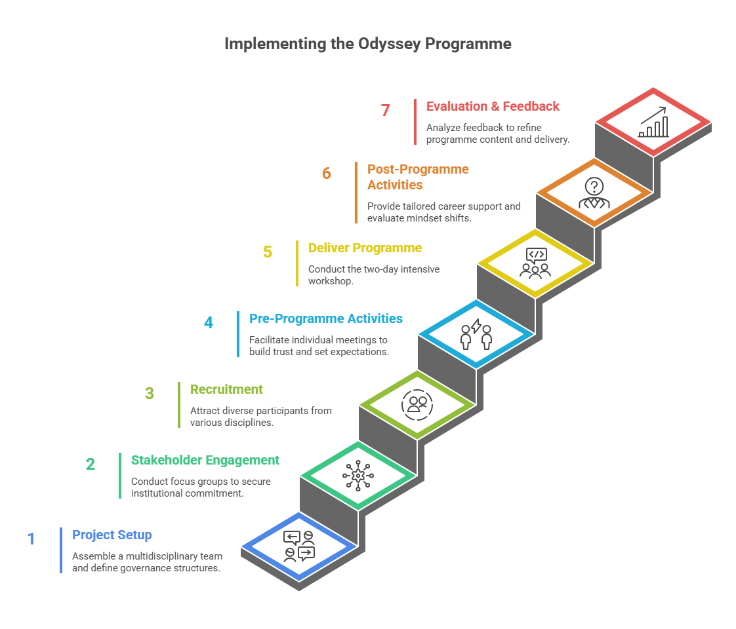
Programme Structure:
- Pre-meeting: Build trust, set expectations.
- Day 1: Shift thinking, explore organisational cultures beyond academia.
- Day 2: Practical job search skills, networking, and interview techniques.
- Post-meeting: Individual CV clinic and career action plan.
Key Components:
- Competency-based CV training
- Industry speakers and recruitment specialists
- Odyssey Graduates share career stories beyond academia
- Networking strategies and LinkedIn optimisation
Duration: Two days is “just right” for impact without overload.
Stakeholder Sharing Points
- Programme Impact: 99% of participants recommend it for all PhDs; strong shift in mindset toward non-academic careers.
- Institutional Benefits: Builds talent pipeline aligned with national strategies (Impact 2030), enhances university reputation.
- Observer Role: 50% plan to implement locally
- Collaboration Opportunities: Engage recruiters, diversify data sources, and introduce career development tools.
- Cultural Barriers: Address organisational resistance and normalise non-academic career paths early in the PhD journey.
Professional Development Plan
A Professional Development Plan (PDP) is a structured document that outlines an individual’s goals, skills, and actions for career growth and continuous learning. It typically includes short-term and long-term objectives, the competencies needed to achieve them, and specific steps or resources such as training and mentoring that will support progress. The purpose of a PDP is to help PhD candidates take ownership of their development, align personal aspirations and track progress over time. It serves as both a roadmap and a reflection tool, ensuring professional growth is intentional and measurable.
EU Researcher Competency Framework
ResearchComp is a tool that helps
- PhDs assess and develop their own transversal skills
- higher education institutions and training providers adapt their offerings to PhD candidates
- employers to be aware of the wide set of competences of PhD candidates
Contact
For further information regarding the HEA Odyssey Programme please contact the National Coordinator
Mary Kate O'Regan at marykate.oregan@ucc.ie
Useful Links
Department of People and Culture - Research
Contact us
Ground Floor, Block E, Food Science Building, UCC