

In This Section
- Home
- Research & Innovation
- Stories with Impact
- College Team
- Programmes
- Hospital Partners
- Community Partners
- Jennings Gallery
- Graduate Studies
- Programmes for International (Non-EU) Students
- Interprofessional Learning (IPL)
- ASSERT
- CoMH Civic & Community Engagement
- Dr Ashleigh Byrne-O’Brien Memorial Fund & Awards
- iEd Hub
- Inaugural Professorial Lecture Series
- Learning, Teaching & Curriculum
- Philanthropic Lectures
- UCC Academic Health Sciences
- Continuing Professional Development
Two Roads to Physio
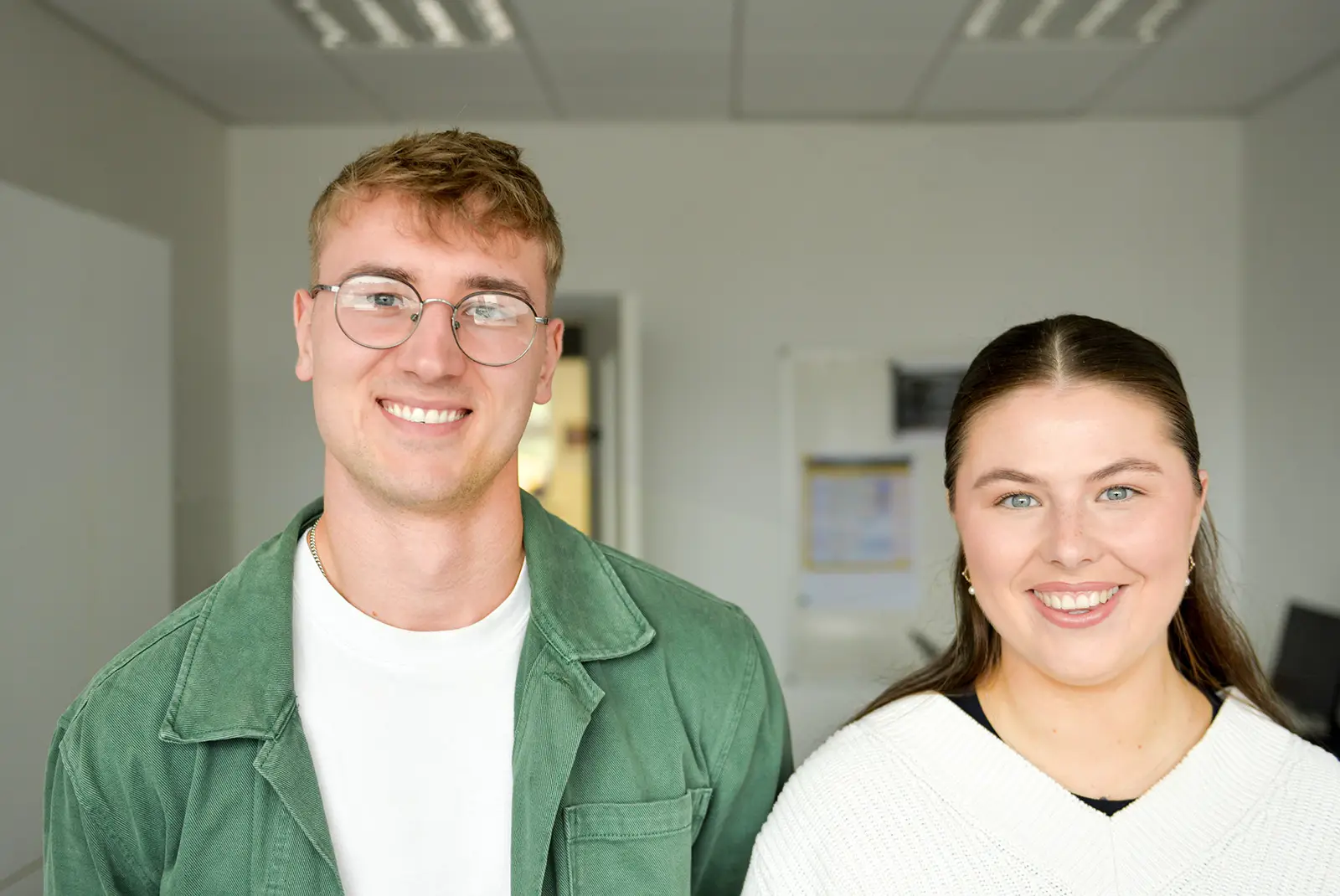
How two PhD student researchers found their way to research, and what they’d say to anyone thinking of following them.
Katie Mathews and Amadeusz Lelental didn’t take the obvious route to physio. One came via a childhood injury and a lifelong love of sport; the other spent four years as a nurse before deciding he wanted to work with patients to develop their physical independence and autonomy. Both ended up on the MSc in Physiotherapy at UCC. Both are now PhD student researchers on PD-Life, an all-island research project on Parkinson’s disease funded by the North-South Research Programme.
For Katie, from County Louth, the pull was simple. ‘When I was 12, I played a lot of sports and I got an injury. I went to physio and within a couple of weeks I was back playing football. It kind of got me back to where I wanted to be. Ever since then I was hooked.’ Amadeusz’s route was less direct. He worked as a nurse for almost four years before a stint with multidisciplinary teams changed his mind. ‘The one big thing that drew me into physio was the amount of autonomy and independence it gave patients,’ he says. ‘As a nurse, I felt like I was doing things for patients, helping them walk from A to B, but I wasn’t giving them the power to do it themselves. I really wanted to have that knowledge to share.’
Katie is certain about why she chose UCC: the people. ‘I’ve had a great relationship with the lecturers. They were always wanting the best for you, pushing you to dreach your potential... they were also so supportive. I’m a couple of hundred kilometres from home, and they made Cork a home for me. I felt really safe and supported here.’ Amadeusz had completed his undergraduate degree at UCC and found the return easy. ‘Very similar to Katie, I just found UCC really welcoming. Going back to college, I was going back to a familiar place.’
Neither student set out to do a PhD. For Katie, the turning point was an email from lecturer Ruth McCullagh about PD-Life. ‘The minute I read it, it just sparked something in me. I had this overwhelming sense to apply for it, go for it, see what happens. And it worked out.’ Amadeusz’s story is less straightforward, ‘I actually failed my first assignment, which was research!’ He worked closely with Dr Joseph McVeigh after the bad grade, and his approach changed how he thought about research entirely. ‘Over the two years, I had a complete change of mind about what research is and what it brings to the table, compared to when I was working clinically only.’ When the PD-Life email arrived, he jumped at it. ‘I don’t think it’s going to come too often that you have this kind of chance.’
Their projects in some ways reflect their backgrounds. Katie’s PhD looks at turning exercise from prescription into habit. ‘I come from a big sporting background, and I did sports and exercise science as my undergrad. Exercise has such an impact on people with Parkinson’s, on their symptoms. I want to help give them a better quality of life through it.’ Amadeusz’s explores the role of dance in Parkinson’s care, at University of Limerick, a choice he’s quick to qualify. ‘I’m not a dancer,’ he laughs. ‘But we know any form of exercise is good for people with Parkinson’s. It’s a progressive, life-long disease, so it needs a life-long solution. The problem is people won’t always do it… they find it hard to stay motivated, something will always comes up. But if you do it while enjoying it, or it’s a social event, something like a dance class, then hopefully people will keep it up for life. And the social benefits can bring even more than the exercise alone.’
"Go get your experience, talk to someone who’s done the course, put your best foot forward. When you’re in, it’s incredible. You make friends for life."
Both are newly embedded in PD-Life and describe it with a mixture of awe and honesty. ‘It’s quite scary coming in when you’ve got all these incredibly intelligent people in front of you,’ says Katie. ‘But they’re so welcoming. Every meeting, I’m introduced and welcomed into the team. It’s daunting, but I look forward to learning more from them.’ For Amadeusz, ‘If you’re the least smart in the room, you’re probably doing quite well. You’re probably in the right room.’ He adds: ‘Every single person involved with PD-Life is just so intelligent. It is in really good hands, and hopefully we’ll get to that level.’ Katie sums it up neatly: ‘To be in that room is a privilege.’
Ask either whether the MSc Physiotherapy is worth it, and the answer is immediate. ‘Go for it,’ Katie says. ‘Absolutely apply. Go get your experience, talk to someone who’s done the course, put your best foot forward. When you’re in, it’s incredible. You make friends for life. My best friends are from Physio now. It’s changed my life altogether.’ Amadeusz tells a similar story. ‘I loved where I was working, and the people around me actually encouraged me to do something else. They said, go do it, you’ll regret it if you don’t. It’s probably one of the best things that’s ever happened. It’s opened so many doors.’
If there’s one theme that runs through both conversations, it’s commitment and the cost of delaying it. ‘The weeks fly by,’ Katie warns. ‘There’s no point getting a goal in place and waiting until week six. By week six, it’s rough.’ She points to the second semester of first year as the crunch point: classroom exams, projects, OSCEs, MCQs, cadaver lab exams. ‘If you don’t have that routine from the get-go, you’re already falling behind.’ Amadeusz agrees. ‘It’s actually a really good thing to learn. If you can get through all of that, you must have a good routine in place.’
Both single out the educators who shaped how they think about the work. Amadeusz recalls Rosey Clarke his clinical educator in Kerry. Katie names Shirley Cahill, her clinical educator in Mallow, and Trish O Sullivan, her dissertation supervisor. ‘There was no issue too big, no issue too small, no concern that was ever silly. I was nervous about doing the dissertation, and when I got offered the PhD, she was the first person I asked for advice. She said, go for it.’
PD-Life is funded by the North-South Research Programme, and the collaboration is practical, not just symbolic. PhD students spend a minimum of three months working with a different college – Queen’s Belfast, University of Limerick or UCC. ‘It’s really nice to get that collaboration and see what everyone else is doing,’ Amadeusz says. Katie adds, ‘We get the expertise from the wider team, including UL and Queen’s, and they learn from us. It gives a better service to the patients who’ll benefit. No one is left out. We’re all in this together.’
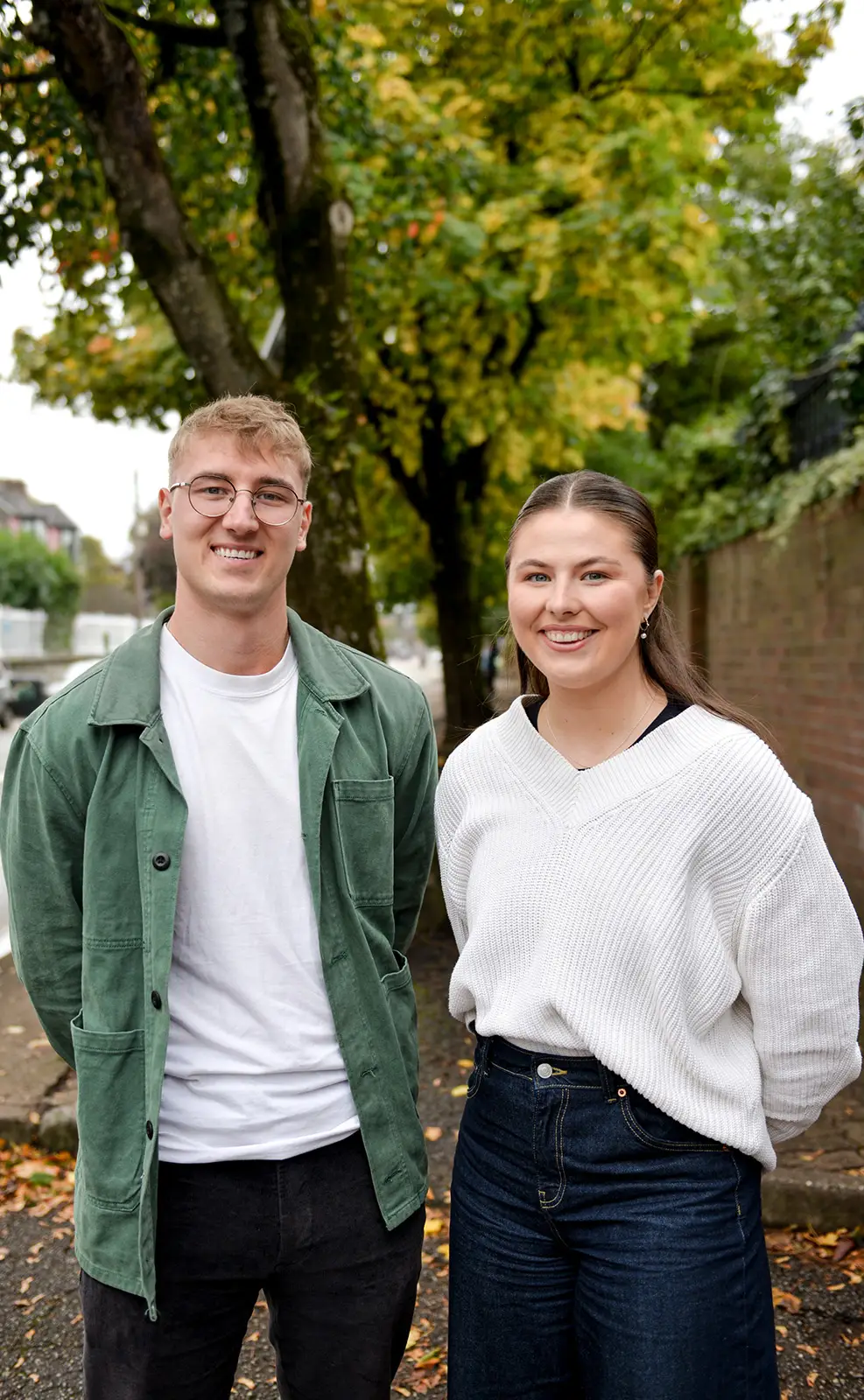
Katie and Amadeusz are PhD student researchers on PD-Life at University College Cork and University of Limerick. Their work is funded by the North-South Research Programme.
College of Medicine and Health
Coláiste an Leighis agus na Sláinte
Contact us
3rd Floor, Erinville, Western Road, University College Cork, T12 EKDO