In This Section
- Home
- About the College
- Governance
- College Committees & Steering Groups
- College Assembly
- College Council
- College Executive Management Committee
- College Academic Programmes and Curriculum Development Committee
- College Graduate Studies Committee
- College Research & Innovation Committee
- College Teaching Learning and Student Experience Committee
- College Sabbatical Research Leave Committee
- College of SEFS Adjunct Appointments Committee
- College Postgraduate Student Committee
- Athena SWAN Steering Group
- College Committees & Steering Groups
- Human Resources
- UCC STEM Awards
- Scholarships and Prizes
- Women in STEM Panel Talks
- Inaugural Professorial Lectures
- Athena SWAN in SEFS
- Proposal Calls
- Contact Us
- Science in Society Public Lecture Series
- Governance
- News
- Staff
- Schools and Departments
- Current Students
- Undergraduate Courses
- Postgraduate Courses
- International Students
- Research and Innovation
- Employability and Careers
- Outreach and Public Engagement
- Science Week
- Transition Year Programmes and STEM Events
UCC Rocketry Society Flies High at International Competitions
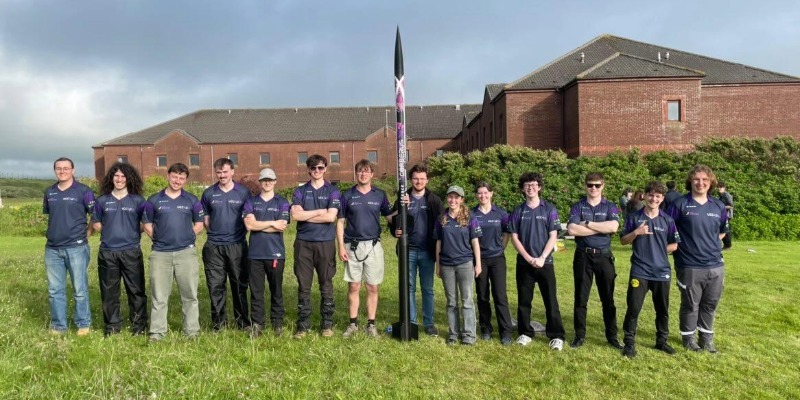
This summer, members of UCC’s Rocketry and Space Exploration Society (RES) conducted two major firsts for Irish Rocketry: the testing of Ireland’s first liquid rocket engine of the 21st century and the launch of Ireland’s first high-powered two stage rocket.
Both these milestones occurred at and in the lead up to two major international competitions in the UK, Mach-26 and Race2Space. Although UCC RSES was formally established only last year, the student engineering team behind these projects has been active for over a year beforehand.
A growing team
Originally formed as a small group under UCC's School of Engineering and Architecture, the team has since had many successful launches, including a recent multi launch test program to validate Ireland’s first flight computer capable of tracking where the rocket is and controlling events during flight.
Over time, the team has expanded significantly, with a dedicated team of over 60 core students. Over the past ten months, members have conducted the research, design, manufacturing and testing required to develop both Ireland’s first liquid rocket engine test campaign of the 21st century and its first high-powered two-stage student rocket.
All this would not be possible without the continued support from sponsors and supporters, including Cadence, Shannonvale Tubing, UCC School of Engineering & Architecture, and Impact Metals Ireland. These supporters provided parts, simulation software and monetary support throughout the previous few months and without them none of these projects would be possible.
Liquid rocket engine ’Ixion’
The liquid rocket engine ’Ixion’, was successfully tested on 6 July. Liquid propulsion represents one of the most challenging areas of amateur rocketry. Commercial solid motors are readily available to be bought and used, whereas liquid motors require fully integrated fuel delivery, ignition, and cooling systems all working together while operating under extreme stress and heat.
As such, liquid rocket engines present a much higher barrier for entry, with extensive knowledge of layout and fuel types needed before any design decisions can be made. Ixion was Ireland’s first liquid propellent rocket this century, reflecting both the rapid growth of student rocketry in Ireland and the months of engineering effort invested by UCC RSES.
Ixion is a 2 kilo-newton liquid engine capable of pushing a two ton car quickly up hill that uses Isopropyl Alcohol and Nitrous Oxide as the fuel and oxidiser respectively. All parts were made from the ground up, with each subsystem multiple iterations before construction began.
The injector was made entirely using additive manufacturing, to ensure the high degree of precision needed a first of it’s kind in Ireland. With the successful hot-fire test, UCC RSES plans to integrate Ixion into a future rocket launch in the coming future.
High powered two stage rocket ’Cerberus’
The high-powered two stage rocket ’Cerberus’ was launched in June. The main feature of Cerberus is its two-stage design. An initial booster stage allowed the rocket to take off the launch pad with significant speed. The rocket was designed to separate using drag separation before the upper half of the rocket would ignite its solid rocket engine and boost it to a maximum altitude of 3km.
Unfortunately, due to a launch rail issue, the rocket was slightly off course when the second stage was meant to ignite and the onboard flight computer automatically prevented the ignition of the second stage and instead deployed a parachute.
Within the rocket, there was a custom designed computer with capabilities to track sensor data, a UV light sensor, an accelerometer, a pressure sensor, a temperature sensor and a GPS. The computer performed flawlessly with all data being transmitted during flight.
The onboard payload that was developed alongside the UCC Medical Research Society to study the effects of high acceleration environments on blood clots was awarded the airbus best payload award. Similarly to Ixion, Cerberus launched at an international rocketry competition, Mach-26, which takes place in Scotland and attracts the top teams from the UK and Ireland to compete.
While the two Stage Rocket flight did not go perfectly to plan, UCC RSES still launched Ireland’s first two stage rocket the month prior in a fully successful launch in Northern Ireland.
Beyond the competitions themselves, Ixion and Cerberus represent the forefront of Irish amateur rocketry. What started as a project between a small number of students quickly grew into one of the country’s most ambitious student engineering programmes. For UCC RSES, Ixion and Cerberus are the foundation for more ambitious projects in the year ahead.
College of Science, Engineering and Food Science
Coláiste na hEolaíochta, na hInnealtóireachta agus na hEolaíochta Bia
Contact us
Block E, Level 3, Food Science Building, UCC, Cork, T12 YN60.