

In This Section
- Home
- About the College
- Governance
- College Committees & Steering Groups
- College Assembly
- College Council
- College Executive Management Committee
- College Academic Programmes and Curriculum Development Committee
- College Graduate Studies Committee
- College Research & Innovation Committee
- College Teaching Learning and Student Experience Committee
- College Sabbatical Research Leave Committee
- College of SEFS Adjunct Appointments Committee
- College Postgraduate Student Committee
- Athena SWAN Steering Group
- College Committees & Steering Groups
- Human Resources
- UCC STEM Awards
- Scholarships and Prizes
- Women in STEM Panel Talks
- Inaugural Professorial Lectures
- Athena SWAN in SEFS
- Proposal Calls
- Contact Us
- Science in Society Public Lecture Series
- Governance
- News
- Staff
- Schools and Departments
- Current Students
- Undergraduate Courses
- Postgraduate Courses
- International Students
- Research and Innovation
- Employability and Careers
- Outreach and Public Engagement
- Science Week
- Transition Year Programmes and STEM Events
New UCC research highlights duckweed’s potential as a sustainable protein
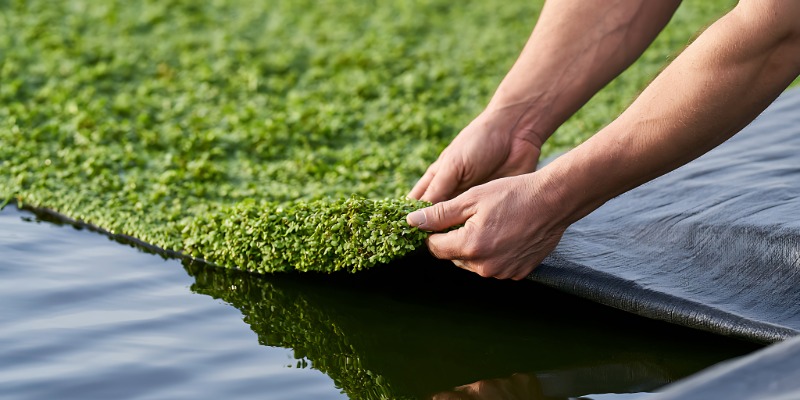
New research from University College Cork (UCC) highlights duckweed as a promising Irish-grown alternative that can help produce more protein-rich animal feed domestically.
Currently, livestock, dairy and poultry production in the Republic of Ireland requires approximately 900,000 tonnes of protein annually, much of which is supplied through imported soybean meal. Most of this soybean is imported from South America and comes with a high carbon footprint. This dependence on imported feed exposes the sector to global market volatility, supply chain disruptions and the environmental costs associated with long-distance transport.
While increased production of beans, peas and other pulses is being pursued, there is also growing interest in developing new Irish-produced plant protein sources, helping to build a more resilient and self-sufficient feed sector. In turn, this can reduce Ireland's dependence on imported soybean meal, helping to retain more value within the domestic agricultural economy while lowering the carbon footprint associated with livestock feed production.
Duckweed refers to a group of free-floating freshwater plants of the Lemnaceae family. They can be found in wetlands across all continents except Antarctica. Plants grow rapidly and can produce high levels of protein from relatively small land areas. Growth trials at Mt. Lucas, Co. Offaly, have demonstrated the potential to achieve yields of up to 30 tonnes of duckweed dry weight per hectare, highlighting duckweed as a home-grown protein for animal feed, and alternatively as a source of green manure and biofuel.
A study in the Irish Journal of Agricultural and Food Research by UCC’s Alexandra Jansen, with colleagues at Teagasc, TUD, MU and Devenish Ltd, explains how global advances in the production and use of duckweed present opportunities for developing the crop in Ireland.
However, realising duckweed’s potential will require investment across the value chain, from cultivation and processing to feed formulation and market development. If these challenges can be addressed, duckweed could play an important role in making Irish agriculture more sustainable, reducing reliance on imported protein feeds while further strengthening the environmental credentials of the sector.
Professor Marcel Jansen, UCC, Principal Investigator on duckweed projects funded by the Department of Agriculture, Food and the Marine (Duck-Feed) and the EU (IMPRESS), comments: “The development of a duckweed protein industry in Ireland depends on upscaling of duckweed production, development of processing technology and formulation of duckweed-enriched feeds. Upscaling can take advantage of cut-away bog that is not suitable for peatland reservation, and of local wet patches of land unsuitable for grazing. Converting 2,200 hectares of land for duckweed cultivation can substitute 10% of the annual soy import at a competitive trade value per hectare.
Processing of duckweed biomass will also create rural employment, and lead to production of sustainable feeds aligned with Ireland’s green international image. Achieving this necessitates a concerted collaborative effort by researchers and industry, aligning biomass supply with commercial protein demand, and especially the development of innovative duckweed-containing feeds”
College of Science, Engineering and Food Science
Coláiste na hEolaíochta, na hInnealtóireachta agus na hEolaíochta Bia
Contact us
Block E, Level 3, Food Science Building, UCC, Cork, T12 YN60.