In This Section
- Home
- About the College
- Governance
- College Committees & Steering Groups
- College Assembly
- College Council
- College Executive Management Committee
- College Academic Programmes and Curriculum Development Committee
- College Graduate Studies Committee
- College Research & Innovation Committee
- College Teaching Learning and Student Experience Committee
- College Sabbatical Research Leave Committee
- College of SEFS Adjunct Appointments Committee
- College Postgraduate Student Committee
- Athena SWAN Steering Group
- College Committees & Steering Groups
- Human Resources
- UCC STEM Awards
- Scholarships and Prizes
- Women in STEM Panel Talks
- Inaugural Professorial Lectures
- Athena SWAN in SEFS
- Proposal Calls
- Contact Us
- Science in Society Public Lecture Series
- Governance
- News
- Staff
- Schools and Departments
- Current Students
- Undergraduate Courses
- Postgraduate Courses
- International Students
- Research and Innovation
- Employability and Careers
- Outreach and Public Engagement
- Science Week
- Transition Year Programmes and STEM Events
Civil society from across the EU gathers at UCC to reinforce Europe’s sustainability agenda
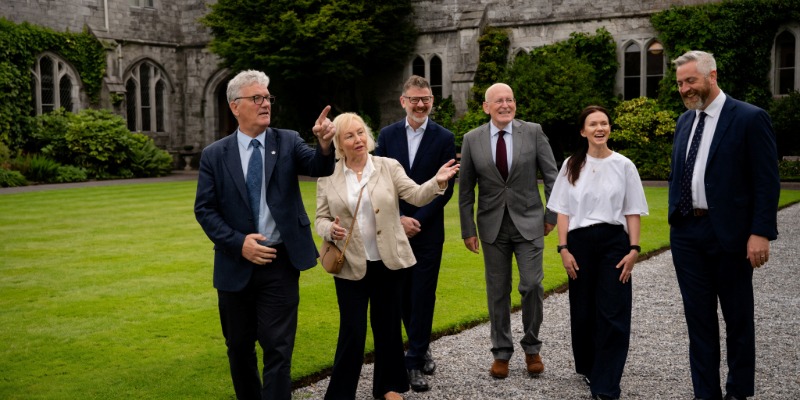
Representatives of civil society, academia, and public authorities gathered at University College Cork (UCC) for the conference Civil society driving the EU sustainability agenda, organised by the European Economic and Social Committee’s (EESC) Civil Society Organisations’ Group.
Participants from across Europe discussed how civil society can help advance and shape sustainable development, strengthen democratic participation and support Europe's long-term resilience.
In his inaugural remarks, Cillian Lohan, President of the Civil Society Organisations’ Group, reaffirmed the group’s longstanding commitment to sustainable development and called for renewed ambition as Europe looks beyond the UN’s 2030 Agenda for Sustainable Development. He stressed that sustainability remains essential not only for environmental protection, but also for economic prosperity, democratic resilience and strategic autonomy. Public engagement and countering negative narratives on the energy transition are key.
'The aim of this conference was to give fresh momentum to the European sustainable development agenda - at a time when sustainability policy is coming under increasing pressure, despite being urgently needed. Our event also highlighted the role of local communities and civil society organisations in designing, implementing, and monitoring sustainability measures that make our communities more resilient.'
Professor John O’Halloran, UCC President, welcomed participants and highlighted the university’s commitment to addressing global sustainability challenges through research, education and engagement with communities.
'We are honoured to host this prestigious event at University College Cork, and to welcome partners from across Europe to engage in these important discussions. Through our research and education, UCC is focused on addressing the most pressing global sustainability challenges and on working with communities and stakeholders to help shape a more resilient and sustainable society.'
The conference took place on the eve of the start of the Irish Presidency of the Council of the EU. Participants examined key challenges including climate change, biodiversity loss, energy independence, competitiveness, democratic resilience and the implementation of the 2030 Agenda with its 17 SDGs.
Addressing the conference, Christopher O’Sullivan, Irish Minister of State for Biodiversity, underlined the importance of restoring nature and ensuring that Ireland is prepared to implement the EU Nature Restoration Law.
'Delivering on the Nature Restoration Law is my top priority as Minister for Nature. I am currently working with colleagues across Government to put the necessary resources and supports in place so that Ireland is ready to grasp this once-in-a-generation opportunity and ensure we can all share in the benefits of a healthy, thriving natural environment.'
The keynote address was delivered by Frans Timmermans, former Executive Vice-President of the European Commission and architect of the European Green Deal. Reflecting on the multiple challenges facing Europe and the world, he emphasised the importance of an empowered and engaged civil society.
'Never before has humanity faced so many challenges at the same time. Climate change, industrial revolution, geopolitical upheaval, social disruption: all these challenges need to be addressed at the same time. Because this affects societies at every level, civil society will play a crucial role in determining whether we succeed or fail in tackling all these challenges. Empowering civil society is essential' and it should be part of every step. Energy transition and environmental policies can only succeed if they have a strong socio-economic dimension that guarantees a just transition.
A panel discussion entitled 'Civil society at the steering wheel of the sustainability agenda' brought together experts from the fields of sustainable development, public health, youth engagement and environmental advocacy to explore how civil society organisations can continue to contribute to EU policymaking and implementation.
Among the speakers, Karen Ciesielski, Chief Executive Officer of the Irish Environmental Network, highlighted the indispensable role of civil society organisations in connecting citizens and policymakers. 'We bring local knowledge, practical experience and public trust into conversations that can otherwise feel remote or technical. We help connect communities to decision-making and keep long-term environmental and sustainable development goals in view, even when the political climate is difficult. In order to have strong civil society networks and institutions, we need them to be sufficiently funded and supported, with clear pathways for engaging with decision-makers.'
The conference forms part of a broader series of initiatives led by the EESC Civil Society Organisations' Group, including events in Larnaca (in the framework of Cyprus’ EU Council Presidency) and Brussels and recent work on the circular economy. The results of the conference will inform the work of the group, which focuses in its current term on empowering resilient communities, defending democracy, contributing to peace, and promoting the sustainable agenda. The group also stands up for an EU long-term budget 2028-2034 that is guided by a clear European ambition and delivers for democracy, civil society, and social inclusion.
Background
The European Economic and Social Committee (EESC) represents the various economic and social components of organised civil society. It is an institutional consultative body established by the 1957 Treaty of Rome. Its consultative role enables its members, and hence the organisations they represent, to participate in the EU decision-making process.
The EESC Civil Society Organisations' Group is made up of a wide range of representatives and stakeholders from the economic, civic, professional and cultural fields, including farmers', consumers' and environmental organisations, the professions, social economy actors, associations representing persons with disabilities, women, young people and many others.
College of Science, Engineering and Food Science
Coláiste na hEolaíochta, na hInnealtóireachta agus na hEolaíochta Bia
Contact us
Block E, Level 3, Food Science Building, UCC, Cork, T12 YN60.