
In This Section
- Home
- Semester and Timetable Information
- Study Physics
- Our Research
- Our People
- Careers and Alumni
- Seminars, News and Events
- Outreach and School Resources
- About the School
- What is Physics
- The Crawford Observatory
- Frequently Asked Questions
- UCC Futures Quantum & Photonics
- Supports/EDI
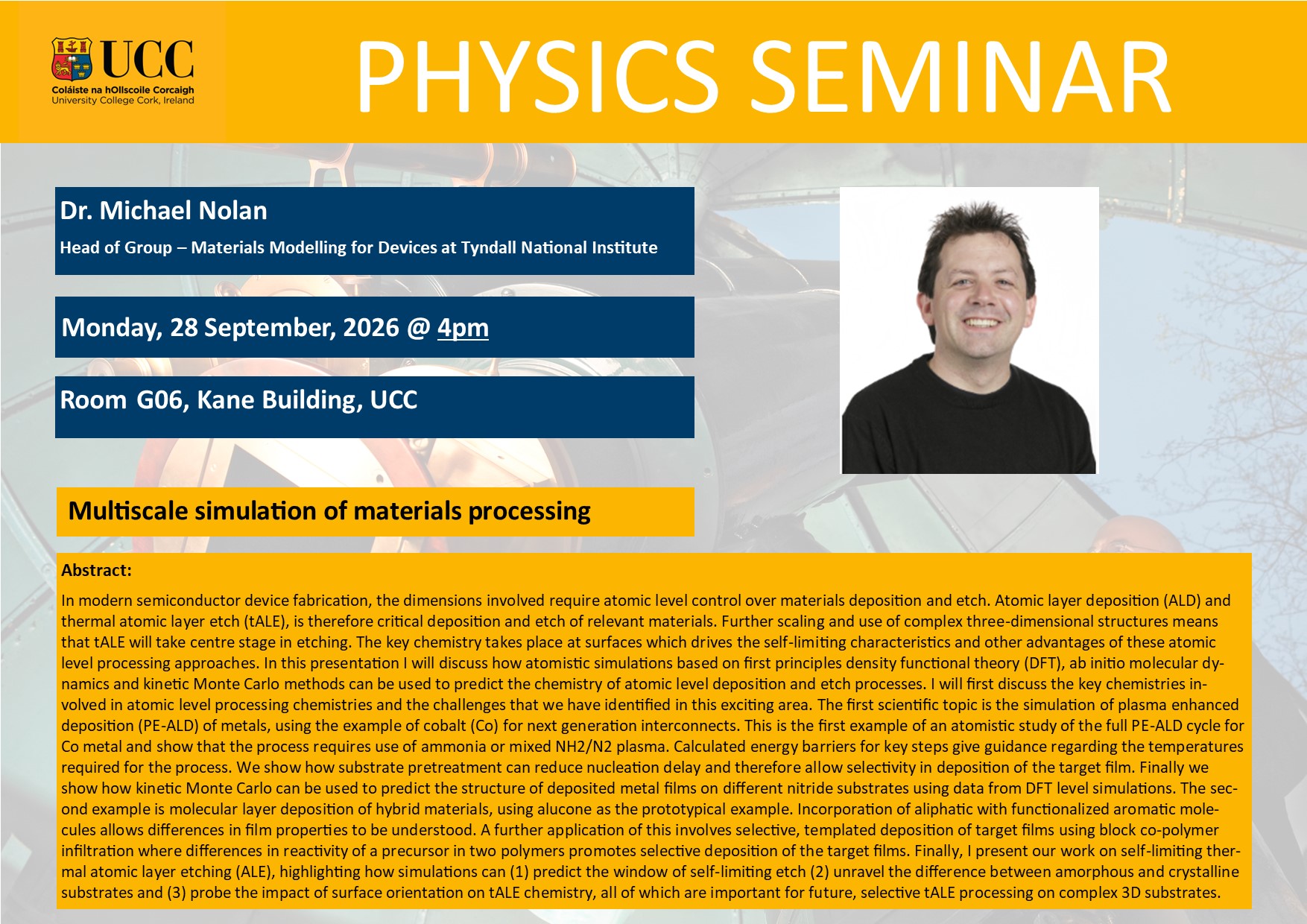
Dr. Michael Nolan 28 September 202
| Seminar Speaker |
Dr. Michael Nolan |
| Venue |
Room G06, Kane Science Building, UCC |
| Time/Date |
4pm / Monday, 28 September, 2026 |
| Title |
Multiscale simulation of materials processing |
| Abstract |
In modern semiconductor device fabrication, the dimensions involved require atomic level control over materials deposition and etch. Atomic layer deposition (ALD) and thermal atomic layer etch (tALE), is therefore critical deposition and etch of relevant materials. Further scaling and use of complex three-dimensional structures means that tALE will take centre stage in etching. The key chemistry takes place at surfaces which drives the self-limiting characteristics and other advantages of these atomic level processing approaches. In this presentation I will discuss how atomistic simulations based on first principles density functional theory (DFT), ab initio molecular dynamics and kinetic Monte Carlo methods can be used to predict the chemistry of atomic level deposition and etch processes. I will first discuss the key chemistries involved in atomic level processing chemistries and the challenges that we have identified in this exciting area. The first scientific topic is the simulation of plasma enhanced deposition (PE-ALD) of metals, using the example of cobalt (Co) for next generation interconnects. This is the first example of an atomistic study of the full PE-ALD cycle for Co metal and show that the process requires use of ammonia or mixed NH2/N2 plasma. Calculated energy barriers for key steps give guidance regarding the temperatures required for the process. We show how substrate pretreatment can reduce nucleation delay and therefore allow selectivity in deposition of the target film. Finally we show how kinetic Monte Carlo can be used to predict the structure of deposited metal films on different nitride substrates using data from DFT level simulations. The second example is molecular layer deposition of hybrid materials, using alucone as the prototypical example. Incorporation of aliphatic with functionalized aromatic molecules allows differences in film properties to be understood. A further application of this involves selective, templated deposition of target films using block co-polymer infiltration where differences in reactivity of a precursor in two polymers promotes selective deposition of the target films. Finally, I present our work on self-limiting thermal atomic layer etching (ALE), highlighting how simulations can (1) predict the window of self-limiting etch (2) unravel the difference between amorphous and crystalline substrates and (3) probe the impact of surface orientation on tALE chemistry, all of which are important for future, selective tALE processing on complex 3D substrates. |
School of Physics
Scoil na Fisice
Contact us
Room 213 (Physics Office), 2nd floor, Kane Science Building, University College Cork, Ireland.,