In This Section
- Home
- Semester and Timetable Information
- Study Physics
- Our Research
- Our People
- Careers and Alumni
- Seminars, News and Events
- Outreach and School Resources
- About the School
- What is Physics
- The Crawford Observatory
- Frequently Asked Questions
- UCC Futures Quantum & Photonics
- Supports/EDI
Postgraduate Spotlight
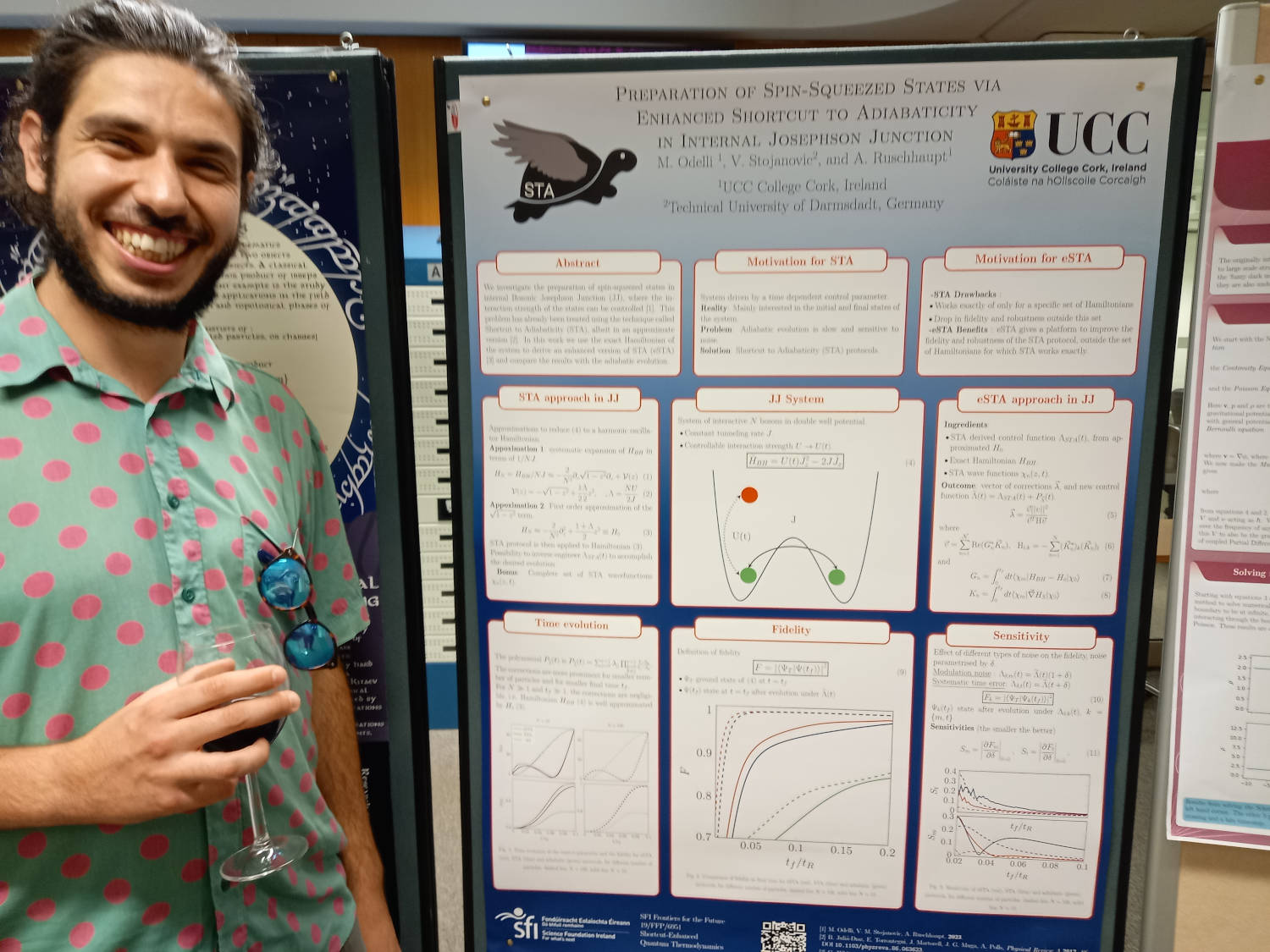
The School of Physics would like to highlight the work of Postgraduate Student Manuel Odelli.
"Having just submitted my PhD thesis gives me the opportunity to look back to what have been a quite long and winding journey, not free from challenges but extremely satisfying. What I loved the most was seeing each project I have been part of growing and taking shape as the weeks went by, especially considering that my work lies at the intersection between theoretical and computational physics, where everything usually starts by scribbling equations on a piece of paper and ends up with huge simulations of quantum systems thousands of lines of codes later. I am not sure what lies ahead of me but my time in UCC has been a blast, I had the privilege of collaborating with so many talented people and I will always be grateful."
Manuel has been part of the quantum control group in UCC under the supervision of Professor Andreas Ruschhaupt where he devoted his energy working on new ways to better manipulate quantum states with the goal of speeding up the production and transport of quantum particles.
Quantum control is one of the key aspects in the fields of quantum technology and quantum computing which has experienced huge progress and a surge in popularity in the last few years.
Most of his research is inspired by the so-called Shortcuts to Adiabaticity (STA), a set of analytical and numerical methods to drive the evolution of quantum states in a fast and controlled fashion.
In particular he applied a new technique developed in the UCC quantum control group, called Enhanced Shortcuts to Adiabaticity (eSTA) to generate spin squeezed states and to produce quantum entangled states to use in the context of quantum metrology.
Moreover, in the past year he studied a novel method to design the trapping frequency profile in curved matter-wave guides.
With this method, one could design a quantum wave guide that minimizes the transverse excitation of a quantum particle travelling in a bent region.
This could help facilitating quantum state transfer in a compact region without any information loss.
We wish Manuel all the best in whatever lies ahead for him. No doubt he will be a great asset to the scientific community and continue to make meaningful contributions to the advancement of quantum technologies.
School of Physics
Scoil na Fisice
Contact us
Room 213 (Physics Office), 2nd floor, Kane Science Building, University College Cork, Ireland.,