
Using music to understand illness and addiction experiences
The Challenge
SDG 3 is concerned with ensuring good health and wellbeing for all. We know, however that many people do not have good health. In Ireland, for example, many people struggle with addiction. Musicians are one group who are more likely to struggle with addiction than the general population. This stems from a number of interlinked issues relating to personal characteristics, the difficulties of working in a precarious creative industry- that is becoming more precarious as a result of technological change- and the difficulties that come with having to travel long distances for work.
At the same time, the work that musicians create is often very beneficial for the health of other people. Music is compassionate. It will be with you whenever you suffer in life. There is a paradox here: being a musician can be risky for health. However, the music that you create can have a positive impact on a population health level.
This project is aiming to increase our understanding of addiction experiences in musicians, how addiction develops in musicians and how musicians survive and make sense of addiction. This research aims to be of use to musicians and people and families who are dealing with addiction.
The Research
This study is based on analysis of music, lyrics, videos and interviews with members of two of the key rock bands from the 1990s: Guns N’ Roses and Nirvana. Members of both of these bands struggled with addiction and also made music about addiction.
So far to date I have analysed over 500 interviews with members of these bands, as well as all of their music and lyrics. The data from all of these sources has been thematically analysed. I am writing up separate case studies on each band.
Each case study is being used to explore a different aspect of addiction. For example my work on Nirvana is being used to understand the psychological experience of being in the middle of an addiction crisis. This work is also investigating how addiction and illness information is conveyed polyphonically, for example through sound, visuals and text.
My work on Guns N’ Roses is exploring addiction trajectories through time, from onset of addiction through to recovery. This work is therefore exploring how addiction develops over a thirty-forty year time frame.
The Impact
This work has had a number of impacts. Firstly, I have published articles from this study in leading peer-reviewed journals.
Balfe, M. (2026). The perils of rock n’ roll decadence: Deviance in the lives of Guns N’ Roses 1988-1991, a Bourdieusian analysis with implications for strain and desistance theory. Deviant Behavior.
Balfe, M. (2025). Value rationality in collective edgework experiences: The making of Guns N’ Roses Chinese Democracy 1994-2008. Sociology Lens, 38, 4, 405-420.
Balfe, M. (2025). Abjection in Nirvana’s In Utero. Deviant Behavior.
My article on Nirvana is the 7th most read article in the Deviant Behavior in the past year, with over 2500 views:
https://www.tandfonline.com/action/showMostReadArticles?journalCode=udbh20
In addition to these two published articles, I currently have two more articles from the study in review in peer-reviewed journals.
As well as these five published/submitted articles, I am working on two more articles that deal with early childhood experiences of these musicians, and also with their experiences of survivorship in later adulthood.
One of my key aims for this project is to increase awareness about addiction experiences in musicians. I wrote an article on Nirvana for RTE Brainstorm.
https://www.rte.ie/brainstorm/2025/1006/1537037-nirvana-in-utero-angel-themes-abjection-death-life/
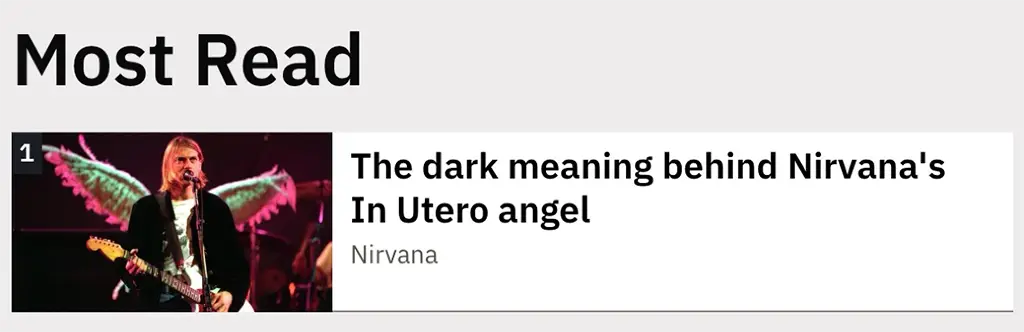
This became the most read article on the RTE website (please see banner picture). This was also chosen as an ‘editor’s choice’ article.
Furthermore, I wrote an article on Guns N’ Roses which became the eight most read article on the RTE website.
Once I publish the next two articles from the study I intend to write on musicians and addiction for the Irish Times. This will be timed to coincide with Guns N’ Roses playing Ireland in June.
This study has had an important impact on my teaching. Firstly, I have been able to use the data to teach students how to analyze music sociologically. This class was very well received by students. Secondly, I have been able to use the case studies in specialist modules on health and illness. The feedback was very positive:
“Really enjoyed this module. Our lecturer found ways in every class to make it engaging through music to make it relevant to us. It was one lecture I would look forward to all week. I found myself talking about the topics with my friends and family when I went home”.
“I really enjoyed it. The outside sources such as music was a great help at understanding the module”.
So the study has overall had a measurable impact internally in UCC but also in Ireland more generally.
I had two UCC strategic goals that I wished to meet with this research. The first was 1.4., which relates to the implementation of engaged research. However I am also pursuing goal 2.4., which relates to improving student health and wellbeing. I try to use the case study of Guns N’ Roses to get across to students that no matter what difficulties people face in life, these difficulties can often be overcome, or at least endured. Even people who are going through severe health and personal crises can ultimately become survivors. I think that this is an important message to convey to students given the challenges that that they face at this point in history.
For More Information
For more information, please see: https://research.ucc.ie/en/persons/myles-balfe/
“This project is seeking to analyze addiction experiences and how people become illness survivors by analyzing metal and grunge music. It is seeking to highlight and increase understanding of the challenges that musicians can sometimes face in their careers”.
– Myles Balfe, Senior Lecturer in Medical Sociology.
College of Arts, Celtic Studies & Social Sciences
Coláiste na nEalaíon, an Léinn Cheiltigh agus na nEolaíochtaí Sóisialta
Contact us
College Office, Room G31 ,Ground Floor, Block B, O'Rahilly Building, UCC