Building Capa-Cities: Co-creating behavioural capacity with and for local governments to deliver effective, collaborative and scalable climate action
The Challenge
Local authorities are central to delivering climate action (SDG-13) and creating sustainability cities and communities (SDG-11), yet they are frequently expected to drive ambitious behavioural and systemic change without the organisational capacity, skills or structures required to do so effectively. Despite strong national and EU climate commitments, fragmented, reactive and siloed government practices limit the ability to translate policy targets into sustained climate-positive behaviours. In Cork City, this challenge is compounded by the need to balance emissions reduction with economic vitality, social inclusion and public trust. Research shows that behavioural science offers effective strategies for innovative decision-making and service delivery, but these strategies are currently underutilised within the training (SDG-4), organisational support (SDG-17) and a collaborative culture to develop and implement behavioural expertise. Furthermore, community climate initiatives led by local government, such as sustainable mobility interventions, require carefully designed communication and engagement strategies to deliver environmental benefits while maintaining local economic resilience (SDG-11). Building durable behavioural capacity within local government is therefore foundational to effective, just and scalable climate action.
The Research
The Building Capa‑Cities project is underpinned by an original, rigorous and engaged programme of interdisciplinary research, bringing together academics and researchers across UCC School of Applied Psychology, Cork University Business School and UCC Sustainability Academy, working in partnership with Cork City Council, local businesses and community stakeholders to examine how behavioural approaches can be effectively embedded within local government practice to support climate action.
A mixed-methods approach is employed across three complementary strands of activity. Qualitative semi-structured interviews with Council staff explore how behavioural science is interpreted, adopted and constrained within organisational contexts. Guided by innovative behavioural frameworks, the analysis captures multi-level influences on institutional change. In parallel, community-level behavioural interventions are evaluated through a real-world sustainable transport initiative (“Open Streets”). Behavioural, economic and perceptual impacts are assessed using on-site public and business surveys, footfall data, and experimentally designed communication messages informed by goal framing theory.
A central innovation of the research is the co‑creation of a micro‑credential on sustainable behaviour change with local authority staff. This participatory approach integrates experiential learning, theory and practical implementation tools, ensuring organisational relevance and usability. After a collaborative pilot, the first round of the micro-credential was attended by over 20 Council employees across different departments.
The Impact
Building Capa‑Cities is generating significant and sustained impact by strengthening the capacity of local authorities to act as effective drivers of climate‑positive behavioural change through innovative ways of working internally and with local communities. The project translates behavioural science research into practical tools, skills and governance innovations that directly inform public policy, organisational practice and community engagement, with demonstrable and anticipated impacts over time. The three complementary strands of the project ensure that the outcomes and impacts are evidence-informed and human-centred, as both the staff interviews and the community intervention evaluation will contribute to enhance the micro-credential.
Key research outputs include evidence‑based organisational diagnostics, evaluated behavioural interventions, and a co‑created micro‑credential in sustainable behaviour change for public administration. These outputs are already shaping decision‑making within Cork City Council by embedding behavioural insights into everyday workflows, policy design and service delivery. The project is also generating academic dissemination outputs, including peer-reviewed publications and conference presentations, to advance the current scientific knowledge on building behavioural capacity in local government for climate action.
Outcomes include a mapping of micro-, meso- and macro-level influences on introducing behavioural science principles in a complex organization, increased staff confidence in applying behavioural strategies and tools, enhanced cross-directorate collaboration, and improved communication strategies for climate-related initiatives, and an increased understanding of the economic and perceptual impact of community interventions from a consumer and business perspective.
Building Capa‑Cities exemplifies engaged research through sustained dialogue with internal and external partners, including city officials, business associations, and civil society organisations. The co‑creation of the micro‑credential ensures that learning outputs are context‑specific, scalable and embedded within organisational professional development pathways. This approach enhances the longevity and significance of impact by moving beyond pilot projects towards systemic capability building. Importantly, it creates opportunities for scaling up capacity building of public servants and local authorities beyond Cork City, thus addressing national climate priorities. External partners have acknowledged the project’s practical value, noting that research insights are applicable to climate action work and organisational change. This feedback underscores the project’s contribution to evidence‑informed governance and capacity building, addressing recognised gaps between climate ambition and delivery. Ultimately, the project contributes to positive societal impacts by empowering local authorities to develop more effective and collaborative strategies for sustainable cities and communities.
The project strongly advances UCC’s strategic priorities in teaching and learning through the development of accredited, practice‑oriented training that integrates research, experiential learning and real‑world application. It strengthens research and innovation by positioning UCC at the forefront of behavioural public administration and climate governance, generating publishable insights with international relevance.
Through deep collaboration with Cork City Council, the project enhances UCC’s external engagement and civic mission, reinforcing the university’s role as a trusted knowledge broker. Its alignment with NetZeroCities and collaboration with sister municipalities in other countries supports UCC’s internationalisation strategy, enabling transnational learning and replication. By embedding training within existing professional development systems in the future, the project creates reusable research and teaching assets.
Nationally, Building Capa‑Cities contributes to Ireland’s evolving climate action and local governance research landscape by demonstrating how behavioural science can be operationalised within the public sector. Importantly, the project provides a transferable model for other municipalities seeking to build internal capacity for sustainable transitions. By combining organisational research, community experimentation and co‑created education, the project delivers impact that is deep, scalable and enduring, supporting sustainable development well beyond the lifespan of the research itself.
For More Information
To learn more about the Building Capa-Cities initiative in Cork City Council visit:
For any questions, contact Dr. Marica Cassarino (mcassarino@ucc.ie) or Dr. Annalisa Setti (a.setti@ucc.ie).
“The Building Capa-Cities project has the potential to have a uniquely deep and long-lasting impact combining inter- and trans-disciplinary research with Cork City Council on behavioural change for climate and sustainability action. This approach has enabled us to integrate research findings into broader behavioural science and economics frameworks enabling Cork City Council staff design more effective interventions for a sustainable and resilient city.”
– Dr. Paul Bolger, UCC Sustainability Academy
Banner Image
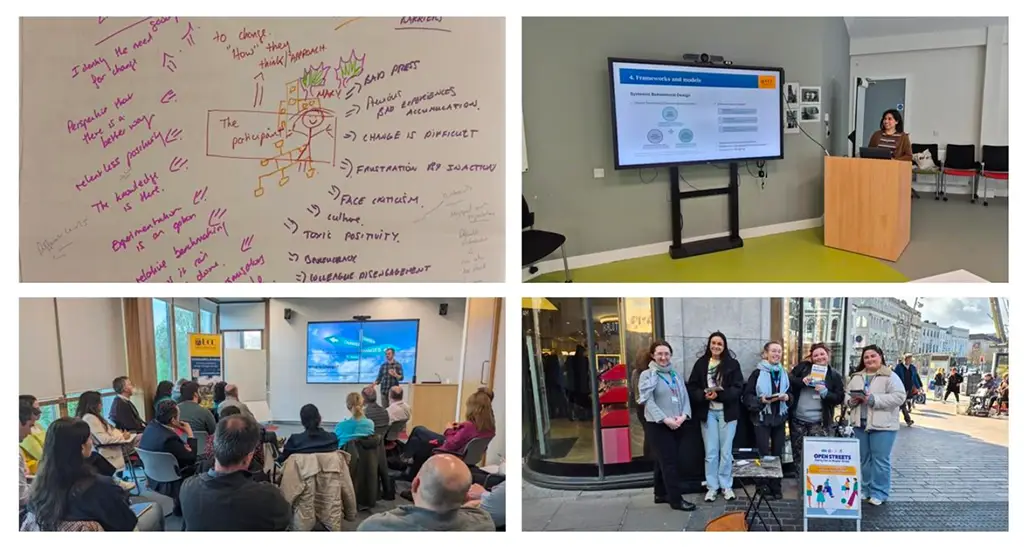
Building Capa-Cities UCC Team working with public servants, communities and businesses to co‑create skills, confidence and collaboration for meaningful climate action at city level
College of Arts, Celtic Studies & Social Sciences
Coláiste na nEalaíon, an Léinn Cheiltigh agus na nEolaíochtaí Sóisialta
Contact us
College Office, Room G31 ,Ground Floor, Block B, O'Rahilly Building, UCC