The living archive: Putting heritage at the heart of peatland conservation
The Challenge
During COVID-19, people over 70, in nursing homes in Ireland, died at 21 times the rate of people over 70 who cocooned at home (Covid Evaluation, 2026). In a rush to protect public health and the lives of people in nursing homes, blanket visitation bans were administered which effectively treated family of residents, as “only visitors” rather than essential care partners (Egan et al. 2024). Whilst not explicit in the bans, residents were often trapped inside buildings unassisted or permitted to leave for fear that they could contract the virus. Research suggests that whilst these bans were intended to help, they unwittingly impacted residents (through cognitive, physical, emotional decline and deprivation of liberty), families of residents and staff in negative ways (e.g. Normally et al. 2022). Sometimes, that meant that people died alone, without kin, or support.
Why the rate of death was so high deserves further and urgent investigation. This research, however, answers a question about the quality of the end-of-life experiences of these older adults. This question is important as we need to understand more about pandemic end-of-life experiences, so that we can support palliative care more positively in future pandemics, as well as enable the human rights of older adults in institutional care more broadly.
The Research
Dr. Sarah Robinson and Graham Gillespie (a former master’s student in the School of Applied Psychology) conducted the first qualitative study of end-of-life experiences of bereaved family members of nursing home residents (who died in care during the first three waves of the pandemic). The paper, published in a special issue of the International Journal of Care and Caring in May 2026, highlights the profound impact that blanket visitation bans had on residents (now deceased) through the voices of their remaining kin. As one participant stated indicating the wider policy environment that impacted older adults in care at this time: These people (residents) would not be shifted to hospital, they really weren’t worthy of living and another talking about her deceased mother: “She didn’t like that she was locked in… at one stage she said she felt a burden… ‘Wouldn’t it be easier for everyone if they took them out the back and shot them?’… she felt she had no quality of life.”
Families also reported reduced standards of care, when staff were overwhelmed and family were absent as support. There was an overall negative impact on relatives when they were unable to connect, in worst instances families indicate their absence contributed to death through loneliness.
The Impact
This research has been disseminated widely through ISS21’s Care Visions workshops, Human Rights activists, the Irish Human Rights and Equality Commission, briefings at the Oireachtas, the Covid Evaluation Committee, and with the Irish Hospice Association as well as being on the reading list of the BA degree in Social Science at UCC, informing teaching in this policy area.
The research was also developed as part of a multi-disciplinary approach with Applied Psychology and Human Rights Law students, and informed both undergraduate and postgraduate teaching in both disciplinary areas at UCC, and NUI Galway’s Centre for Human Rights, leading to an innovative collaboration.
The research is published in a Special Issue of the Journal of Care and Caring on the dark side of care in May 2026.
The research also influenced an initial policy response from the government to include a nominated person for nursing home residents at all times, even during a pandemic. It has been used by family advocacy groups in their ongoing quests for policy change and has been described as deeply meaningful by participants who engaged in the research process. The findings also support calls by human rights scholars and family activists for further legislative change, so that no resident will ever die alone again, (pandemic or not) and that the essential care role of family (in the broadest sense) can be formally recognized.
This research also aligns closely with the UN Sustainable Development Goals, particularly SDG 3 (Good Health and Well‑being), SDG 10 (Reduced Inequalities), and SDG 16 (Peace, Justice and Strong Institutions), by highlighting how policy decisions can unintentionally harm residents and carers when policy positions family as risk, rather than essential partners in care, and prevents connection between older adults in care and the people they love.
It strongly aligns with UCC’s Futures strategic goals. As one in three women, and one in four men will likely live in a nursing home in their lifetime (Liu, 2013; Sage Family Advocacy,2016), so this research also contributes to our collective social futures
For More Information
For more information about this research please contact Dr Sarah Robinson at sarah.robinson@ucc.ie or find our paper at the International Journal of Care and Caring here
“Our research suggests that visitation restrictions meant families felt locked-out and residents felt locked-in leading to widespread deteriorations in health and wellbeing, and in worst instances, leading older adults to die alone. In two instances families were informed of their relatives’ deaths when they were contacted to pick up their belongings, and sometimes people went days or weeks without contact.”
– Dr Sarah Robinson, Lecturer, School of Applied Social Studies
Banner Image:
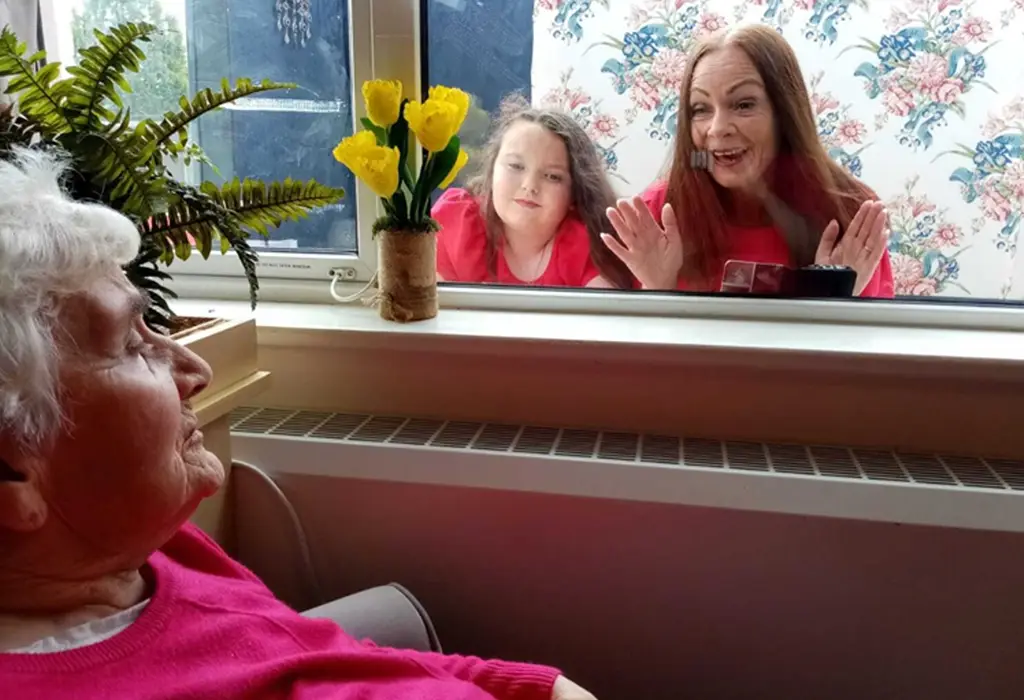
Christine Thompson and her daughter, Sarah, enjoy a precious window visit with her mother, Kathleen. Image available on the RTÉ Website
College of Arts, Celtic Studies & Social Sciences
Coláiste na nEalaíon, an Léinn Cheiltigh agus na nEolaíochtaí Sóisialta
Contact us
College Office, Room G31 ,Ground Floor, Block B, O'Rahilly Building, UCC