Seeing the Unseen: Non‑Invasive Mapping and Monitoring of Ireland’s Cold‑Water Coral Ecosystems to Inform Marine Conservation and Policy
Developing and applying non‑invasive seabed mapping and monitoring techniques to transform how Ireland’s deep‑sea cold‑water coral ecosystems are understood, protected, and managed.
The Challenge
Cold-water corals (CWCs) are among the most important yet least understood ecosystems in the global ocean. At depths of hundreds to thousands of metres, these slow growing, reef-forming organisms create complex three-dimensional habitats that support high biodiversity, act as essential feeding and nursery grounds for commercially important fish species, and contribute to long-term carbon cycling. Despite their significance, CWCs are extremely vulnerable to disturbance. Bottom trawling, climate-driven oceanic changes, and pollution threaten their structural integrity and long-term survival.
A central challenge in protecting CWCs is difficulty in observing and monitoring them without causing further damage. Traditional sampling approaches are invasive, spatially-limited, and poorly suited to capturing the fine‑scale structure and dynamics that underpin reef health, resilience, and recovery. Therefore, policymakers and conservation managers often lack the high‑resolution, site‑specific evidence needed to design effective Marine Protected Areas (MPAs), assess fisheries impacts, or evaluate long‑term environmental change.
Addressing this challenge is critical to achieving UN Sustainable Development Goal 14 (Life Below Water), particularly targets focused on conserving marine ecosystems, regulating destructive fishing practices, and strengthening the scientific basis for ocean governance. Therefore, robust, repeatable, and non‑invasive approaches that can deliver actionable evidence while safeguarding the ecosystems they aim to protect are imperative.
The Research
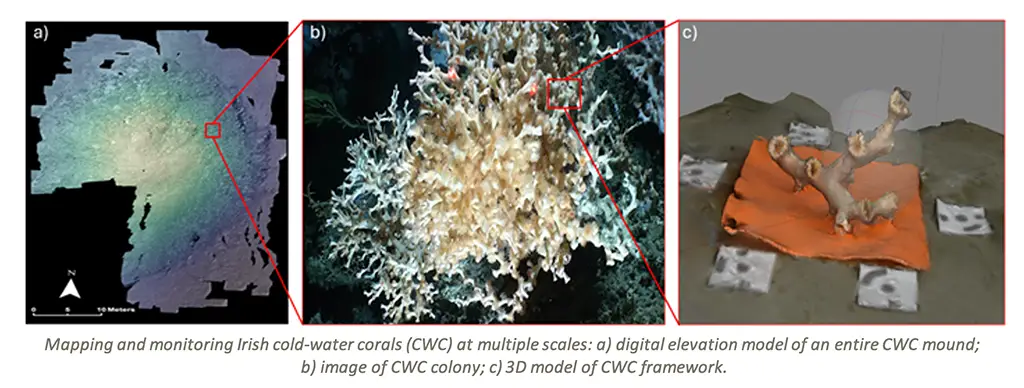
Over more than a decade, UCC has led, developed, and applied an integrated, non-invasive framework for mapping and monitoring CWC ecosystems offshore Ireland. The research combines cutting-edge seafloor observation technologies with targeted field campaigns to capture processes operating from individual coral colonies to entire mound provinces.
Central to this work are remotely operated vehicles (ROVs) equipped with high-definition video, multibeam echosounders, side-scan sonar, magnetometry, and in-situ oceanographic instrumentation. Repeated ROV surveys, most recently the CE25006 ROV Monitoring Survey (April to May 2025), have delivered centimetre-scale, fully georeferenced 3D reconstructions of three coral mounds within the Belgica Mound Province (BMP) Special Area of Conservation (SAC). These datasets allow the same reefs to be revisited, enabling detection of environmental change, variability in coral distributions, and how these are linked to local hydrodynamics.
The programme explicitly integrates biological observations with physical drivers, including near-bed currents and sediment dynamics, to understand why corals thrive in some locations and decline in others. Crucially, all methods are designed to avoid physical disturbance, setting a new standard for ethical deep-sea research. Alongside discovery-driven science, the research is embedded within long-term national monitoring efforts, training early-career researchers, and producing datasets relevant to conservation, regulation, and marine spatial planning
The Impact
This research has delivered direct and sustained impact on how Ireland manages, monitors, and understands its deep-sea CWC ecosystems, particularly within designated SACs.
Supporting statutory conservation obligations
Ireland has a legal obligation under the EU Habitats Directive to assess, protect, and monitor the condition of SACs, including offshore CWC habitats in the BMP. This research directly supports that obligation. Surveys are designed and delivered in consultation with the National Parks and Wildlife Service (NPWS) from the outset, ensuring that data products align with regulatory needs rather than purely academic questions. Survey reports, including full technical documentation and spatial datasets, are submitted directly to NPWS and form part of the evidence base used to evaluate habitat condition, pressures, and conservation effectiveness.
Crucially, the work is conducted both inside and outside existing SAC boundaries, enabling objective comparison of protected and non‑protected areas. This has allowed informed review of SAC boundary adequacy, identifying where coral habitats extend beyond designation lines and where protection may not fully capture ecologically active or vulnerable reef areas. Rather than assuming static habitats, the research treats SACs as dynamic systems that require evidence‑led reassessment through time. This work aligns closely with national and international priorities, including Ocean Knowledge 2030, Ireland’s Climate Action Plan, and Impact 2030.
Enabling repeat, non‑invasive monitoring at scale
A major impact of this research has been the establishment of repeatable, non-invasive monitoring protocols capable of detecting real ecological and geomorphic change without damaging fragile reef structures. Through systematic full-mound ROV surveys and centimetre-scale 3D reconstructions, some of the same coral habitats (e.g. Piddington, Lucy, and Mila) have been surveyed multiple times over more than a decade. This provides us as scientists and stakeholders with something that previously did not exist: a defensible baseline of the deep sea against which future change can be measured.
This approach moves monitoring away from isolated observations or partial transects and toward whole‑habitat assessments, aligning scientific practice with regulatory requirements for representative condition assessment. It also ensures that monitoring effort is proportionate and scalable, a critical consideration given Ireland’s vast offshore territory.
Reducing uncertainty about drivers of change
Several years ago, this research demonstrated unequivocally that CWC reef surfaces are changing over relatively short (multiyear) timescales, overturning the long-held assumption that deep-sea reefs are effectively static. Since then, the programme has shifted focus from detection of change to understanding why that change is occurring.
By explicitly linking high-resolution reef mapping with measurements of near-bed currents and sediment dynamics, the research has identified hydrodynamic forcing as a primary control on coral growth, erosion, and reef stability. Results show that while corals can persist in high-energy environments, sustained increases in current speed leads to physical erosion of coral framework, increased sediment mobility, and net habitat degradation. This mechanistic understanding is essential in the context of climate change, as large-scale alterations to ocean circulation are projected to modify bottom current regimes in the Northeast Atlantic.
For decision‑makers, this shifts risk assessment from abstract climate projections to identifiable physical thresholds beyond which reef development becomes unsustainable. It provides a scientifically robust basis for anticipating future vulnerability of SACs under climate‑driven change, rather than reacting only after degradation has occurred.
Building long‑term national capacity
Finally, the programme has embedded technical expertise, trained researchers, and operational know‑how within Ireland, ensuring that the country can continue to meet its conservation and monitoring obligations into the future. By integrating policy‑relevant science with long‑term datasets, this work has helped move Irish deep‑sea conservation from descriptive mapping toward evidence‑based, adaptive management grounded in repeat observation and process understanding.
For More Information
Learn more via the Earth & Ocean Lab website or connect with the researchers:
- Luca Caminiti, PhD candidate at UCC
- Corie Boolukos, PhD candidate at UCC
- Aaron Lim, PhD, Senior Lecturer/Associate Professor at UCC
- Earth and Ocean Lab
“For me, impact is about giving society the tools to protect ecosystems we rarely see but fundamentally depend on. By developing non‑invasive ways to observe cold‑water corals, we can understand how they work, how they change, and how best to safeguard them-without damaging the very environments we are trying to protect."
– Dr Aaron Lim, Senior Lecturer in Marine Geosciences
College of Arts, Celtic Studies & Social Sciences
Coláiste na nEalaíon, an Léinn Cheiltigh agus na nEolaíochtaí Sóisialta
Contact us
College Office, Room G31 ,Ground Floor, Block B, O'Rahilly Building, UCC