The Elephant in the Room: A participatory, arts-based research project making racism visible, discussable and actionable within university spaces
The Challenge
Racism remains a persistent yet often unspoken reality within higher education. Despite institutional commitments to equality, diversity and inclusion, there is a well-documented gap between policy and lived experience. Students and staff from minoritised backgrounds continue to encounter exclusion, microaggressions and structural inequalities that are insufficiently acknowledged or addressed.
Conventional university responses such as policy frameworks, reporting mechanisms and training, tend to operate at a procedural level and often fail to create meaningful spaces for dialogue, reflection or transformation. As a result, racism frequently remains present but unspoken: an “elephant in the room.”
The Elephant in the Room project responds directly to this challenge by developing a creative, participatory and research-informed approach to anti-racism in higher education. Emerging from the Praxis Project at University College Cork, it situates racism within wider global justice concerns and aligns with key UN Sustainable Development Goals, including SDG 4 (Quality Education), SDG 10 (Reduced Inequalities) and SDG 16 (Peace, Justice and Strong Institutions).
The project addresses an urgent need for approaches that move beyond awareness toward dialogue, critical reflection and action, offering a model for institutions seeking to engage meaningfully with racism.
The Research
The Elephant in the Room project is an engaged, arts-based research initiative developed collaboratively with staff and students at University College Cork as part of the Praxis Project. It integrates creative practice, participatory pedagogy and qualitative research to explore how racism is experienced, understood and addressed within the university.
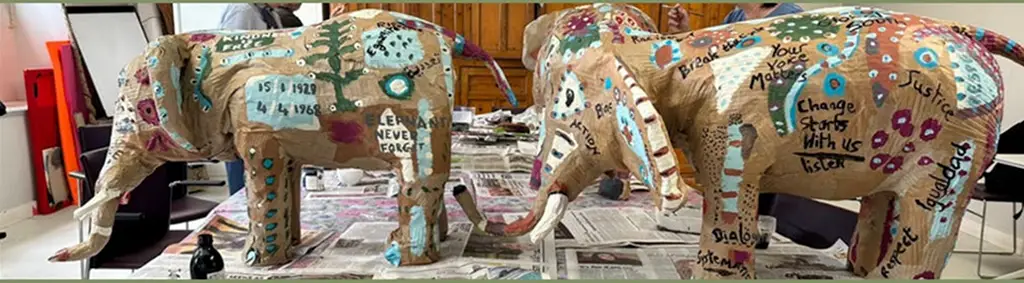
The research was designed as a multi-phase, iterative process comprising: anti-racism training; creative workshops; campus-wide public engagement; and research dissemination. Central to the methodology was the creation of life-sized papier-mâché elephants, symbolising the unspoken presence of racism. These were developed through facilitated workshops combining artistic practice with structured dialogue on racism, power, privilege and justice.
Participants co-created the installations and engaged in critical reflection through both informal and structured discussions. As identified in the project resource, the creative process enabled deeper emotional and intellectual engagement, facilitating conversations that are often difficult to initiate in traditional academic settings .
The project extended into public space through campus installations that invited anonymous contributions from the wider university community. These contributions form a qualitative dataset documenting lived experiences of racism. The research is underpinned by critical pedagogy, critical race theory and decolonial approaches, ensuring both academic rigour and social relevance.
The Impact
The Elephant in the Room project has generated significant and multi-layered impact across individual, pedagogical, institutional and societal domains.
At an individual level, the project created a powerful and often rare space for students and staff to articulate experiences of racism. The use of creative, arts-based methodologies enabled participants to engage in ways that were reflective, emotional and dialogical. As outlined in the project, creative practice functioned as an “open invitation” to engage with complex and sensitive issues, lowering barriers to participation and enabling more honest and meaningful contributions . Participants reported a greater sense of connection, validation and confidence in expressing their experiences.
At a pedagogical level, the project demonstrates a transformative model for teaching and learning in higher education. It evidences how creative, participatory methodologies can deepen engagement with social justice issues, moving beyond traditional, content-driven approaches toward more embodied, reflective and action-oriented learning. Staff involved in the project have begun integrating these approaches into their teaching and research, contributing to the embedding of Global Citizenship andDevelopment Education (GCDE) and anti-racism frameworks across disciplines.
At an institutional level, the project has made a significant contribution to surfacing and evidencing experiences of racism within the university. The campus-wide installations generated a body of anonymous narratives that provide insight into lived experiences, perceptions of institutional culture and the gap between policy and practice. As reflected by participants, this gap remains a critical issue, with frustration expressed regarding the lack of clear, actionable responses to racism despite existing frameworks . These findings contribute to ongoing institutional discussions and have informed dialogue within university networks concerned with race equality, inclusion and student experience.
The project also aligns strongly with UCC’s strategic priorities in inclusive education, student engagement, research impact and civic responsibility. It demonstrates how engaged, participatory research can contribute to institutional reflection and transformation, while also enhancing the student learning experience.
At a broader societal level, the project has expanded the reach of research beyond traditional academic audiences. By situating installations in public campus spaces, it created accessible entry points for engagement, inviting spontaneous participation from the wider university community. This approach positions the university as an active site of public dialogue, contributing to wider conversations on racism, equality and social justice.
Importantly, the project offers a transferable and scalable model for other higher education institutions. Its integration of creative practice, participatory research and public engagement provides a replicable framework for addressing complex and sensitive issues in meaningful and impactful ways. As articulated within the resource, the project contributes to an emerging body of work on embedding anti-racism within higher education teaching, research and institutional practice.
For More Information
The Elephant in the Room resource and research outputs are available through the Praxis Project, University College Cork. For collaboration, dissemination or access to materials, please contact Dr Gertrude Cotter, School of Education, UCC. Gertrude.cotter@ucc.ie
Educational Resource and Research Findings are available here: https://praxisucc.ie/resources/the-elephant-in-the-room/
Student Project is available here: https://praxisucc.ie/student-case-studies/student-projects/class-of-2024/the-elephant-in-the-room-students2024-group1/
“The art really helped us connect and start the conversation. It made talking about racism less intimidating, more like a shared experience.”
– Student Participant
College of Arts, Celtic Studies & Social Sciences
Coláiste na nEalaíon, an Léinn Cheiltigh agus na nEolaíochtaí Sóisialta
Contact us
College Office, Room G31 ,Ground Floor, Block B, O'Rahilly Building, UCC