The living archive: Putting heritage at the heart of peatland conservation
The Challenge
For generations, Ireland's peatlands have been central to community identity, culture, and livelihoods; these landscapes shaped by nearly 10,000 years of human history now stand at the frontline of the climate and biodiversity crisis. However, as urgent restoration programmes accelerate, the rich tangible cultural heritage preserved in these waterlogged landscapes, wooden trackways, artefacts, and 'bog bodies' face irreversible destruction. Experts describe this as a crisis, affecting nearly 4,000 sites in Ireland alone, with far-reaching consequences for sustainable communities and cultural continuity (SDG 11 and 15).
Extensive drainage and peat extraction have also turned previously carbon sequestering peatlands into significant sources of greenhouse gas emissions, contributing approximately 4% of human-induced GHG output globally (SDG 13). Internationally, organisations such as UNEP's Global Peatlands Initiative promote peatland restoration as a nature-based climate solution, but tangible cultural heritage is chronically under-appreciated in 'Natural Capital' frameworks, marginalising an essential dimension of Ireland's shared identity.
Locally, community groups engaged in rehabilitation work frequently lack the knowledge and resources to protect their surviving heritage. Nationally, Ireland's peatland biodiversity targets require inclusive narratives that meaningfully connect climate action to themes of identity and place. This challenge demands collaboration across academia, communities, and national and international policymakers (SDG 4 and 17).
The Research
This challenge has been addressed through a suite of UCC-led funded projects, including Wetland Futures in Contested Environments (Joint Planning Infrastructure/Cultural Heritage), New Foundations (IRC/RI), and the Research Ireland COALESCE INSTAR+ project Irish Peatland Archaeology Across Time (IPeAAT). These projects unite researchers across UCC's Departments of English and Archaeology, the Glucksman Gallery, industry partners Archaeology and Built Heritage, the Heritage Council, the Discovery Programme, Wageningen University (Netherlands), the University of Bradford (UK), the International Union for the Conservation of Nature Peatland Programme, the UNEP Global Peatlands Initiative, Historic England, and Historic Environment Scotland.
The IPeAAT project developed the first national synthesis of Irish peatland archaeology, enabling spatial and chronological mapping across millennia, supporting planning for heritage and other ecosystem services. Co-creation was foundational: workshops with community organisations and public bodies shaped research for real-world applicability. Communication and engagement included collaborations with artists and poets, public talks, a short film, a co-curated Glucksman Gallery exhibition with a structured schools programme, and a Heritage Council booklet Ár dTírdhreacha Ársa (English translation available).
Chairperson of the Lemanaghan Bog Group (LBG), Aoife Halligan wrote to RI: "This project exemplifies the kind of impact that reaches far beyond academia – strengthening community connections, raising awareness of environmental heritage, and sparking meaningful conversations about conservation and cultural identity."
The Impact
Educational Impact (SDG 4)
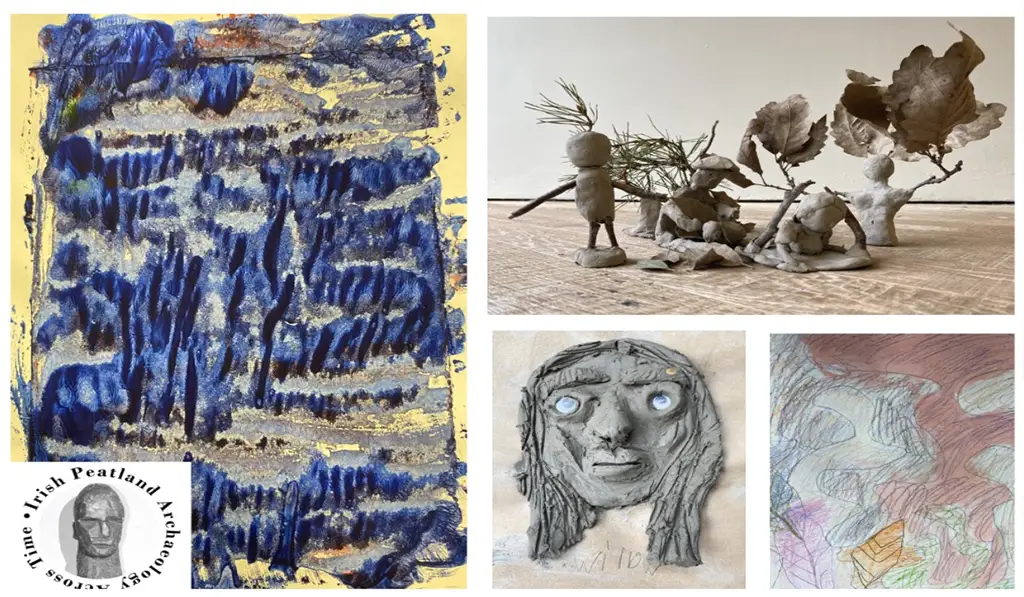
The IPeAAT arts-led programme (Radical Archaeologies), co-curated with the Glucksman Gallery drew over 29,000 visitors and delivered a structured education programme engaging approximately 800 Cork schoolchildren in workshops combining contemporary art, archaeology, and climate and biodiversity themes, culminating in the two-day student art exhibition Beneath Our Feet. Teacher questionnaires evidenced positive learning outcomes across all three themes.
IPeAAT also supported students in the National Lego League competition (2025) with an archaeology theme. Their teacher, Mr Maycock (Physics Teacher, Coláiste Daibheid, Cork), reported: "Dr Gearey really helped them understand more about the world and work of archaeologists — which is something that really inspired our students in a field that…they would have limited knowledge on." The team won a Research and Innovation Prize. A dedicated event held at the European Archaeology Day in Kilkenny (2024) in partnership with the Heritage Council engaged a further 500 schoolchildren.
Social and Cultural Impact (SDGs 11, 15)
Community-level impacts were co-designed and evidenced through workshops and focus groups with civic organisations including the Community Wetlands Forum, West Cavan Bog Association, and LBG. Participants reported tangible changes in awareness and behaviour. Collaboration with the LBG and artist activists Deep Time Agency (Heritage Week 2025) co-created Bog Guardians, a site-specific performance communicating peatland heritage in a novel and publicly accessible way. A short film, Protecting Peatlands for Future Generations, produced with UCC's AVMS team and the Clara Bog Group (2023), was screened at UCC's Sustainable Futures Forum and made freely available online.
"I will be mindful of the possible archaeological features of the bog… [and] report any possible finds immediately."
— Community workshop participant, LBG focus group
Policy and Political Impact (SDGs 13, 15, 17)
International policy reach is demonstrable and measurable. Dr Gearey co-authored a chapter in The United Nations Global Peatland Assessment (2022) and a submission from the WetFutures project is formally referenced in the UN Human Rights Commission's 2020 Report on Climate Change, Culture and Cultural Rights. Collaborative research with Historic England has driven concrete policy developments, including the co-production of formal guidance.
Most significantly, Prof Mark Reed (SRUC, co-chair, Global Peatlands Initiative) has confirmed: "Dr Gearey's research has led to changes in Scottish Government [peatland] restoration programmes and the UK's largest peatland carbon market, the Peatland Code (v2.0, 2023), which now provides protection for historic environment features." IPeAAT has also directly informed the Discovery Programme's strategic research frameworks, shaping Ireland's national research landscape.
Academic and Research Impact:
The first national synthesis of Irish peatland archaeology and environmental evidence, currently undergoing final checks, with an open-access hosting platform in development, represents a landmark infrastructural output: a reusable, scalable digital resource that will underpin research, planning, and policy for the future. Transdisciplinary collaboration with Dr Maureen O'Connor, led to a paper published open-access in Green Letters, currently ranking among the top ten most-downloaded articles in that journal.
Contribution to UCC's Strategic Goals:
This research advances all five of UCC's strategic pillars. In teaching and learning, rigorously evaluated schools programmes and postgraduate engagement have deepened student understanding of sustainability, heritage, and place (SDG 4). In research and innovation, the national database establishes a significant new infrastructure for the Irish research ecosystem. In external engagement, partnerships with civic communities, the Heritage Council, and national bodies have co-created durable real-world resources. In internationalisation, active participation in UNEP networks, UN policy fora, and collaboration with Wageningen, Bradford, Historic England, and Historic Environment Scotland have extended UCC's global reach and reputation. In infrastructural and financial sustainability, the open-access database and educational toolkit provide enduring foundations for future impact with minimal additional resources. Together, these impacts advance SDGs 4, 11, 13, 15, and 17.
For More Information
Contact: Dr Benjamin Gearey B.Gearey@ucc.ie
Visit: https://www.ucc.ie/en/peatlands/
Collaborators:
Collaborators: Cathy Moore (ABH, Dublin), Dr Ellen O’Carroll, Dr Lauren Shotter, Dr Clare Nolan, Dr Maureen O’Connor, Prof Fiona Kearney, Tadgh Crowley
“Over the past 30 years there has been a paradigm shift in the approach of heritage organisations towards wetlands. In essence transitioning from an exploration and recording approach to one of people, place and policy. Dr Gearey has been at the forefront of that change. His work in the academic sector typifies this new approach, placing people at the heart of the policy environment.”
– Dr William Fletcher, Development Team Leader, Historic England
Banner Image:
A selection of art produced by school children, Beneath Our Feet education programme, curated by the Glucksman Gallery, Cork City, in collaboration with IPeAAT. Front of postcard produced by the project.
College of Arts, Celtic Studies & Social Sciences
Coláiste na nEalaíon, an Léinn Cheiltigh agus na nEolaíochtaí Sóisialta
Contact us
College Office, Room G31 ,Ground Floor, Block B, O'Rahilly Building, UCC