In This Section
- Home
- About The School
- News
- People
- Courses
- Current Students
- Research
- Outreach and Public Engagement
- Green and Sustainable Chemistry
- ICI Colloquium 2026
School of Chemistry staff contribute to the Climate and Health Alliance position paper to address the health threat posed by air pollution
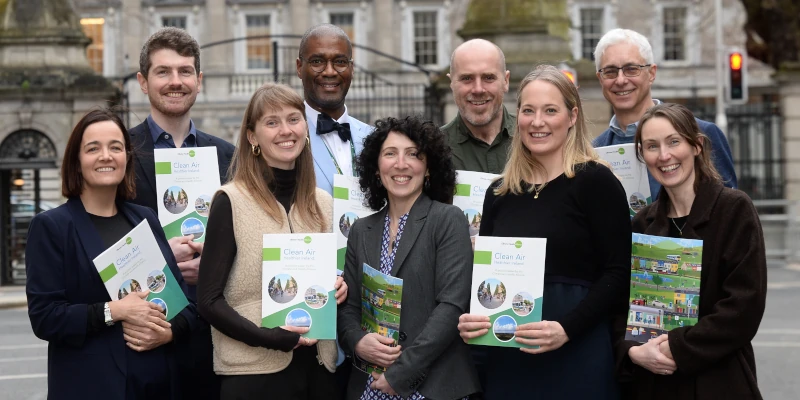
Public health coalition the Climate and Health Alliance (CHA) announced the publication of ‘Clean Air — Healthier Ireland’ at an event on Tuesday 17th February in the Oireachtas.
Dr Dean Venables from the Centre for Research into Atmospheric Chemistry (CRAC) in the School of Chemistry played a leading role in writing the position paper and was present at its launch in the Oireachtas.
The report (available here) outlines that air pollution has no safe level and contributes to heart and lung disease, stroke, dementia, pregnancy complications as well as mental health issues. It urges government action to address this invisible health threat. The event was hosted by Deputy Jennifer Whitmore of the Social Democrats, who called for urgent, collaborative action across government to reduce harmful emissions and protect people.
Commenting on the paper, Mark Murphy of the Climate & Health Alliance said, “Clean air is a fundamental human right, yet over 1,600 people in Ireland die prematurely each year from fine particulate matter produced largely by burning solid fuels. This is nearly ten times the annual number of road deaths in our country”. Ireland regularly fails to meet levels of air quality deemed safe to health by the WHO, in large part because of burning solid fuels for heating and its high dependence on private vehicles for transport. The launch event also heard from Martha Halbert, a social inclusion worker for Cork City Council, who spoke of her grave concern about the harm caused by air pollution to vulnerable communities in Cork City and its effect on her daughter living with asthma.
The CHA paper points to successful examples, such as the ban on smoky coal and wet wood, as evidence that strong policy can improve air quality. However, Ireland is still far from meeting updated WHO Global Air Quality Guidelines. The CHA’s position paper calls for accelerated action across government, including increasing public awareness of air pollution as a major health risk, empowering local authorities to enforce air quality standards and stamp out the importation of smoky coal, promoting and investing in healthy and sustainable transport options, and legislating for ‘No Idling’ policies for vehicles outside schools, third level institutions and health service campuses. The latter is a policy that CRAC researchers have already motivated UCC to adopt.
The Climate and Health Alliance’s chair, Dr Sean Owens, noted that political courage was needed to face the public health crisis of air pollution. “Air pollution is not inevitable. Cleaner air is possible, and the health, economic, and societal benefits are enormous” he said.
School of Chemistry
Scoil na Ceimic
Contact us
Second Floor, Kane Building, University College Cork, T12 YN60