
In This Section
Chronic respiratory disease burden in flood-prone areas of tropical cities.
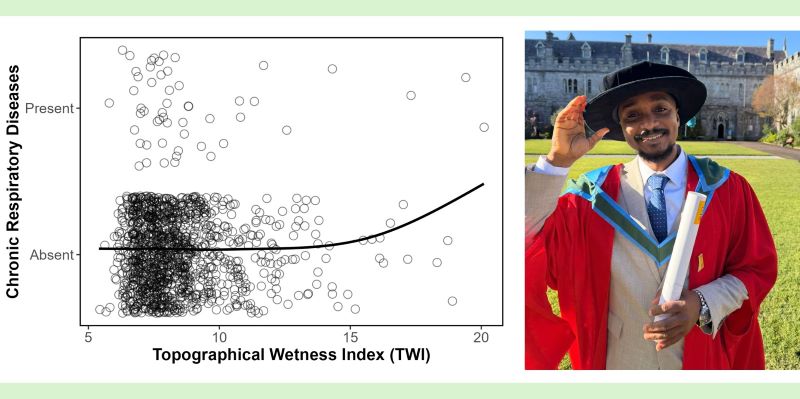
Dr Ibrahim Msuya demonstrates that living in flood-prone parts of Dar es Salaam city in Tanzania greatly increases risk of chronic respiratory diseases.
Chronic respiratory diseases (CRDs) cause serious health problems worldwide, leading to millions of deaths every year. While smoking is a major cause, other factors like polluted air and lung infections also play a role. In his latest published study (https://doi.org/10.1029/2025GH001764) as a UCC-BEES doctoral scholar based at the Ifakara Health Institute (IHI) in Tanzania, Dr Ibrahim Msuya combined detailed satellite data on land wetness with health surveys from over 1,500 households in neighbourhoods encompassing a wide spectrum of affluence and poverty. Living in the most flood-prone parts of the city, where the poorest communities tend to settle down, increased chronic respiratory disease risk approximately nine times. Furthermore, qualitative examination of the exceptions proved the rule of this large-scale quantitative rule: In many areas where remotely sensed topographic data failed to predict the occurrence of chronic respiratory disease cases, clear signs of inundation (eg. runoff channelling, ridge-and-furrow agriculture or elevated construction practices) were visually obvious in real colour satellite images or in situ during ground truthing exercises. While larger households and shared waste bins also increased risk, air conditioning lowered it and average income across neighbourhoods had no apparent influence once such directly causative social and environmental factors were accounted for. This study highlights how living in damp environments contributes to lung disease, especially among the poorer communities who often find themselves forced to live in flood prone areas. Understanding these links can help improve urban planning policy and practice, especially in resource-constrained tropical countries.
Dr Ibrahim Msuya is a Research Scientist at the Ifakara Health Institute and his recently completed his Employment-Based PhD was jointly supervised by Prof Gerry Killeen and Dr Jean O’Dwyer (Both UCC BEES, Ireland) and Dr Francis Levira (IHI, Tanzania). Ibrahim’s paid study leave and research datacollection were funded by IHI and his academic doctoral scholarship was funded by the UCC College of Science, Engineering and Food Science. Prof Killeen’s Research Chair position was jointly funded by the AXA Research Fund and the UCC College of Science, Engineering and Food Science. The employment-based scholarship model underpinning Ibrahim’s PhD enabled IHI and UCC to jointly support his professional development and career progression at his home institution in Tanzania, where his skills and expertise are most relevant and greatly needed.
School of Biological, Earth and Environmental Sciences
An Scoil Eolaíochtaí Bitheolaíocha, Domhain agus Comhshaoil
Contact us
Distillery Fields, North Mall, University College Cork, Ireland , T23 TK30