
In This Section
Dramatic reductions of malaria disease burden in rural Zambia
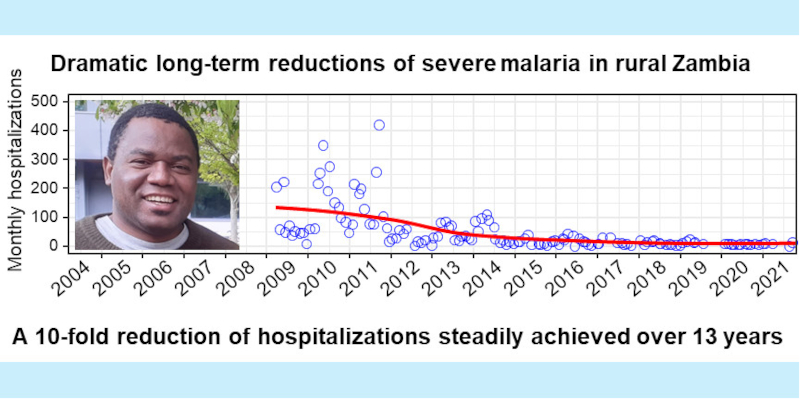
Mr Dingani Chinula, UCC-BEES doctoral candidate based at the Zambian Malaria Elimination Programme (ZMEP), has demonstrated how he and his colleagues have reduced rates of total malaria cases by over 80% and severe, life threatening cases requiring hospitalization by over 90%.
Mr Dingani Chinula, a UCC BEES Employment-Based PhD Scholar at the Zambian Malaria Elimination Programme (ZMEP), recently analysed over 13 years of legacy data from one exceptionally well-monitored district to demonstrate how he and his colleagues across the Zambian Ministry of Health (MoH) have steadily reduced rates of hospitalization due to severe malaria by over 90%, simply by spraying people’s houses with safe insecticide formulations and expanding the outreach of rural health services (https://doi.org/10.1371/journal.pone.0336099).
By the start of the study in 2009, the people of Luangwa District had already received large numbers of long-lasting insecticidal nets, to protect them while they sleep and kill mosquitoes attempting to feed on them. Starting in late 2010, however, Dingani and his colleagues at the ZMEP began also spraying safe insecticide formulations on the indoor surfaces of the walls and roofs of their houses. Although this began using the same pyrethroid class of insecticides used on the bednets, the ZMEP increasingly used more durable insecticide formulations from complementary chemical classes, resulting in a steady decline of malaria cases, which accelerated again after eight new health facilities were opened by the MoH in 2016. Malaria burden continued to dissipate until the end of the study in 2021, at which point the total number of cases each year had declined by at least 80%, while the number of severe cases admitted to hospital as inpatients was reduced by more 90%. Overall, the latter figure reflects a transition from one in every 20 people being hospitalized with severe, life-threatening malaria every year to one in every 200 people 13 years later.
Dingani Chinula is a Malaria Specialist at ZMEP and his recently submitted PhD was jointly supervised by Prof Gerry Killeen and Dr Tom Reed (Both UCC BEES, Ireland), Dr Samson Kiware (Ifakara Health Institute (IHI), Tanzania) and Dr Busiku Hamainza (Zambian MoH). Dingani’s paid study leave and research data collection were funded by ZMEC and his academic doctoral scholarship was funded by the UCC College of Science, Engineering and Food Science. Prof Killeen’s Research Chair position was jointly funded by the AXA Research Fund and the UCC College of Science, Engineering and Food Science. The employment-based scholarship model underpinning Dingani’s PhD enabled ZMEP, IHI and UCC to jointly support his professional development and career progression at his home institution in Zambia, where his skills and expertise are most relevant and greatly needed.
School of Biological, Earth and Environmental Sciences
An Scoil Eolaíochtaí Bitheolaíocha, Domhain agus Comhshaoil
Contact us
Distillery Fields, North Mall, University College Cork, Ireland , T23 TK30