In This Section
New Study Demonstrates the Power of Citizen Science and Satellite Data for Monitoring Ireland’s Birdlife
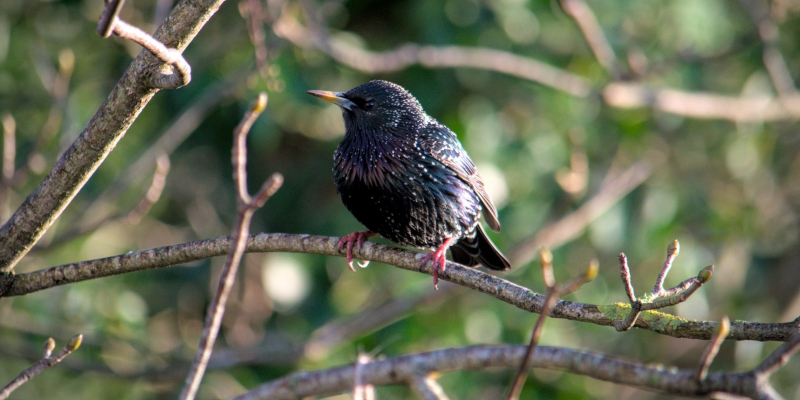
A new study led by Dr. Crego from the School of BEES, in collaboration with BirdWatch Ireland and the National Parks and Wildlife Service (NPWS), shows the potential of combining eBird data, high spatial resolution remotely sensed products, and advanced modelling techniques to study and monitor bird populations across Ireland.
A new research publication led by Dr. Crego from the School of BEES, in collaboration with BirdWatch Ireland and the National Parks and Wildlife Service (NPWS), highlights the potential of using citizen science data to monitor bird populations across Ireland. The study, published in Ibis, explores how eBird data, satellite observations, and advanced modelling techniques can be combined at a national scale.
eBird was launched in 2002 by the Cornell Lab of Ornithology and the National Audubon Society in the USA and has become one of the most successful citizen science projects in the world. eBird is a web platform and a phone app in which bird enthusiasts can document and report their bird observations. There are about 121 million checklists submitted by over a million people across the world today.
The data is publicly and freely available and is used in many research projects. For instance, a recent paper in science showed a decline in species abundance across North America using eBird data. In our research, we wanted to understand if the eBird platform was being used by people in Ireland and if the data was sufficient to map the distribution of Irish birds and understand species habitat associations.
We found an exponential increase in the use of the eBird platform across Ireland over the past two decades, with over 66,000 checklists reported by over 4,000 users up to 2023.
Citizen science data comes in quantities, but the data is of “poor quality” from a scientific perspective. When people go out looking for birds in their free time, they usually do it in the middle of the day, close to roads, or around cities. Of course, the idea of bird watching is to have fun and connect with nature and birds, not to do science.
However, with the use of advanced modelling techniques, we showed that these biases can be accounted for. By using information on the time of day, the length of time spent searching for birds, approximate location, weather conditions, and even an estimate of observer experience, we were able to account for observation biases and obtain “corrected” species distributions and species habitat preferences.
When comparing our modelling results with annual data collected by trained volunteers across the country (a project coordinated by BirdWatch Ireland), we found very similar results. Of course, models for not all species were good, but with more data, we anticipate that models will improve quickly. In the paper, we outline some practical recommendations for generating more “analysis-friendly” data within the eBird platform. Examples are conducting short checklists (< 1 km), frequently revisiting the same location (important to model observation biases), birding in more natural habitats away from cities, and birding in places with low bird activity (important to understand why certain species avoid certain areas).
As the number of observations reported on eBird keeps growing, we will be able to improve models and study birds year-round, across the entire island, something very difficult to do in a coordinated manner. We can also use the eBird data to complement existing datasets for habitats where good information is missing. We also made the entire code available for other people to use it or improve it.
In a time when people are more disconnected than ever from nature, birds are helping people restore their connection with the natural world. Researchers, in turn, can use the data to generate information that can help protect species and guide the highly needed restoration of Irish natural habitats.
School of Biological, Earth and Environmental Sciences
An Scoil Eolaíochtaí Bitheolaíocha, Domhain agus Comhshaoil
Contact us
Distillery Fields, North Mall, University College Cork, Ireland , T23 TK30