In This Section
New Research: Wild refuge populations of African malaria vector mosquitoes and what they feed on
Refuge populations of an African malaria vector mosquito deep inside conserved wilderness areas create new opportunities to slow the evolution of resistance against public health insecticides.
The Anopheles arabiensis mosquito is one of the most behaviourally flexible and resilient vectors of persisting residual malaria transmission across Africa because it can avoid contact with insecticide-treated bednets by blood feeding outdoors, often on cattle. As this life-saving vector control measure has been scaled up, robust populations of this important malaria vector have evolved to become increasingly resistant to the insecticides used to treat them. In the field of agricultural pest management, strategies for slowing the evolution of pesticide resistance rely on providing target arthropods with refuge areas without any selection pressure where susceptible wild-type alleles can be sustained within the population.
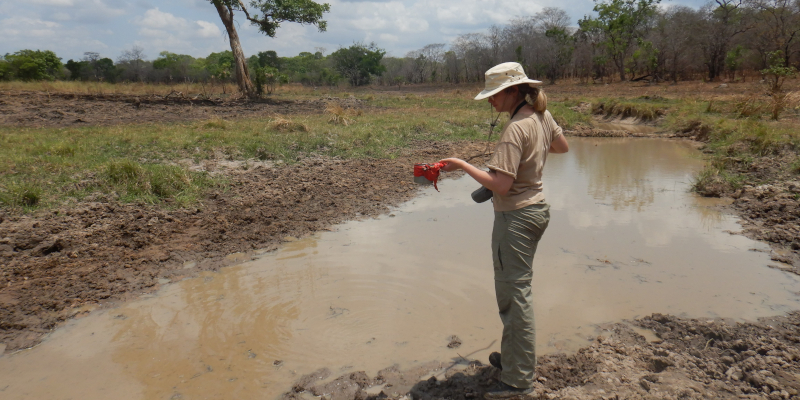
In her recent publication (https://doi.org/10.1371/journal.pone.0344670), UCC BEES MSc graduate Katrina Walsh, working with a collaborative team from the Ifakara Health Institute (IHI) and Sokoine University of Agriculture (SUA) in Tanzania, demonstrated that wild refuge populations of this key malaria vector exist in even the remotest wilderness areas without any humans, livestock or insecticide use. Taking their surveys deep into the most remote corners of Nyerere National Park, they found self-sustaining populations of Anopheles arabiensis that clearly rely on wild animals for blood. These wild populations deep inside a consolidated conservation area almost as big as the Republic of Ireland represents a vast refuge from insecticide pressure that should make the resistance management game an easier one for national malaria control programmes to play.
However, in well conserved areas of the park and an adjoining community-led wildlife management area, Anopheles arabiensis was found to co-exist with the closely related ancestral species it is thought to have evolved from as people and their livestock became increasingly abundant across Africa. Although Anopheles quadriannulatus is physically indistinguishable from Anopheles arabiensis, Katrina’s colleague Deo Kavishe recently demonstrated that it is so uninterested in human blood that it is incapable of mediating malaria transmission (https://doi.org/10.1111/mve.12813). Wherever natural land cover and wild mammal populations flourished, this essentially harmless sibling species outcompeted its close relative, dominating larval samples collected from the puddles, ponds and stream beds those animals so often come to drink from.
Furthermore, by quantifying signs of human, livestock and wildlife activity around the surface water bodies that these mosquitoes breed in, Katrina was able to identify preferred blood sources for both mosquito species, based on how the availability of specific mammals to feed on swung the balance of the competitive relationship between them. Consistent with its key role in sustaining residual malaria transmission, Anopheles arabiensis completely dominated domesticated or encroached landscapes with even the sparsest populations of humans and/or cattle. In contrast, Anopheles quadriannulatus fared better in fully conserved landscapes wherever impala, warthog and bushpig were found. These three large mammals are all non-migratory, resident species with fixed, compact home ranges where surface water is available throughout the year, so ideal blood sources for a mosquito adapted to wild Africa to specialize upon.
Katrina Walsh was supervised by Prof Gerry Killeen and Dr Fidelma Butler (Both UCC BEES, Ireland) and Dr Emmanuel Kaindoa (Ifakara Health Institute, Tanzania). Her MSc studentship, the research project it was nested within, and Prof Killeen’s Research Chair position were jointly funded by the AXA Research Fund and the UCC College of Science, Engineering and Food Science.
School of Biological, Earth and Environmental Sciences
An Scoil Eolaíochtaí Bitheolaíocha, Domhain agus Comhshaoil
Contact us
Distillery Fields, North Mall, University College Cork, Ireland , T23 TK30