
In This Section
New Research: Busy Zoos Keep Lions Asserting their Dominance Around the Clock
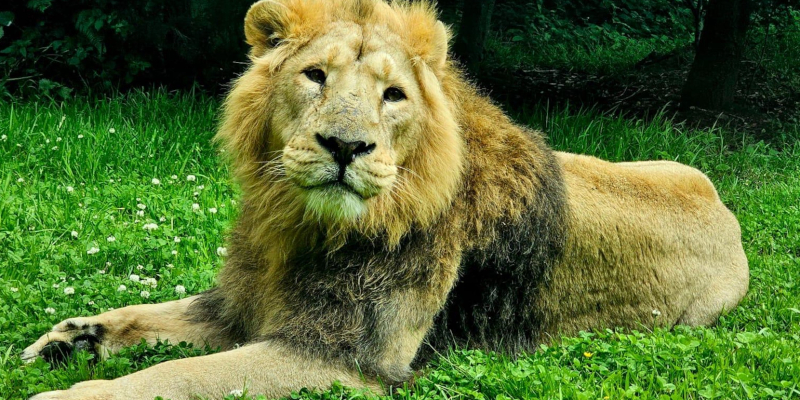
A new study by UCC-BEES in collaboration with Fota Wildlife Park (FWP) reveals that the busy daytime environment of zoos appears to stimulate lions to assert their territorial dominance by roaring throughout the day.
The territorial vocalizations of lions, often referred to as roars, are the loudest natural sounds of biological origin, allowing them to broadcast their dominance over distance of up to 8 kilometres.
The latest in a series of publications arising from the long-standing collaboration between the UCC School of Biological, Earth and Environmental Studies (BEES) and Fota Wildlife Park (https://www.fotawildlife.ie/) confirms that captive lions in zoos appear to be stimulated by their characteristic busy daytime environments, prompting them to assert their territorial dominance throughout daylight hours
UCC-BEES undergraduate student Clóideach Walsh carried out the study as part of her final year research project at FWP, under the supervision of Dr Declan O’Donovan (FWP) and Prof Gerry Killeen (UCC-BEES). Over the course of six months, Clóideach followed the successful introduction of a new male (Yali) to an established pair of females (Gita and Gira) and monitored the behaviours of all three as Yali rapidly asserted his dominance within the pride. Just like his wild lion cousins, Yali was observed roaring at night. However, he also mirrored the surprizing habits of his predecessor at FWP (A male called Shanto who died of natural causes some months previously) by roaring throughout the day. Such persistence of daytime territorial vocalizations do not occur among wild lions but have been reported anecdotally from other zoos around the world.
This study suggests that the impressive spectacle experienced by visitors during daily opening hours at FWP is stimulated by the zoo’s busy environment rather than just being a random idiosyncrasy of any individual lion or a socially learned behaviour passed between pride members. Although small, this captive pride at FWP is of particular conservation significance because Asiatic lions are an endangered subspecies, for which only one wild population of a few hundred animals survives in the Gir Forest of India today.
School of Biological, Earth and Environmental Sciences
An Scoil Eolaíochtaí Bitheolaíocha, Domhain agus Comhshaoil
Contact us
Distillery Fields, North Mall, University College Cork, Ireland , T23 TK30