In This Section
- English
- About the Department
- People
- Study
- Research
- News
- Media Gallery
- Edmund Spenser in Cork - School of English UCC
- Mary Breen: Pride and Prejudice
- MA in Irish Writing and Film
- Ann Coughlan: The Irish Influence on America's Greatest Abolitionist
- MA in Modernities: Romanticism, Modernism, Postmodernism
- MA in American Literature and Film
- MA in English Texts and Contexts: Medieval to Renaissance
- PhD in English
- Prof. Claire Connolly
- Tonio Colona - PhD in the School of English, UCC
- Prof Patricia Coughlan
- Mike Waldron - PhD in the School of English
- Ken Rooney and Heather Laird Book Launch
- School Welcome Event September 2014
- Contemporary American Trauma Narratives Book Launch
- Staged Transgressions in Shakespeare's England
- Seamus Heaney Memorial Event September 2013
- Creative Writing
- Current Students
- Student Achievements
- Digital Humanities
- Creative Writing
Lines of Communication: Telegraphy, Literature, and Security in Ireland and the British Empire, 1794–1850 (LINC)
Funded by the Taighde Éireann – Research Ireland Pathway Programme.
Lines of Communication: Telegraphy, Literature, and Security in Ireland and the British Empire, 1794–1850 (LINC) is a four-year research project that examines the cultural, literary, and political histories of early telecommunications in the pre-electrical era. The project focuses on the optical (or semaphore) telegraph, a human-powered signalling system developed at the close of the eighteenth century that promised to enable the rapid and secure transmission of information across long distances.
LINC explores how infrastructures of secret and high-speed intelligence emerged in Ireland and across the British Empire, and how they shaped evolving ideas of state security and insecurity. Taking an explicitly interdisciplinary approach that combines literary studies, cultural and social history, and the history of science and technology, the project recontextualises the optical telegraph not simply as a machine, but as a cultural and political technology embedded in systems of governance, surveillance, and empire.
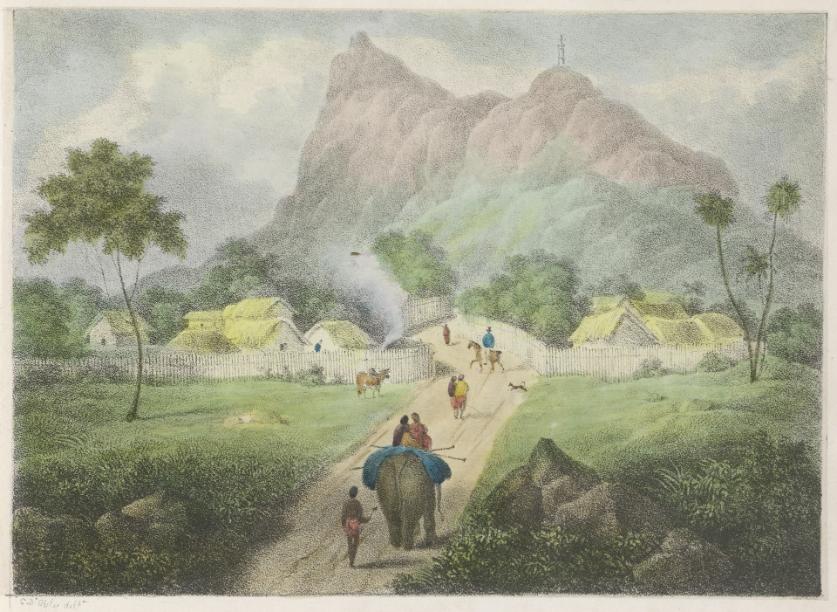
Charles D’Oyly, ‘View of the Village and Hill of Silwar with a Telegraph Tower,’ 1830, Yale Centre for British Art
A central concern of the project is the interplay between telegraphy and literature. LINC examines how literary forms, metaphors, and practices informed the design, promotion, and interpretation of early communication technologies, and how, in turn, the telegraph influenced literary and political discourses of speed, secrecy, and security. Particular attention is paid to the work of Maria Edgeworth, a major Irish writer who played a significant yet underappreciated role in the development and cultural mediation of the telegraph invented by her father, Richard Lovell Edgeworth. Although the Edgeworth telegraph was operational in Ireland only briefly in 1804, it was later adapted for use by the British East India Company in Bengal, linking Ireland directly to wider imperial networks of intelligence.
Through a comparative analysis of telegraph schemes in Ireland, India, Van Diemen’s Land (lutruwita/Tasmania), and the Cape Colony in southern Africa, LINC traces how the technology was imagined, implemented, adapted, and contested in diverse colonial settings. The project pays close attention not only to moments of innovation and expansion, but also to the crises, failures, and forms of resistance that accompanied the telegraph’s use. By foregrounding technological breakdown, environmental contingency, and local opposition, LINC challenges narratives of seamless technological progress and highlights the precarious nature of early surveillance infrastructures.
By situating the optical telegraph within longer histories of communication, security, and empire, LINC offers new perspectives on Ireland’s complex position within British imperial systems, as both a site of innovation and a locus of colonial governance. More broadly, the project contributes to historically informed debates on the legacies of surveillance, secrecy, and technological acceleration, demonstrating how early experiments in ‘secret and swift intelligence’ continue to shape modern understandings of communication, power, and state security.
Team
Joanna Wharton is Principal Investigator of Lines of Communication: Telegraphy, Literature, and Security in Ireland and the British Empire, 1794–1850 (LINC), funded by the Taighde Éireann – Research Ireland Pathway Programme. Her research explores the intersections of literature, science and technology, and empire, with a particular focus on women’s writing in eighteenth-century and Romantic-era Britain and Ireland. Her first monograph, Material Enlightenment: Women Writers and the Science of Mind, 1770–1830 (Boydell, 2018), examined the contributions of writers including Anna Letitia Barbauld, Maria Edgeworth, and Hannah More to early psychological discourse and educational practice. Before joining UCC, Joanna lectured at the University of York and at Birkbeck, University of London, and held research positions at the University of St Andrews and Georg-August-Universität Göttingen. Through LINC, she brings together her expertise in literary history and history of science and technology to examine the cultural foundations of early communication and intelligence systems.
PhD candidate: Jessica White
Jessica White is a Research Ireland-funded PhD candidate at UCC. Her research explores the ways children’s literature, political economy, and science intersect in women’s writing in the long eighteenth century. Her doctoral thesis considers the contributions of children’s writers to the discourses of Enlightenment pedagogy, economic theory, and technological progress, with a specific focus on the work of key educationalists Maria Edgeworth, Anna Letitia Barbauld and Jane Marcet. Central to her thesis is an examination of attempts to use educational practice to increase individual and national happiness.
Project mentor: Professor Claire Connolly
Claire Connolly is Professor of Modern English at University College Cork in Ireland and author of A Cultural History of the Irish Novel, 1790-1829 (Cambridge UP; awarded the Donald J. Murphy Prize for Distinguished First Monograph by the American Conference for Irish Studies) as well as many essays on eighteenth- and nineteenth-century Irish culture. Her book on Irish Romanticism was published by Cambridge in December 2025.
With Marjorie Howes (BC), she was General Editor of the six volume series, Irish Literature in Transition, 1700-2020, as well as editor for Volume 2 of the series, Irish Literature in Transition, 1780-1830 (Cambridge UP).
Prof Connolly is a member of the Royal Irish Academy, a Fellow of the Learned Society of Wales and an International Fellow of the Royal Society of Edinburgh. She has been O’Brien Professor at Concordia University in Montreal, Parnell Fellow in Irish Studies at Magdalene College, Cambridge, Burns Scholar at Boston College and Visiting Professor at the Greenhouse Center for Environmental Humanities, University of Stavanger.
English Department
Roinn an Bhéarla
Contact us
O'Rahilly Building, University College Cork, Cork. Ireland