
In This Section
- English
- About the Department
- People
- Study
- Research
- News
- Media Gallery
- MA in Irish Writing and Film
- Ann Coughlan: The Irish Influence on America's Greatest Abolitionist
- MA in Modernities: Romanticism, Modernism, Postmodernism
- MA in American Literature and Film
- MA in English Texts and Contexts: Medieval to Renaissance
- Prof. Claire Connolly
- Tonio Colona - PhD in the School of English, UCC
- Prof Patricia Coughlan
- Mike Waldron - PhD in the School of English
- School Welcome Event September 2014
- Current Students
- Student Achievements
- Digital Humanities
- Creative Writing
Social Network Analysis
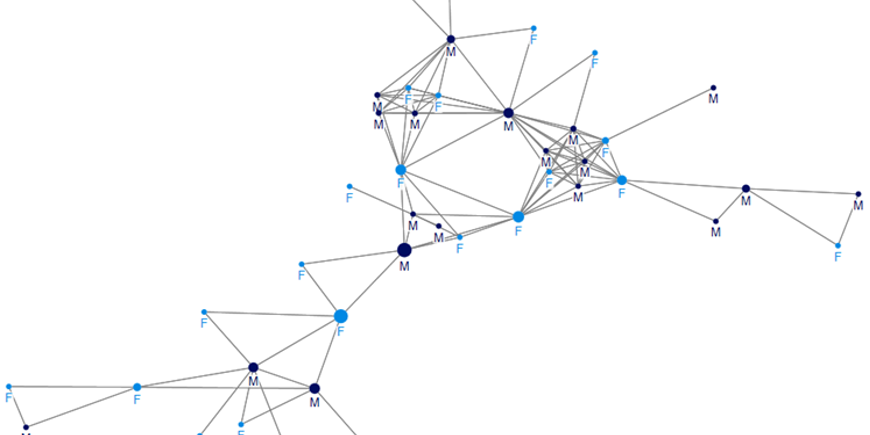
Dr Máirín MacCarron has published an article with Professor Julia Hillner, University of Bonn, on Social Network Analysis in late Roman and early medieval societies. Their chapter appears in Brill’s Companion to Roman Prosopography, edited by Marietta Horster, Richard Flower, Frédéric Hurlet and Ralph Mathisen, published in December 2025.
Dr Máirín MacCarron (School of English and Digital Humanities, UCC) and Professor Julia Hillner (Center for Dependency and Slavery Studies, University of Bonn) have published an extensive study outlining the efficacy of applying social network analysis to late Roman and early medieval sources. This article assesses the affordances of data-driven analysis in humanities research, considers the methodological links between contemporary social network analysis and long-standing practices in historical prosopography, and applies network science to a selection of case studies.
This approach allows a re-appraisal of the importance of social relationships in the tetrarchy, the imperial Roman system of co-rule and succession theoretically based on merit (not blood) that existed in the late third and early fourth centuries. Traditional historiography has focused on male connections in this group; social network analysis illuminates the role of women in what is a complicated kinship network.
This study also examines the creation of networks from disparate sources through analysing ecclesiastical networks in fourth- and fifth-century Egypt, specifically concerning exiled clerics, and the role of character networks in understanding social structures on the island of Britain in the seventh and eighth centuries. In analysing the underlying networks in Bede’s Ecclesiastical History of the English People (c. AD 731), the mathematical measure of communicability was employed to assess influence over time in social networks. Among other findings, the enduring importance of abbesses such as Hild of Whitby (d. 680) came to the fore.
Digital Humanities
Daonnachtaí Digiteacha
Contact us
Room 2.22, O'Rahilly Building, University College Cork, Ireland