Researching innovation to empower an entrepreneurial ecosystem
Goal 1.5 of UCC’s strategic plan 2023 – 2028 is to ‘Create an innovation culture and entrepreneurial campus, underpinned by an ethos of creativity and discovery’. Central to this, is research informed teaching to develop future entrepreneurs from UCC’s diverse student population.
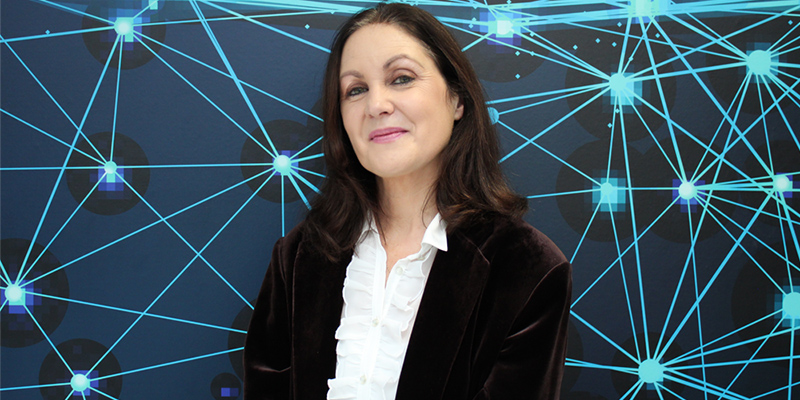
Dr Gillian Barrett is a Lecturer in Entrepreneurship & Management in Cork University Business School. Gillian’s research interests lie at the intersection of innovation management, open innovation, and entrepreneurship. Prior to academia, Gillian worked for fifteen years in industry in a variety of senior project management and leadership roles primarily managing innovation and technology projects. She is now embedding her experience and research expertise into teaching the next generation of innovators and entrepreneurs in UCC and beyond.
As Innovation Week continues in UCC, Gillian speaks here about her research and her ongoing work contributing towards the creation of an entrepreneurial ecosystem in UCC.
Can you describe your research into innovation and entrepreneurship?
My research expertise crosses multiple sub-disciplines within the broad area of innovation and entrepreneurship. First, global high-tech small and medium sized enterprises (SMEs) and their adoption of open innovation. Second, the innovation practices across the triple helix (university, academia, and industry) within renewable energy SMEs. Third, student’s entrepreneurial extracurricular activities. More recently, I have been exploring the role of Generative Artificial Intelligence in entrepreneurship education.
Can you highlight some key findings in this research?
My research identified the ‘human element’ as core to successful adoption of open innovation within global SMEs. This human element refers to the entrepreneurial founder and their underlying skills, background, experience, and education. My findings revealed the importance of the founder’s managerial skills (such as networking, problem solving and communication skills) in promoting innovation within their organisations. Founders with a scientific or technical background have a higher ‘absorptive capacity,’ draw on their expertise and entrepreneurial confidence to initiate action, and treat knowledge or experience gaps as problems to be solved through collaboration rather than as barriers to entry.
What is your vision of an entrepreneurial ecosystem at UCC?
My vision for the UCC entrepreneurial ecosystem is one of inclusivity and interdisciplinarity, to offer every student the opportunity to take an entrepreneurship module regardless of discipline or year of study. By taking an entrepreneurship module, students will be introduced to the language of entrepreneurship, supported to build their entrepreneurial confidence and curiosity, and helped to develop transversal skills and capabilities (including creativity, complex problem solving, critical thinking, networking, and communication) to take entrepreneurial action. Our desire is to create entrepreneurial leaders who will be a sustainable driving force for future societal and economic benefit.
This entrepreneurial ecosystem is a community comprised of many actors, our colleagues in UCC Innovation, entrepreneurs in residence, guest speakers (i.e. entrepreneurs who inspire through their start-up stories and experiences), adjunct professors, funders and many more.
How is your research-led teaching embedding an entrepreneurial culture at UCC?
I developed and lead the University-Wide entrepreneurship module UW0007/PG7052, entitled ‘Developing an entrepreneurial mindshift’, enabling students to discover their inner entrepreneur. These modules support entrepreneurially motivated students to create economic, social, and environmental impact and helps PhD researchers to translate breakthrough research into sustainable technology ideas.
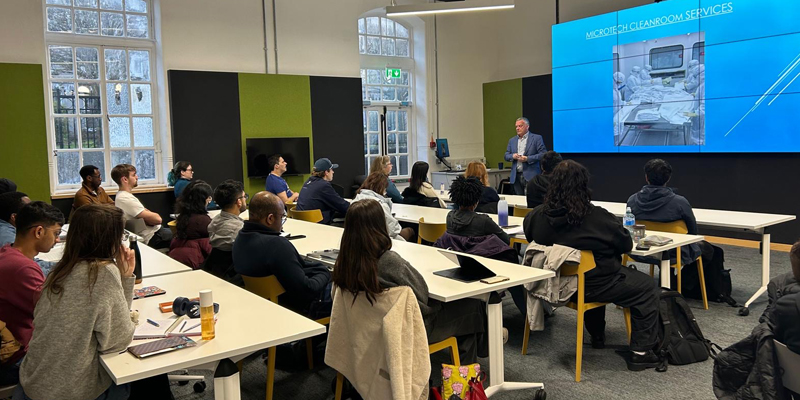
Photo: UCC Students undertaking the University-wide module entitled ‘Developing an entrepreneurial mindshift’.
First, I focus on the self-development of each student through an entrepreneurial lens. Given my research findings on the importance of managerial skills, I take a practice-based approach to entrepreneurship education and use this as a model of effective student learning helping them to take action to develop entrepreneurial skills.
Second, students work within interdisciplinary groups to formulate problems which form the foundation from which opportunities are identified from the enormity of societal grand challenges that exist. Students connect with like-minded students from diverse backgrounds; every week, they take action and experiment using risk-free experiential learning techniques.
Since the introduction of UW0007 and PG7052, what are the key differences you see in students when they complete the module?
I have seen two significant differences.
First, there is a positive momentum towards entrepreneurship at present which we must build upon. Through our ambition to create an innovative culture and entrepreneurial campus, we have an opportunity to lead nationally and internationally. Students are excited to learn and to participate in various curricular and extra-curricular entrepreneurship initiatives including the SPARK Start-Up Lab, Student Meetups, various competitions – for example, locally (UCC Entrepreneurship Competition, led by colleagues in UCC Innovation), nationally (HEA SDG Entrepreneurship initiative, led by CUBS colleagues) and internationally (Hult Prize Competition, student led in UCC).
Second, upon completion of the ‘Developing an entrepreneurial mindshift,’ the most impactful difference for me has been student confidence and self-belief. To see a diverse student group, pitch live at the end of 8 weeks and to communicate effectively, the problem they set out to solve, with a proposed solution, is tremendously rewarding for me. I look forward to working with many more entrepreneurial students in the future.
UCC Research
Aistriú Taighde
Contact us
Office of Vice President for Research & Innovation, 4th Floor, Block E, Food Science Building University College Cork, T12 K8AF