

Narratives and the Politics of Time and Futurity in Latin America
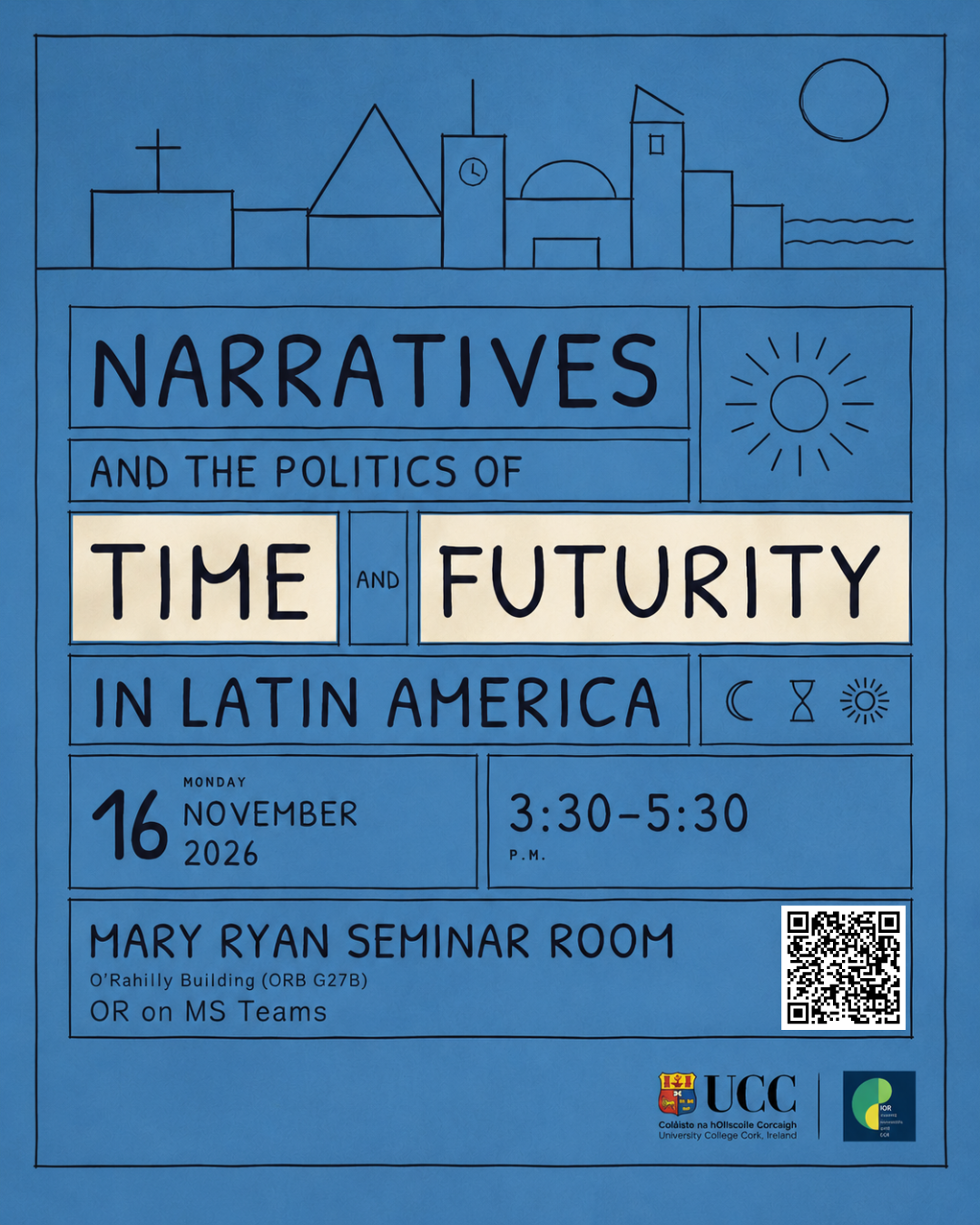
16th November 2026 – 15.30PM-17.30PM – Mary Ryan Room, O’Rahilly Building, UCC
Narratives and the Politics of Time and Futurity in Latin America
16th November 2026
15.30PM-17.30PM
Mary Ryan Room, O’Rahilly Building, UCC OR online on MS Teams (https://teams.microsoft.com/meet/3184362769609156?p=PYlT5MZaUPNrVMWCnv)
Seminar organisers: Helena Rezende Ramires, Leandro Wallace and Carlos Garrido Castellano.
This seminar analyses how contemporary literature in the American continent is being repurposed as a tool to design and materialise radical futures. Through four interrelated interventions, the event explores how recent fictional creativity engages with time and temporality; how toxicity alters the potential for storytelling; how videogame culture addresses and challenges coloniality; and how fiction problematises scientific discourses.
Nícollas Cayann (University of Tallinn) Imagining the South: Can there be a Gaucho without the Pampa?
Abstract: Regional Brazilian literature has been built upon 3 major aspects: the countryside man, the regional aspects of their speech and the environment in which they live. Southern Brazilian literature has historically constructed the Pampa as a geographical, symbolic, and cultural space which has been central to representations of the gaucho’s regional identity. This presentation examines the relationship between literary landscapes, cultural memory, and the construction of the gaucho as a regional figure. It further questions what happens to these imaginaries when the landscapes that sustain them are increasingly threatened by environmental degradation and climate change.
Bio: Nícollas Cayann holds a PhD in Comparative Literature. The researcher is currently a Marie Skłodowska-Curie Postdoctoral Fellow at Tallinn University, Estonia. His research works across Comparative Literature, Translation Studies, Visual Culture, Comics Studies, and Postcolonial Studies, with particular attention to the textual and visual representation of otherness. His current project, DEPICTNESS, investigates representations of otherness in illustrated narratives, while his research on Southern Brazilian literature explores the construction of regional identities through literary and visual representations of the gaúcho.
Carlos Garrido Castellano (University College Cork) Saturated Stories
Abstract: What does toxicity do to scale and calibration? How can scalar imagination help better understand a toxic planet? And finally, what happens with literature in a
toxic world? These are the key questions this presentation seeks to answer by looking at a recent example of Uruguayan fiction.
Bio: Carlos Garrido Castellano is Professor and head of the Department of Spanish, Portuguese and Latin American Studies in University College Cork. He is also Senior Associate Researcher at the Visual Identities in Art and Design (VIAD), University of Johannesburg. He is Principal Investigator of the IRC Laureate Consolidator Project “Assessing the Contemporary Art Novel in Spanish and Portuguese: Cultural Labour, Personal Identification and the Materialisation of Alternative Art Worlds (ARTFICTIONS). He is the author of Beyond Representation in Contemporary Caribbean Art (Rutgers University Press, 2019), Art Activism for an Anticolonial Future (SUNY Press, 2021), Literary Fictions of the Contemporary Art System (Routledge, 2023), Chorus: Sonic Politics of the Carnivalesque in Tragic Times (Liverpool University Press, 2026) and Scalar Imagination: Exercises in Coalescing and Rearranging the World in Latin American Fiction (forthcoming 2028).
Leandro Wallace. Playing ourselves: the colonial wound and videogames
Abstract: Past, present and future are intertwined in our cultural expressions as part of the colonial wound in Abya Yala. Part of these conversations involve understanding and exploring our own identity, crossed by the different effects that emerge from that colonial wound. Videogames have become part of these exchanges. Through its interactive characteristics, videogames can both share developers’ ideas but allow players to explore their own. This talk will discuss how past, present and future are negotiated in Zupay: Shadows of Independence, Gauchos Inmortales and The Swamp Daughter and what role the colonial would have as the shadow line connecting these different stories.
Bio: Leandro Wallace (él/he/him) has a doctorate from the Department of Critical Indigenous Studies Macquarie University, working across Critical Indigenous Studies, Gender and Queer Studies, History and Game Studies. His thesis, "Gaining Lives: queer Indigenous resistances in videogames", works on queer Indigenous practices to counter colonial influences in and around video games and screen media more generally, through a rights-based approach. He is a member of En-Gender! as editor, conference organizer and cohost and coproducer of the “EnGender Conversations” podcast; as well as several research groups based in public universities in Argentina.
Jade Arbo (University of Birmingham) Night Gardening: Narrating Modern Science and Its Repercussions in the Global South
Abstract: The achievements of modern science have consequences that are unevenly distributed across the planet. Focusing on the figure of the “night gardener” in Benjamin Labatut’s When We Cease to Understand the World, this presentation explores how narrative practices can trace these connections by attending to the small and particular, highlighting strategies of care and survival that resist the violence of progress and envision alternative ways of inhabiting a damaged world.
Bio: Jade Arbo is a postdoctoral researcher at the University of Birmingham, UK. She holds a PhD in Literature and a Master’s degree in Philosophy from the Federal University of Pelotas, Brazil. Her current project, Speculative Narratives for Climate Responsibility: Science Fiction as a Tool to Expand Ethical Horizons in Science and Sustainability, explores how speculative fiction can foster futures literacy, ethical deliberation and cross-disciplinary conversations about how to better inhabit our planet.
Department of Spanish, Portuguese and Latin American Studies
Contact us
First Floor - Block B East O'Rahilly Building University College Cork Ireland