Welcome to Ethics, Responsibility and Sustainability (ERS) at Cork University Business School
With a vision to "Shape Leaders for a Sustainable Future", CUBS is a leader in UCC’s continued efforts in embedding sustainability in our research, teaching and operations. Our school is committed to putting sustainability at the heart of what we do by advancing knowledge through cutting edge research and nurturing conscientious leaders who strive to build successful organisations that contribute individual, societal and environmental wellbeing.
About ERS at CUBS
CUBS are building on UCC’s reputation as a global leader, being the first University in the world to be awarded a Green Flag from the Foundation for Environmental Education and is the first university to achieve the milestone of five Green Flag awards. UCC has placed fourth in the UI Green Metric World University Rankings 2024, an international ranking of third-level institutions from around the globe. As a university we aim to achieve significant targets including becoming a zero-waste campus by 2030 and a carbon neutral campus by 2040.
PRMEis a key initiative for CUBS in furthering our ambition of embedding the principles of responsible leadership and sustainability increasingly at the heart of all that we do in our research, programmes and operations. The PRME Champions represent a group of dedicated business and management schools from across the PRME community that are committed to working collaboratively to develop and promote activities that address shared barriers for the PRME community, and which deliver value for business and society at large.
With a focus on innovation to deliver economic, societal, educational and entrepreneurial impact, CUBS faculty and researchers are engaged in high impact disciplinary and inter-disciplinary research collaborations and clusters within and across the school and internationally, investing in existing and new emerging areas where we have the potential to lead.
UCC Futures enables a dynamic enhancement of research, support of innovation and translation of research to tangible solutions to address emerging societal needs and global grand challenges. Our strategic research agenda in CUBS is directly aligned with UCC Futures’ aim to produce impactful research that will support our society to thrive and to secure a sustainable future for all.
Research Centres
TheCentre for Co-operative Studieshas carried out extensive research into agricultural, community, worker, housing and credit co-operatives and social enterprises. The Centre’s activities are focused on helping people identify their own problems and meet their own needs through co-operative, economic and social action.
TheCentre for Resilience and Business Continuitytakes a multi-disciplinary approach to resilience and business continuity planning through the application of best practice and academic research. Led by Dr Karen Neville, the centre coordinated the S-HELP project, a €3.5 million FP7-funded research project to develop to a suite of decision support tools and interoperability standards to aid coordination and control of major disasters across European borders.
TheCentre for Sustainable Livelihoodsaims to determine and address issues that impact on people's ability to maintain and sustain their livelihoods. A current project led by Dr. Stephen Onakuse, Sustainable Production and Consumption: The Influence of Social Norms (SPAC), presents an opportunity to understand the social norms or behavioural characteristics to responsible production and consumption in Ireland. The project findings will identify areas on attitude-behavioural gaps and targets to stimulate sustainable behavioural change for attention of policy makers and the public.
TheSpatial and Regional Economics Research Centreled by Prof. Frank Crowley and Prof. Justin Doran focuses the themes of spatial economic analysis, Spatial analysis of Innovation and Firm Growth, and City and Regional Economics. Research includes The Healthy Workplace Ireland: A Survey of Mental Health & Well-Being Promotion in Irish Firms, authored by Dr. Jane Bourke (UCC) Prof. Stephen Roper (Warwick Business School) and Niamh Lenihan (MTU & UCC), highlighting the challenges Irish employers face in relation to employee mental ill health and the organisational response to such challenges.
As part of theNational Forum on Research IntegrityUCC and CUBS are committed to ensuring the highest standards of integrity in all aspects of research, founded on basic principles of good research practice to be observed by all researchers and research organisations. OurCode of Research Conduct applies to all involved in research, both staff and students, with a positive research culture underpinning our research integrity and research excellence.
ERS in Education
ERS themes feature prominently in CUBS undergraduate and postgraduate learning outcomes with specific modules on ethics, sustainable business and responsible leadership. All of our undergraduate programmes have a compulsory requirement linked to the principles of ERS. Across our postgraduate portfolio, 96% of all programmes have a core module requirement embedded in the principles of ERS. New programmes including the MSc International Sustainable Business lead innovative offerings to equip our graduates to influence and lead sustainable global businesses.
A new CUBS wide programme-level outcome (PLO) of ‘Apply ethical and sustainability principles to address contemporary business issues’builds on existing ERS-aligned courses and is guided by the Principles for Responsible Management Education (PRME). This PLO ensures that all CUBS graduates will have a deep understanding of ERS and its applicability to our changing business world.
Connected Curriculum and Graduate Attributes
As part of our commitment to the PRME Charter, CUBS has undertaken a full review of all modules and programmes, mapping learning outcomes to the SDGs. Further embedding of the principles of ERS in our education has been enabled through mapping toUCC’s Connected Curriculumand the universityGraduate Attributes Programme.
Six components have been identified as comprising the Connected Curriculum at UCC, namely research-based teaching, employability, sustainability, inter- and transdisciplinarity, global reach, civic and community engagement. This priority seeks to surface good practice and provide inspiration and tools to support staff to integrate the distinct components of the Connected Curriculum framework in their teaching. The implementation of the Connected Curriculum at CUBS ensures that these connected experiences are articulated and visible in the course descriptions and learning outcomes.
The Graduate Attributes and Values Compass supports our students in considering their holistic development, through both the formal curriculum and the many ways that our student can grow and develop a range of skills, knowledge and abilities, that are applicable in a range of contexts in their lives.
Planet Module
CUBS’ commitment to embedding the principles of ERS in education also informs the wider UCC community as evidenced by the recent launch of a new module at CUBS, “Planet - Preparing Leaders for a Sustainable World”. Available to all UCC staff and students, the module was created to equip students with a high level of knowledge about environmental aspects of sustainability, complimenting the learning students undertake in their chosen programme of study. The module has been designed to provide students with an understanding of the main environmental challenges facing our planet and the key drivers behind them. As part of the learning outcomes, participants will recognise the impacts of our economic activities on our earth systems, natural environment, and human society, particularly the most vulnerable. With an opportunity to explore responses and solutions to mitigate and adapt to environmental and sustainability issues, students are encouraged to reflect on why sustainability in now a key risk and opportunity for business.
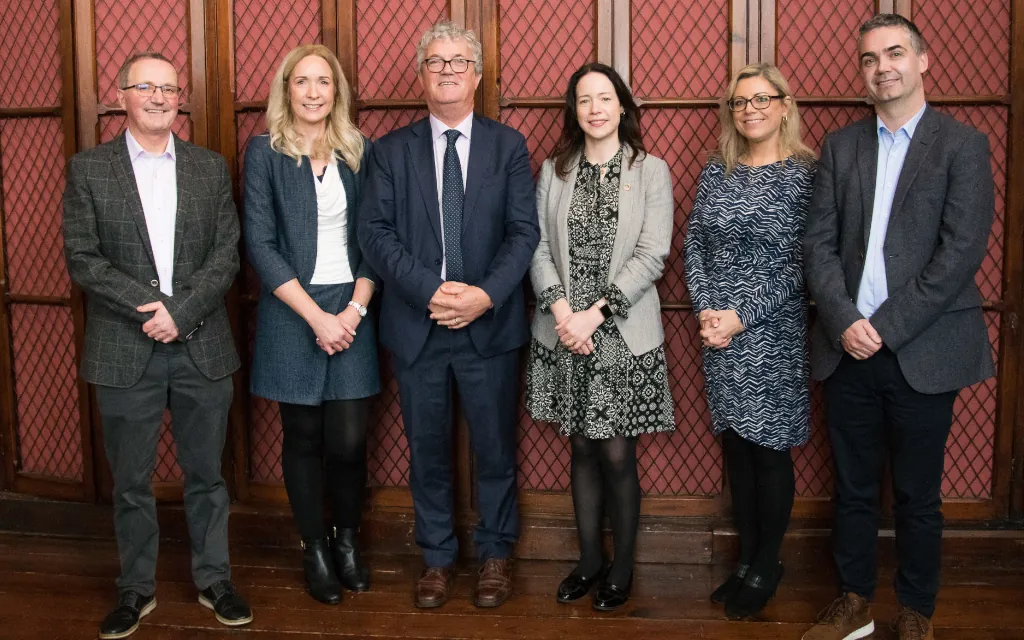
Launch of CUBS Planet Module: Dr Paul Bolger ERI, Prof Geraldine Ryan Vice Dean CUBS, Prof. John O'Halloran President, UCC, Tanya Fitzgerald, Enterprise Liaison Officer, Patricia O'Shaughnessy School Manager, CUBS, Prof Anthony McDonnell Dean of CUBS.
The MSc in Sustainable Development, Agri-Food and Co-operatives
The MSc in Sustainable Development, Agri-Food and Co-operatives is the only course of its kind in Ireland that fully integrates co-operative approaches into the study of sustainable development and agri-food. The course was recently recognised by The Education Awards 2024 where it was voted the 'Best Masters Programme' in Ireland. A unique course, with a very strong practical emphasis, students are equipped with the organisational and management skills needed to make innovative contributions to the development of local economies, with particular emphasis on co-operatives, social enterprises, and food businesses in Ireland and overseas. Aimed at graduates from a wide range of disciplines the programme enables students to secure exciting roles across sustainable development and agri-food, in areas such as ESG, green energy, logistics, project management, agri-advisory and consultancy and research.
ERS in Our Community
CUBS places Ethics, Responsibility, and Sustainability (ERS) at the heart of its operations and outreach. The page emphasizes the school’s commitment to fostering positive change within its internal community (staff and students) and its external community (local, national, and international organizations and charities). The initiatives aim to create an inclusive, sustainable, and socially responsible environment.
Core Principles
Community-Centric Approach: CUBS views its community as central to its mission, focusing on well-being, citizenship, and operational sustainability.
Policy Influence: Researchers at CUBS actively contribute to ERS policy development, collaborating with governments and policymakers to implement sustainable societal changes.
Commitment to Inclusion: The school strives to ensure that “no one is left behind,” promoting equality and empowerment.
Key Initiatives and Achievements
1. Athena SWAN Charter
Bronze Award Recipient: CUBS is a signatory to the Athena SWAN Charter, which promotes gender equality and inclusivity in higher education.
Goals:
Address unequal representation across the school.
Empower students and staff to reach their full potential.
Support progression into academic careers.
Create an inclusive working environment.
Identify areas for positive action and share best practices.
Enhance reputation locally, nationally, and internationally.
2. Pieta Amber Flag
Recognition for Mental Health Awareness: In June 2025, CUBS received the Pieta Amber Flag for promoting mental health and well-being.
Origins: Initially awarded to Business Information Systems (BIS) students in May 2022 for implementing mental health initiatives.
Amber Week 2025 Activities:
Fundraising for Pieta House.
Campus-wide events, including a Sunrise Sea Swim.
Impact: Raised €2,022 through community-driven efforts.
Innovation and Entrepreneurship: Workplace improvements.
Student’s Choice: Peer support.
Exceptional Journey: Overcoming personal challenges.
Notable Examples:
Neasa O’Sullivan (BSc Finance): Won Global Citizen category for creating social enterprises with environmental and societal benefits; represented Ireland at Enactus World Cup 2022.
Emma Coffey (BComm, 2023): Founder of FinalBend, a sustainable sportswear brand promoting eco-friendly practices.
4. Global Citizen Prize
International Recognition: Sophie Healy-Thow (BSc International Development, 2021) won a Global Citizen Prize for her work in food, agriculture, and nutrition.
Act4Food Initiative: Founded in 2021, this youth-led movement advocates for sustainable food systems from farm to table.
5. Entrepreneurship, Creativity & Innovation Summer School
Target Audience: Second-level students, including those from DEIS schools in disadvantaged communities.
Focus Areas: Business, entrepreneurship, marketing, innovation, leadership, and sustainability.
Impact: Prepares future leaders through multidisciplinary learning and HEA-funded programs.
Underlying Themes
Inclusivity and Diversity: Through Athena SWAN and student empowerment programs.
Mental Health and Well-being: Highlighted by the Pieta Amber Flag initiatives.
Sustainability and Social Impact: Evident in student projects, research, and global collaborations.
Leadership Development: Through recognition programs and summer schools.
Contact and Engagement
Location: Cork University Business School, O’Rahilly Building, University College Cork, Ireland.
Channels: Email: business-school@ucc.ie Social Media: Facebook, Instagram, YouTube, LinkedIn, TikTok.
PRME in CUBs
In line with wider sustainability objectives within UCC, CUBS joined PRME and the UK and Ireland Chapter in 2022. CUBS as a newly established business school seeks to become a leader not just in Ireland but also globally in the sustainability and responsible management education space. Since PRME membership the PRME Committee within CUBS has undertaken different projects to both promote and embed the principles of responsible management within the Business School. The PRME Committee is led by Dr. Karen Neville and includes academics from different departments within CUBS.
PRME Funding Awards
PRME membership opens funding opportunities and institutional collaboration. Since joining PRME, CUBS has been successful in receiving responsible management award funding. For instance, Dr. Karen Neville was successful in applying for a PRME Seed Grant for a project entitled “All Ireland Industry SDG Skills-based and Emerging Roles Assessment to Develop Responsible Business Leaders of the Future”. This seed grand allowed CUBS to undertake research in tracking the sustainability and responsible management skills the current graduates of the Business School will need for their future employment. This project allowed CUBS to develop an in-depth picture of how not just CUBS, but also other PRME members can map their educational offerings to industry needs.
PRME Competitions
To promote the principles of responsible management within CUBS, the PRME Committee is currently developing new teaching and student competitions. The PRME teaching award seeks to recognise innovative and ground-breaking teaching in the responsible management and sustainability space within CUBS. For students the PRME Committee is currently designing an award which recognizes student work examining responsible management and sustainability.
PRME in Action
CUBS active role as PRME member has been recognised by the institution receiving PRME Champion status in 2024. This Champion status was in part due to CUBS participating in an Early Adopters Project so that the new reporting requirements of the SIP Report could be tested before general application.
As a PRME member CUBS has not only hosted seminars and workshops internally for CUBS lecturers but also for other PRME members. These seminars and workshops have tackled such issues such as how best provide information under the new SIP Review platform and how to better embed responsible management within curricula
PRME and ERS
CUBS members of PRME dovetails with the wider work of the ERS Committee in promoting responsible management and sustainability within CUBS educational programs. The international reach of PRME and the relationships the PRME Committee within CUBS have developed with other institutions such as Queen’s University Belfast, should further buttress the work of the ERS Committee in respect of institutional collaboration and best practices.
ERS Committee
CUBS ERS Committee leads the school’s ERS ambition and promote a culture of learning, research and continuous improvement. Through our positive engagement with PRME and by aligning our practices with UCC’s Sustainability and Climate Action Plan 2023-2028 and the United Nations Sustainable Development Goals (SDGs), the ERS committee works to integrate these values into all aspects of the school's strategic priorities, ensuring that they shape decision-making, stakeholder engagement, and the long-term impact of CUBS on society and the environment.
You should be seeing some content in this space that is currently blocked due to cookie settings. Open the Cookie Management Tool to change your settings.