| Code | CK101 |
|---|---|
| Duration | 4 Years (Optional 3 Year Accelerated Route Available) |
| Teaching Mode | Full-time |
| Qualifications | BA (Hons) |
| NFQ Level | Level 8 |
| CAO Points | 2025: 300 |
| CAO Points Range | 2025: 300-613 |
Course Outline
The New BA (Hons) Arts: Global Experience, Employability, Unrestricted Choice.
The Bachelor of Arts (Hons) programme has been fundamentally reorganised to integrate global perspectives and professional experience into its core. Rooted in the Liberal Arts tradition, this four-year degree gives you the unprecedented freedom to shape your own career path and intellectual journey while guaranteeing you the essential skills, professional training and real-world experience needed for the 21st-century global marketplace.
As one of Ireland's largest and most diverse Arts degrees, the BA (Hons) Arts places innovative research at the heart of education and provides strong foundations for critical thinking, effective communication, and intellectual discovery.
Year One: Foundations for Flexible Learning
The first year is designed for broad discovery and essential skills development, ensuring every student graduates with both an informed academic perspective and tangible professional competencies.
Students take 20 general credits (10 core and 2 x 5 electives) and 40 subject-specific credits (4 x 10-credit subjects) as below.
|
Component |
Credits (Total: 60) |
|
|
Subject Exploration |
4 x 10 Credits (Student Choice) |
Your chance to explore your interests in-depth. Select four distinct subjects from our extensive list of 30 options. |
|
Introduction to the Arts and Social Science |
1 x 10 Credits (Core) |
A common intellectual framework for all Arts students, fostering critical thinking, academic writing, and research methods across the Humanities and Social Sciences. |
|
Skills and Discovery |
2 x 5 Credits (Student Choice) |
Develop highly sought-after professional skills. Choose modules focused on Digital Fluency, Employability and Professional Readiness, or interdisciplinary Idea Discovery outside of your core subjects. |
Your Subjects: A World of Choice
Draw your four subject choices from our extensive list of disciplines. You may choose any four subjects from the lists below.
- Archaeology
- Asian Studies
- Béaloideas
- Celtic Civilisation
- Chinese Studies
- Computer Science
- Digital Humanities
- Economics
- English
- European Studies
- Folklore
- French
- Gaeilge
- Geography
- German
- Greek
- Greek & Roman Civilisation
- History
- History of Art
- Italian
- Latin
- Mathematical Studies.
- Philosophy
- Politics
- Portuguese
- Religions & Global Diversity
- Sociology
- Spanish
- Studies in Music
- Studies in Psychology
Years Two, Three & Four: Global Immersion & Specialisation
After First Year, you pursue one of two focused pathways: Joint Honours or Thematic Major. During Years Two and Four, you will specialise in your chosen pathway, deepening your knowledge and skills,
- Pathway 1: Joint Honours: Develop deep expertise in two subjects, studied equally.
- Pathway 2: Thematic Major: Focus on an interdisciplinary thematic major, i.e. a selection of complementary modules clustered around a modern theme (e.g., Climate Action and Sustainable Development; The Arts, Creative Media and Society; Languages, Cultures, and Global Identities; International Relations and Diplomacy).
Year Three: Integrated Study & Experiential Learning
Students will maintain their academic specialisation for one semester while selecting of the following options for the other semester:
- Semester Abroad: study at a partner university across Europe (Erasmus+) or globally, broadening your academic perspective
- Work-Integrated Learning: Undertake a semester-long Work-Integrated Learning module or apply for a highly prestigious Research Internship, gaining vital industry connections and applying academic knowledge
- Discovery track: broaden your studies by taking 30 credits of modules from subjects either within or outside your specialisation.
To study abroad for the full academic year, you should apply for our Arts (International) programme.
Accelerated Three-Year Option
Students may opt to complete the degree in three years by foregoing the experiential learning component in Year Three. This is an accelerated route to completion.
Course Practicalities
Expected lecture hours: Normally lectures are scheduled Monday to Friday, 9am to 5pm. Each student’s timetable will differ depending on the subjects selected. In First Arts each subject entails three to four lectures per week plus a one-hour tutorial. Even though you will take only two subjects after Year 1, the workload is broadly similar. Each 5-credit module has about 24 one-hour lectures. Students take 60 credits worth of modules each year.
Expected lab/practical hours: Language subjects will have additional weekly language laboratories.
Field trips: Archaeology and Geography require students to attend field trips.
Why Choose This Course
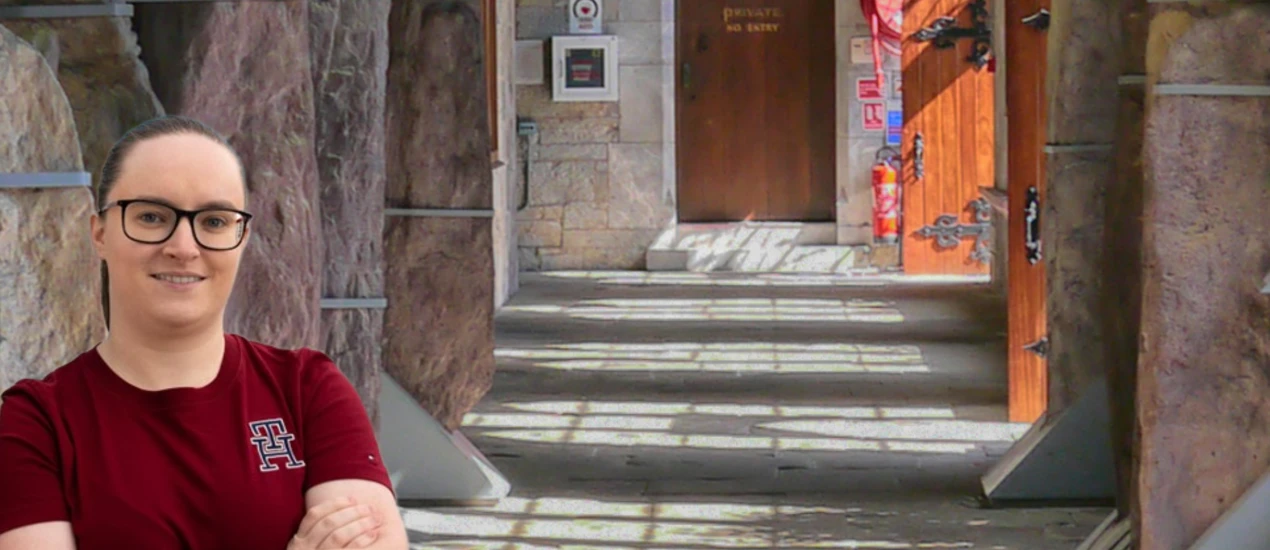
Being able to criticise is crucial in journalism. My English and French degree help me do that, they help me analyse the current situation.
Imasha Costa – BA (Hons) Arts (English and French)
Digital News Journalist, Irish Examiner
Find Out MoreYou can study multiple subjects and really discover who you are...
Judie Russell – BA (Hons) Arts (Economics and Sociology)
Video Strategist and founder of The Vidacademy
Find Out MoreI decided to go with Arts because there was more freedom and flexibility to create the path that I wanted.
Rosemarie O'Byrne – BA (Hons) Arts (History and English)
Current MA in English, Presenter and Producer La Vie en Rose, UCC 98.3FM
Find Out MoreI first became interested in planning as an undergraduate while studying geography in UCC
Pádraig O’Donoghue – BA (Hons) Arts
Assistant Planner, Kerry County Council
Find Out MoreConnected Curriculum
We encourage innovative teaching and learning practices at UCC. This learning approach reflects our commitment to the Connected Curriculum where we emphasise the connection between students, learning, research and leadership through our vision for a Connected University. Our staff are at the forefront of this integrative approach to learning and will support you in making meaningful connections within and between disciplines across the Arts programme.
Placement or Study Abroad Information
The College of Arts, Celtic Studies and Social Science (CACSSS) offers an optional Professional Work Experience module (PX3001). This is an accredited professional work experience module that allows CACSSS students to explore and develop their career interests.
Skills and Careers Information
As an Arts graduate, you will make significant contributions to our society, culture, and economy. The cultural and intellectual enrichment derived from the process of your learning will extend to your contributions, significant and subtle, to your future work environment, community and culture.
Aside from your subject knowledge and expertise, employers across a range of professions increasingly seek out individuals with a range of intellectual attributes such as the ability to:
- think critically and independently
- be creative and innovative
- problem solve
- contribute to cultural, economic, and social challenges
- conduct research
- communicate with a high level of intellectual fluency
Our graduates have pursued careers in a wide range of areas including:
- Archaeologist
- Arts Management
- Finance/Banking
- Information Sciences
- Interpreter
- Marketing and Management
- Public Affairs
- Publishing
- Researcher
- Teaching/Lecturing
- Theatre
- TV/Radio
UCC Employability Guide
Our UCC Employment and Employability Guide notes that University College Cork (UCC) graduates are highly sought-after by employers: 93% of our graduates are in employment or further studies within nine months of graduating.
Postgraduate Studies
Due to the extensive range of subject choices on offer, you will have vast opportunities for Postgraduate Study in UCC, Ireland, and Internationally. In UCC our graduates have gone on to postgraduate study in such areas as:
- MA Criminology
- MA Digital Arts and Humanities
- MSc Economics/Business
- PME Education
- MA Film & Screen Media
- MSc Computing Science
- MSc Management & Marketing
- MA Global Gallery Studies
- MA Translation Studies
Please see the CACSSS postgraduate page for more information on a vast array of postgraduate programmes, including CACSSS PhD options for graduates.
Requirements
Leaving Certificate Entry Requirements
At least six subjects must be presented. Minimum grade H5 in two subjects and minimum grade O6/H7 in four other subjects. English and Irish are requirements for all programmes unless the applicant is exempt from Irish. Applicants will need to meet the following minimum entry requirements:
| English | Irish | Other Language |
|---|---|---|
| O6/H7 | O6/H7 | O6/H7 |
Additional Requirements
There are further subject-specific requirements for subjects on offer through the BA in Arts. You can find out details on subject-specific entry requirements in the Academic Programme Catalogue.
EU/EFTA/UK Qualifications
EU/EFTA/UK applicants presenting an equivalent school-leaving qualification should review the EU/EFTA/UK Applicants page for information on equivalent grades and how to prove their level of English.
Mature Applicants
To compete through the mature entry route, you must be 23 years of age on or before 1 January of the application year and apply online via the CAO by 1 February. Your application should include a statement of interest.
You can find further information on applying as a mature student on the Mature Applicants and Mature Student Entry support pages.
QQI FET Entry
Applicants who meet the required level of distinctions in required subjects can apply for entry to this course using specific QQI FET qualifications. Please review the Programme Requirements on our Information for QQI FET Applicants page for information on related QQI courses, and visit Access UCC’s QQI/FET Entry section for further support.
Non-EU Applicants
Non-EU applicants are expected to have educational qualifications of a standard equivalent to the Irish Leaving Certificate. In addition, where such applicants are non-native speakers of the English language they must satisfy the university of their competency in the English language.
To verify if you meet the minimum academic and language requirements visit our qualification comparison page and refer to our International Office page for more information.
Fees and Costs
- Whether you are an EU or Non-EU student will affect the course fees applicable to you. See more information on EU Fees, Non-EU Fees, or Free Fees Status.
- The State will pay the tuition fees for EU students who are eligible under the Free Fees Scheme. The annual student contribution and capitation fees are payable by the student.
- See the Fee Schedule to find out the course fee.
- Check out scholarships that may be available to you.
- Explore our Nurturing Bright Futures free online course (Module 5) to learn about managing your money as a student and budgeting for university life.
How To Apply
Irish and European (EU/EFTA/UK) Applicants
Apply via the CAO. See the CAO Handbook for useful information on applying through the CAO.
Mature Applicants
Apply via the CAO by 1 February. To apply for a place as a mature student, you must be 23 years of age on or before 1 January of the year of entry.
QQI/FET Applicants
Apply via the CAO. See our QQI/FET Applicants page for information on the Quality and Qualifications Ireland (QQI) Further Education and Training (FET) application process and whether there are routes available to this course.
Non-EU Applicants
If you are from outside the EU/EFTA/UK, apply online via the UCC Apply portal. See our International Office page for more information.
For queries regarding course content or timetables please contact
College of Arts, Celtic Studies & Social Sciences
Coláiste na nEalaíon, an Léinn Cheiltigh agus na nEolaíochtaí Sóisialta
Contact us
College Office, Room G31 ,Ground Floor, Block B, O'Rahilly Building, UCC