Honorary Citation by Professor John Cryan for Professor Carmen Sandi
A Uachtarán na hOllscoile, a dhaoine uaisle agus a chairde go léir, President of UCC, Distinguished Guests, Ladies and Gentlemen and Graduate of the Class of 2025
“Courage is something that comes to us in the moment. It is bred of compassion.”
Those words from — Edna O’Brien one of Ireland’s great writers speak to the spirit of today’s honouree, Professor Carmen Sandi — a scientist and leader whose courage has always been joined with compassion, and whose pursuit of understanding has never lost sight of our shared humanity.
University College Cork is proud to honour a woman whose work has transformed how we think about stress, motivation, and resilience — and who, through her leadership and advocacy, has changed how we practise science itself.
Carmen was born in the town of Torrelavega near Santandar in northern Spain and she attended University in Salamanca where she got her Bsc and MSc in Psychology. Her PhD was at the renowned Cajal institute in Madrid which was followed by postdoctoral training in Bordeaux and the UK. For her first faculty position she returned to Madrid and then to Berne before joining École Polytechnique Fédérale de Lausanne (EPFL) in Lausanne in 2003 She has devoted her career to exploring how stress shapes the brain and behaviour — how experience leaves lasting imprints on who we are and how we relate to others.
In welcoming her to Cork, we also welcome her partner Heidi, her brother Angel and extended family and friends.
We also celebrate the enduring connections between Ireland and Spain — ties of learning and friendship that stretch back to the Irish Colleges of Salamanca and Santiago de Compostela, and live on today in the vibrant exchanges between UCC and Spanish universities. Her career, bridging cultures and disciplines, embodies that same spirit of collaboration and curiosity that links the harbours of Cork with the laboratories of Europe.
As Professor of Behavioural Neuroscience at the EPFL, and Head of its Laboratory of Behavioural Genetics, she has built an extraordinary programme of research that spans the biological, psychological, and social layers of human experience.
Her work has revealed how stress hormones and cellular metabolism influence memory, motivation, and trust — showing how adversity can both hinder and hone our capacity for growth.
Her recent groundbreaking discoveries on the role of mitochondria — the cell’s own engines — in shaping resilience have opened entirely new ways to understand and even strengthen our ability to cope with stress, revealing that the power to adapt and endure may quite literally be fuelled from within. From molecules to mindsets, her science brings new hope for mental health and new insight into the biology of resilience.
Professor Sandi’s research excellence has been recognised through an impressive list of national and international honours.
She received the first Ron de Kloet Prize for Stress Research (2018), the John Scott Lifetime Award for Aggression Research (2020), and the Distinguished Investigator Award from the Brain & Behavior Research Foundation (2024). Earlier in her career, she was awarded the Valkhof Chair at Radboud University (2015), served as a Distinguished Visiting Scientist at the Hungarian Academy of Sciences (2015), and spent a sabbatical year as Professor at Rockefeller University in New York (2016). And most recently, she has been honoured with both the ECNP Neuropsychopharmacology Award (2025) and the Chica and Heinz Schaller Foundation Award in Translational Neuroscience (2026) — two of the most prestigious international recognitions in her field.
Later this month she will travel to San Diego to receive the Mika Salpeter Lifetime Achievement Award from the Society for Neuroscience in the US for promoting the professional advancement of women in neuroscience.
Beyond her laboratory, Professor Sandi has shown the same brilliance in building communities of science. She is co-founder and co-president of the Global Stress and Resilience Network, connecting researchers across continents to explore how the mind withstands challenge. She was the founding Editor-in-Chief of Frontiers in Behavioral Neuroscience and continues to serve on the editorial boards of leading journals and on major institutional panels.
Her service has extended to international research leadership — as a member of the Wellcome Science Panel, and both panel leader and chair for the European Research Council Grants Panel. As Past-President of both the Federation of European Neuroscience Societies (FENS) and the European Brain and Behaviour Society (EBBS), she has been a tireless advocate for openness, collaboration, and scientific integrity.
Perhaps her biggest achievement was to rally neuroscientists to found the ALBA Network — an international alliance dedicated to promoting equity, diversity, and inclusion across the global brain research community. Alba is Spanish for “dawn,” evoking the beginning of a new day and a shift toward greater openness and fairness. The name reflects the network’s mission to usher in a new era in which talent can flourish without discrimination or exclusion. As founder, she has given voice and structure to a global movement for equity and diversity in the brain sciences — ensuring that opportunity is shared, and that leadership is rooted in fairness and empathy.
Her advocacy carries particular resonance, for her own career unfolded in a scientific world that did not always make space for women’s voices. With grace and perseverance, she forged a path through those barriers, turning challenge into change. And in doing so, she has helped many others to rise — not behind her, but alongside her — in the brightening dawn of a more inclusive scientific community.
Those who know her, like I have the privilege of, speak of her warmth, her integrity, and her quiet determination — qualities that have inspired generations of young scientists, especially women, to believe that excellence and kindness can, and must, coexist.
And so, as we celebrate her today, we might recall the words of her great scientific forebear, Santiago Ramón y Cajal, the father of modern neuroscience, who wrote:
“Any man (and I’ll add women) could, if he (or she) were so inclined, be the sculptor of his own brain.”
Through her science, her mentorship, and her example, Carmen Sandi has shown us that we can indeed sculpt our own minds — and our communities — through knowledge, compassion, and courage.
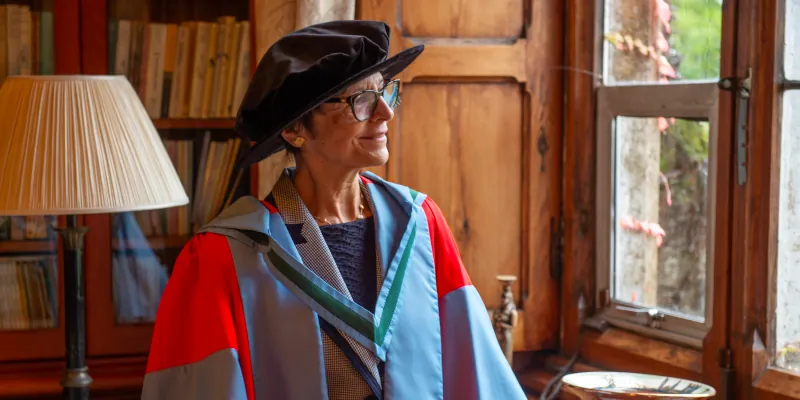
Carmen Sandi — pioneering neuroscientist, transformative leader, and advocate for diversity and inclusion — it is my great honour to invite you to receive the Degree of Doctor of Science.
Praehonorabilis Cancellarie, totaque Universitas, praesento vobis hanc meam filiam, quam scio tam moribus quam doctrina habiles et idoneas esse quae admittatur, honoris causa, ad gradum Gradus Doctoratus Scientiae; idque tibi fide mea testor ac spondeo, totique Academiae.