Honorary Citation by Professor Claire Connolly for Maureen McLane
A Uachtarán na hOllscoile, a dhaoine uaisle agus a mhuintir na hOllscoile
President of UCC, Distinguished Guests, colleagues, graduates
Maureen McLane hears voices and sees spirits in the air. Thanks to her poetry and prose, we too can share in her exceptional powers of sound and sight. And if that makes the work sound rather offputtingly grand, she also deploys a dizzingly diverse range of tonal registers and a deeply ironic sense of humour. Her voice has been described as landing ‘somewhere between teenage fangirl and Wordsworth professor’, which is a way of saying that Maureen’s McLane’s own vernacular and contemporary voice is inflected at every point by her ‘reading, teaching, writing and conversing about Anglophone poetries, 1750ish to now’ (her own, characteristically laconic, description).
Maureen avows that work of reading, teaching and conversing about poetry as Henry James Professor of English and American Letters at New York University. She is the author of 8 lauded collections of poetry in prestige outlets (Penguin in the UK and Ireland and FSG in the US,) 2 experimental creative-critical books 2 influential critical monographs that pioneered interdisciplinary research at the interface of literature, music and the life sciences (both from Cambridge UP) and countless essays and individual poems in notable locations including Granta, London Review of Books, the New Yorker, the Paris Review and PN Review.
With ancestors who hail from Wicklow and Dublin (and Irish cousins who we are pleased to welcome to UCC today), Maureen McLane was born and grew up in Minaro, a small village just outside Syracuse in upstate New York. She did her first degree at Harvard University before going on to a Rhodes scholarship and a second BA at Oxford. A PhD at the University of Chicago led her towards her first influential book, Romanticism and The Human Sciences: Poetry, Population and the Discourse of The Species. McLane’s wager in that book is that the human sciences – including moral philosophy, political economy and anthropology – enabled a new understanding of humans as a species and fuelled the imagination of the Romantic poets. Among other things, she gave us an unforgettable analysis of Frankenstein as a book that intervenes in what are still vital debates about the desirability of population growth.
Next came Balladeering, Minstrelsy and the Making of British Romantic Poetry, again published by Cambridge University Press. Not only did this book open up new understandings of ballads as media, it is perhaps also the place where we can see McLane’s distinctive interest in poetry as vocal practice start to take shape. She has been known to sing, hum and snap during presentations of this research and the book skips joyously between oral and written voices as between song and verse and romantic-era writers and the present.
While at graduate school in Chicago, at a moment when many of us find ourselves turning inwards towards our audience of professional peers (lots of people here on the platform can tell you about the perils of increasing specialisation) McLane turned emphatically outwards. She began to write essays and reviews for venues including the Chicago Tribune, The New York Times Book Review and the London Review of Books and in 2003 she was awarded the National Book Critics Circle Nona Balakian Award for Excellence in Book Reviewing.
In 2012 she unleashed a book upon the world with the deceptively simple title of My Poets. In My Poets, McLane gave us her Chaucer, her Shelley, her Emily Dickinson and so much more. The book made a dazzlingly original entry into a literary scene that, back then, still kept creative and critical writing in separate zones. Long before the ‘creative-critical’ thing took flight and before many academic writers felt free to use their full vocal range, Maureen McLane shows us how poetry insinuates its way into our understanding of – among other things – education, sexuality, marriage, terror and democracy.
In all of these works, as in her most recent and brilliant book, My Poetics, the lesson for the rest of us, applicable across media and perhaps already learned by all of you today graduating with Masters degrees in a range of creative and critical specialisms, is that if we want to write, we have to learn to read.
As we might expect from someone who has written eloquently about her own teachers and some formative classroom moments, McLane is a gifted educator. She reflects with winning humility on her own early adventures as a student and even, in a hilarious chapter from My Poets entitled My Impasses shares some of her earnest student annotations on various anthologies and handouts. In 2012 and 2021, she received a Golden Dozen Award, NYU College of Arts and Sciences’ prestigious recognition of excellence in teaching.
Interested in all the ways in which the self can be scripted in our culture – whether autofiction, bildungsroman or lyric – Maureen McLane draws fearlessly on different modalities of writing. She mixes q&as with lyric poems with critical commentary with urgent and insistent observations powered by remembered lines. Sometimes what we read might be non-fiction — it might even be non-poetry on occasion — but it is always burnished by a fiercely creative power and an utter commitment to the questing imagination.
Maureen McLane’s collection World Enough was chosen as Best Poetry Book of the Year by Paul Muldoon in the New Yorker in 2010 while some of America’s most celebrated and influential poets (Susan Howe, Charles Bernstein, August Kleinzahler) have sung her praises. Among the many rewards for this exceptional body of writing have been membership of the Harvard Society of Fellows and invited creative and critical residencies at the Max Planck Institute for the History of Science, Blue Mountain Center, Hedgebrook, MacDowell, the TS Eliot House, the Virginia Center for the Creative Arts and Yaddo. She was a National Book Critics Circle 2012 Finalist in Autobiography and was awarded a James Merrill House Fellowship in 2023. She has also been a finalist for the Publishing Triangle Audre Lorde Award for Lesbian Poetry.
As she continues to catch the notes of the poets that came before her on the air, Maureen McLane invites us all to take what the great — another great — American poet Walt Whitman calls ‘breaths of common air / draughts of water to drink’. Curious, conversable, convivial — with energies ranging from the everyday to the erotic — her writing is learned, funny, melancholy, argumentative, musical, queer, spirited, engaged and divagatory.
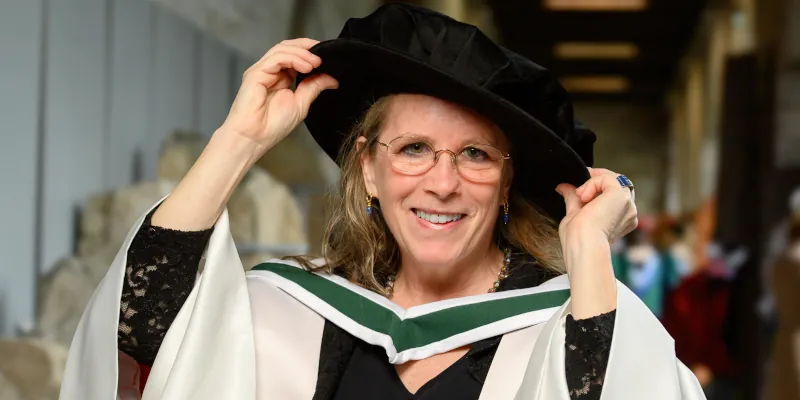
University College Cork is proud to honour an outstandingly accomplished writer whose words ring out across and brighten a transatlantic space too often now marked by darkness and difficulty. Maureen McLane — electrifying writer, transformative scholar — it is my great honour to invite you to receive the Degree of Doctor of Literature.
Praehonorabilis Cancellarie, totaque Universitas, praesento vobis hanc meam filiam, quam scio tam moribus quam doctrina habiles et idoneas esse quae admittatur, honoris causa, ad gradum Doctoratus in Litteris; idque tibi fide mea testor ac spondeo, totique Academiae