Honorary Citation by Dr Ailbhe Ni Ghearbhuigh and Dr Georgina Nugent for an tOllamh Eiléan Ní Chuilleanáin
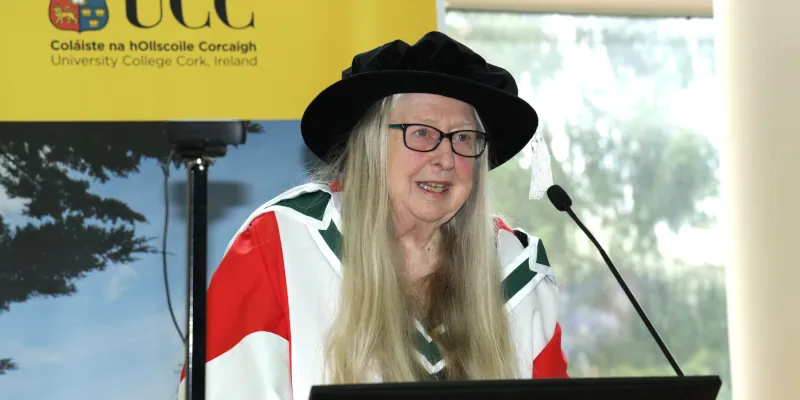
A Uachtaráin agus a chairde gaoil, Is mise Ailbhe Ní Ghearbhuigh agus is mór agam bheith anseo inniu chun an tOllamh Eiléan Ní Chuilleanáin, file, a chur in bhur láthair. Cúis bróid dúinn gur alumna de chuid Choláiste na hOllscoile Corcaigh í. Is féidir a ceangal leis an Ollscoil seo a rianadh siar go dtína hóige, nuair a bhí cónaí uirthi lena muintir i mBrú Uí Eoghanáin, an Honan Hostel. Ollamh le Gaeilge anseo ab ea a hathair, Cormac Ó Cuilleanáin, agus scríbhneoir ab ea a máthair, Eilís Dillon. Go deimhin, bhonn an Ollscoil céim dochtúireacht oinigh ar a máthair sa bhliain 1992.
Tá filíocht Ní Chuilleanáin lán de dhaonnacht, agus tá tar éis dul i bhfeidhm ar léitheoirí ar fud na cruinne. I mBéarla is mó a scríobhann sí, ach is duine ilteangach í a bhfuil meon iltíreach aici. Bíonn sí ag saibhriú na litríochta trína cuid aistriúcháin ón nGaeilge, ón Iodáilis, agus ón Rómáinise freisin. Comaoin eile atá curtha aici ar phobal na litríochta ná an iris, Cyphers, a bhunaigh sí i dteannta a céile ionúin, Macdara Woods, trócaire air, agus a ndlúthchairde Leland Bardwell agus Pearse Hutchinson, an ceathrar acu ar meitheal eagarthóireachta na hirise. Agus an iris ag druidim lena céadú heagrán, aithnímid obair mhór na hirise a thugann ardán do fhilí atá ag teacht chun cinn agus a chothaíonn caidreamh le seanfhondúirí an phinn a bhíonn ag saothrú leo i nGaeilge agus i mBéarla. Ba mhór an phribhléid agus an t-ardú meanman domsa dánta de mo chuid a fheiscint i gcló in Cyphers.
Agus an saol mór ina chíor thuathail mar atá, is géire fós an gá atá againn le filí de mhianach Ní Chuilleanáin, a mbíonn an léargas grinn agus comhbhá na daonnachta ag lonrú trí na dánta. Is beag duine againn a bhíonn i mbun na filíochta nach bhfuil faoi anáil Ní Chuilleanáin agus faoi gheasa ag a saothar. Samhlaíocht neamhchoitianta atá aici ina dtagann mistéireacha an tsaoil in uachtar agus ina sníotar gnéithe den stair náisiúnta agus de ghlórtha an tsinsir i dtaipéis ildaite an taibhrimh. Fágfaidh mé anois é faoi mo chomhghleacaí, an Dr Georgina Nugent, chun a thuilleadh cainte a dhéanamh uirthi.
[Georgina Nugent]
Ní Chuilleanáin’s childhood years on UCC campus continued into early adulthood. She graduated with a BA in English & History here at UCC, and later obtained a PhD from the University of Oxford. From there, Ní Chuilleanáin commenced her academic career at Trinity College Dublin where she lectured on Medieval and Renaissance Literature for forty-five years, until her retirement as a Professor in English in 2011. Elected a Fellow of the College in 1993, she also served as Head of the Department of English and Dean of the Faculty of Arts (Letters). A former colleague in the department once remarked to me, of Ní Chuilleanáin, that she was probably the sole person in the department capable of supervising a thesis on any topic from any period in literary history. I count myself extremely lucky to have spent the final year of my Bachelor’s Degree under her supervision while I was preparing my Bachelor’s thesis.
Hand in hand with this distinguished life of academic service, we also have her life as a poet, translator, and editor. Ní Chuilleanáin is one of the most distinguished, accomplished, and respected Irish poets of her generation.
She is the recipient of several of the most prestigious national and international honours in the field of letters – from the Patrick Kavanagh Award, the Irish Times Poetry Now Award and the Piggot Prize for Poetry, to major international awards such as the O’Shaughnessy Award of the Irish-American Cultural Institute, the 1573 International Poetry Prize, one of China’s highest literary honours, and Griffin International Poetry Prize, which is the world’s largest international prize for a single book of poetry written in English.
To date, she has published twelve collections of poetry, all with The Gallery Press. From 2016 to 2019, she served as Ireland Professor of Poetry. In May 2022 she was elected Saoi of Aosdána, the highest honour in Irish Arts. Ní Chuilleanáin is one of only four Cork natives to have ever been elected to this position. She is the only Cork woman to ever hold this position, and is one of only two UCC alumni to have ever been awarded this singular and rarely granted honour.
When I think of Ní Chuilleanáin’s work, I think of water. Of water. Of memory. Of mystery, history, religion, ritual, and time. Of the marginalised, the cloistered, the unseen, or rather, as is always the case, the unseen by some. The otherworldly and the real, the otherworldly in the real. “Jellyfish, broken shells”, the “tangle of nets, cork, bits of wood, coral” she writes in a poem from her first collection. “Here’s evidence: gather it all up.”
In its scope, in its depth and mutability, in its protean capacity to be both translucent and opaque, her work, like water, seek out gaps, cracks, and hidden alcoves. Like water her work tests out limits and borders, indeed takes particular pleasure in passing through borders and divisions, in mixing, in finding and exploring new psychological spaces. Her work is a testament to a lifelong fascination with the internal, with the internal workings of the mind.
Like all great literature, hers is a poetry that both requires and rewards rereading. Intellectually rigorous, her poems function on multiple levels. There’s the surface of the poem, the precision of the language, the mastery of the technique, and then its layered and unknowable depths. The mysteries of its centre. Her poems are often grounded in very real incidents: yet whether they be historical or personal, Ní Chuilleanáin’s poetry always zones in on moments of uncertainty. It evaluates and observes, without supplanting, displacing, or pronouncing judgement.
History and personal histories converge in her work; indeed her work serves as a reminder that history is made up of the convergence between acts and actors, big and small, between whispers and shadows, or as she puts it in the title poem of her first collection, “no unformed capricious cry/ can sound without its monument.” There is the act, and there is the monument to the act, or as is open the case, there is an absence of monument. There is an element to her poetry that cannot be explained, that draws our attention again and again to the unexplainable and the unknowable, and this is its true genius.
Of her work she has noted: “All of the poems that I write are specifically about this or that, but they are also about so many other things in the world.” Like the sweeping arc of a lighthouse and the moveable dark that surrounds it, her poems draw attention to the fact that in order for anything to be illuminated something else must be in darkness.
Her poetry walks us to the limits of knowledge, to the limits of language and draws our attention to that tenuous space where the known and the unknown dance. This requires great wisdom, but also great modesty. With that modesty has come a lifetime of service, collaboration, and deeply committed friendships conducted in and through poetry.
It’s a great honour for us to present Professor Eiléan Ní Chuilleanáin for the conferring of an honorary doctorate by University College Cork.