Beth Patterson - Musician
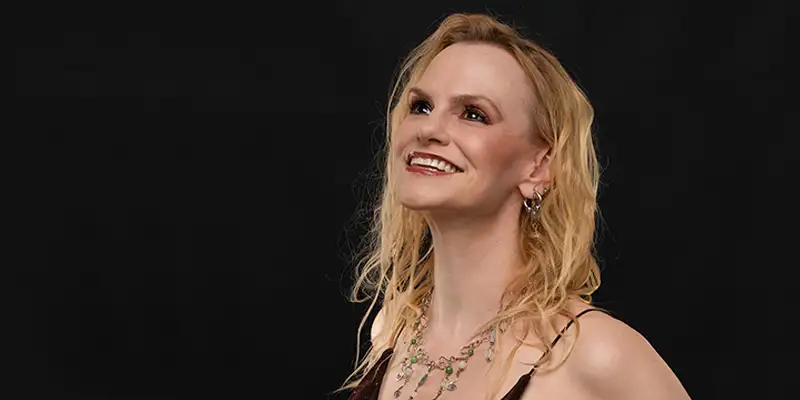
Beth Patterson has been a full-time musician for over three decades. First and foremost a bouzouki and bass player, she divides her time between New Orleans and the east coast of the States. She writes music in various styles, from the folk idiom to progressive rock. Patterson has appeared on over two hundred recordings, performed in over twenty countries, and doesn’t sleep much.
Can you share a bit about your musical journey? What led you from your early influences to becoming a distinctive Irish-folk artist?
My first real hunger to do more than just coexist with music began as a bass player in my teens. Most of us got our starts in heavy metal and I was no exception. Because I’m from Lafayette, Louisiana (the heart of Cajun country), I played bass in some Cajun bands and eventually branched out into the mandolin. My friend Mitch Reed, a legendary Cajun fiddler, turned me on to groups like Planxty, DeDannan and The Bothy Band, which made me want to become a bouzouki player.
I’ve now partnered with an extraordinary fiddler, Seán Heely. We sometimes play as a duo, but when we play with a full band, I alternate between bouzouki and electric bas, and I have to pull more things out of my musical toolbox that I’ve accumulated over the years. Sometimes the band helps me fit in more neatly, such as loping countermelodies around our guitarist’s chord patterns, or falling into various Latin rhythms that our drummer brings to the table. Sometimes I’ll pitch an old idea that I may have tried, tucked away and just held onto, like some sort of seed that hadn’t been ready for planting until then.
You’ve made a couple of contributions to the silver screen recently, one on-screen in Spinal Tap 2 and another through your music in Sinners. What was it like stepping into those projects?
Spinal Tap 2 was utterly mind-blowing because I’d loved the original since I was in my pre-teens. Of course, the sequel was going to be difficult to match the level of the first, simply because everyone knew it was a mockumentary! But somehow that legendary team did it. If there’s anything trad music life had taught me, it was to play it cool in front of people I admired.
Even still, having a pre-audition Zoom meeting with Christopher Guest put this to the test! For the audition, I called some friends in the New Orleans area who I’d worked with before, knowing how we gelled as players and people. There are few greater joys than being able to share this kind of experience with people you respect, love, and can laugh with, even under pressure. Rob Reiner was a lovely man who took the time to talk to each of us and asked us about our instruments. Then we got to watch his quick ideas in action as he fine-tuned the scene concept into the ten seconds you see in the film.
As far as Sinners went, I had no idea what was at stake (if you’ll pardon the pun). I’d gotten a vague email, then a follow-up call from someone in the film industry looking for an Irish accent coach. I knew I wasn’t the person for the job, so I recommended my good friend Tony Davoren. He had been part of Anúna during their time touring with Riverdance, and we often played next to each other at Willie Clancy Week. He’s a great bouzouki player, an astute human being and a limitless source of craic. Plus, I knew he had the skills to organize people, which is no small feat. When they contacted me again looking for a male Irish singer, I recommended him for that too. Next thing I knew, Tony was calling me about a choir he was assembling for a film with the working title Grilled Cheese. I got to reunite with about twenty friends the day of the recording. All we knew was that the film was about vampires and that we were supposed to be a bunch of Irish tenant farmers. About two months before the official release, it was renamed Sinners and there we were on the soundtrack singing The Rocky Road to Dublin. It was interesting that I’d lent my voice for the role of a monster and that the greatest monstrosity wasn’t vampirism.
St Patrick’s Day is a time when Irish culture is celebrated worldwide. What are some of your favourite memories from performing at it?
St Patrick’s Day is sometimes a mixed bag. Here in the States it can range from revelers who have no clue about Irish culture, to event organizers who put a lot of thought into Irish history and heritage and their significance in the fabric of our own land. Irish people certainly had quite an impact on the development of New Orleans, which is where I currently live. I can’t help chuckling at one particular memory of playing at an expat bar in Phnom Penh, Cambodia on St Patrick’s Day. The pub was called Paddy Rice and I was sorely disappointed that they didn’t have t-shirts for sale! There was a football game on, there was green beer and it could have been egregious, but the band and I just made our own craic. We amused ourselves with a lot of spontaneity and we jokingly invented a Cambodian-Louisiana genre we dubbed “Zydekhmer.” By the end of our slew of gigs, I felt like I’d known those lads forever.
How did your experience studying at UCC shape your musical identity?
Just the fact that I got to learn from Mícheál Ó Súilleabháin and Mel Mercier should tell you everything. It was truly a golden era. Their lectures turbocharged my inherent curiosity and opened my mind to the infinite possibilities of where this river of tradition might lead, both in Ireland and across the planet. As a foreigner, I had a lot of catching up to do, but they welcomed my different perspectives and even my quirks (I smoked a pipe back then, which they both found amusing). Getting to immerse myself in the traditional music festival Eigse na Laoi was also a game changer. Still almost intoxicated on Mícheál’s “how does this work?” mindset, I managed to take Brendan McGlinchey aside and ask him what his tune writing process was. So he demonstrated by writing a tune in front of me and years later, Seán and I recorded it on our duo album, Stir the Blood to Fire.
One of the class assignments was to interview whatever trad music mentor we’d had growing up, but I had no such person. I ended up getting Johnny Moynihan’s phone number in Galway (probably from bribing someone with too much cider!) and he agreed to let me interview him. His story was an absolute launchpad for the trajectory I wanted to take. I heard firsthand about a tradition that was still in the process of evolving and finding its own identity and how the Irish bouzouki was actually more or less one of Johnny’s professional regrets. On my spring break and subsequent weekends, I decided to follow his example of hitching around remote places, looking for tunes. It wasn’t the era of his youth, but it was still less risky than it would be today. This formula wasn’t without its caveats, which is how I ended up having to get from Doolin to Ennistymon on the back of a tractor.
I occasionally see influences of my time at UCC resurface: a trifecta of wanting to keep learning, processing it all and the byproduct of occasional absurdity.
Advancement Office
An Oifig Cothaithe
Contact us
Cork University Foundation is incorporated in Ireland as a limited liability company and a registered charity (CRN: 243605, RCN: 20033385, CHY11831). Room 2.12, Western Gateway Building, Western Road, Cork, T12 XF62