2 Planning for Implementation
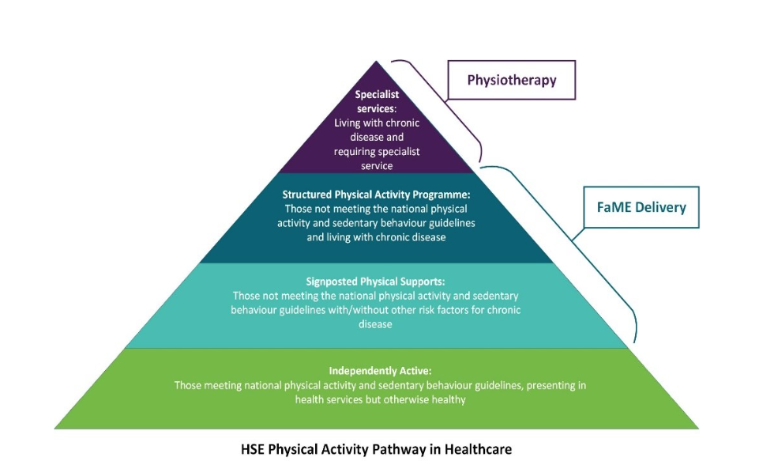
Once funding has been secured for FaME it is time to start planning implementation. FaME does take time to set up, and a FaME Gantt Chart which was developed for use in the UK is attached here. It provides an estimate of the time required to plan for and deliver FaME - the timelines are for illustration only but the stages of the Gantt chart are important to consider. FaME needs to sit within a referral pathway and so a diagram showing how it fits in with HSE falls and physical activity guidance is useful and provides context.
A key part of the planning, or business case process, is to develop a service specification. This should contain recommendations for data collection and quality assurance (QA) systems as previous research has shown that QA is an important part of quality delivery and continuous improvement. We have also included information about a logic model for falls exercise programmes which sets out what the programme aims to achieve and how.
We have also included below some of the key learning from the FaME Ireland study. These highlight some of the more common issues experienced when delivering FaME and suggests strategies to address these issues.
Finally, local providers are procured to deliver the programme locally; they may look different in each area. In the FaME Ireland study there were providers from the HSE working in collaboration with Local Sports Partnerships and community organisations. Therefore, we have included a diagram of an example delivery model with advice to support implementation.
2.1 Where does FaME fit within the falls and physical activity pathways?
The HSE CDLMS Falls Prevention Framework 2025 recommends that older adults at risk of falls should undertake a multicomponent (balance, functional, and resistance) exercise programme – such as FaME – to reduce falls risk. This recommendation aligns with the HSE Physical Activity Pathways in which structured community-based physical activity programmes should be prescribed to those requiring specialist support to manage chronic health issues such as falls.
In line with these HSE recommendations, the following diagram shows how older adults at risk of falls can be opportunistically identified and directed to FaME. This pathway is based on the World Guidelines for Falls Prevention and Management for Older Adults (aged 65 and older).
The purple boxes demonstrate how FaME can be incorporated into this pathway – either as a primary or secondary prevention strategy. The green boxes highlight the key opportunities within the pathway to identify those suitable for FaME. Suitability can be determined through using the three key questions recommended by the guidelines:
1) Have you fallen in the past year?
2) Do you feel unsteady when standing or walking?
3) Do you worry about falling? 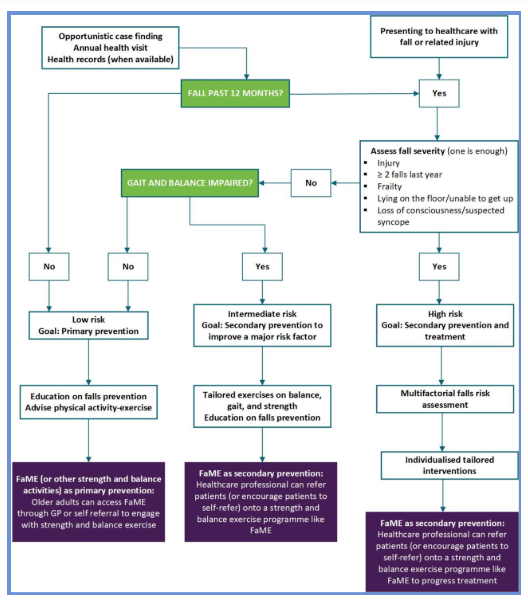
2.2 A service specification for FaME
A service specification should be developed to help support the adoption and planning of FaME within your local context. This document should provide service funders and managers with an overview of the service requirements that are essential to the implementation of FaME with fidelity.
2.3 A logic model for FaME
This logic model sets out the stages of change for the FaME programme. This model was developed based on the implementation studies of FaME across England and the UK.
'A logic model for the implementation of a falls management exercise programme'
2.4 FaME Ireland Study Findings: Tips for Programme Delivery
As part of the FaME Ireland study, we interviewed people taking part in FaME programmes. We asked them what they did and didn’t like about the classes, how they were organised and run, and what encouraged them to continue to attend. In addition, we also interviewed the people involved in the delivery and management of the same FaME programmes (PSIs, exercise professionals, HSE physiotherapists, HSE service managers) to understand how programmes were set-up and run locally and whether they experienced any challenges.
The following summarises the key learning from these interviews alongside previous learning from the original UK toolkit. This learning provides important advice for programme delivery. This is not a comprehensive delivery guide, but rather a highlight of some of the more common issues and more importantly, things that matter to the FaME clients.
Reach: How to identify people for FaME
Referral pathways
Within the FaME Ireland study sites, referrals were mainly made by HSE physiotherapists working within primary care. This meant that most clients attending FaME had a history or high risk of falls. Opening multiple referral pathways – such as self-referrals and GP referrals – can help to identify more clients who would benefit from FaME – particularly those who are not yet a high falls risk but would benefit from FaME to prevent future falls. Multiple referral pathways can also help to more accurately determine service demand. As part of the referral pathways, consider how you will identify both those at high and intermediate falls risks. Common referral pathways into FaME include GPs, community physiotherapists, and self-referrals.
Pre-FaME eligibility check
Screening assessment is important to ensure those referred to FaME are appropriate to attend. This was typically completed by HSE physiotherapists involved in FaME delivery. Exercise Instructors PSIs are trained to complete eligibility checks for any self-referral routes. Consider alternative exercise opportunities and/or referral routes back to physiotherapy if clients are not suitable for FaME.
If participants can self-refer, advertise widely: For self-referrals free papers, circulars, community newsletters and leaflets can be effective ways to advertise. Other methods that can reach potential clients include word of mouth (both friends and family), health care practitioner referrals, outside agency referrals and posters at class venues. Contact existing services, groups and associations to help to promote the classes/advertise.
Effectiveness: How to ensure that FaME is an exercise intervention that reduces falls rates, increases physical activity and social engagement.
Screening: The Right Exercise Programme at the Right Time
Firstly, potential clients need to be screened to make sure they are actually ready for FaME. The programme works best, and delivers the biggest health benefits, when participants are at the right starting point. If FaME looks a bit too demanding, especially for clients who are frailer or rely on a walking aid indoors, it’s better to direct them toward alternative evidence-based options like Otago. Once they build up their strength and graduate from Otago, they can be more prepared and ready for the challenging floorwork and endurance of FaME.
Proper triaging also gives Postural Stability Instructors (PSIs) the confidence to challenge clients safely with complex balance exercises and floorwork. Crucially, screening keeps ability levels consistent within each group. Even though FaME is designed for people at both intermediate and high risk of falls, mixing these tiers in a single class makes session management much harder. In fact, the FaME Ireland study showed that while there were no adverse events in the classes, the instructors felt delivering mixed-ability classes was more risky.
Links with local physiotherapy services: People with long-term conditions or higher levels of frailty.
Secondly, FaME classes do not have to be run, or linked with local HSE physiotherapy services. However, if they are not, consider carefully the eligibility of clients accepted into the class. The FaME Ireland study showed that exercise professionals greatly appreciated access to a local physiotherapist to troubleshoot issues such as comorbidities, ongoing medical conditions and floorwork.
If you plan to run classes without the link to local physiotherapy, consider choosing people who are concerned about falling, but who have not fallen, and who are confident to get down and up from a kneeling position. Having all clients at this level in the programme may help ease its delivery.
Adoption: How to get a FaME programme set-up
Securing funding
Securing funding is essential to the delivery of FaME. Within the FaME Ireland study, sites received funding directly from the HSE or through Local City Councils. At two sites, funding came through the HSE, and was given to either the Local Sports Partnership, or to a local voluntary agency to deliver the programme. At the third site, the local city council annually bid for funding to deliver the programme, and they were supported by HSE physiotherapy staff. Consider who will develop a business case to support funding application and who will fund FaME delivery. Where available, consider local organisations that can co-fund FaME delivery.
Highlight the need for FaME and the importance of falls prevention:
Service managers and leaders having an awareness of the need for FaME is crucial to adoption. Highlight the importance and possible unmet needs around falls prevention in your service. Advocacy is important and collaborating with others can help to share this message widely within your service – particularly those in falls coordinator roles (see Chapter 1 'Case Study: Advocating and coordinating falls services between sectors: Coordinator Role' to understand their impact on adoption and implementation).
Consider partnering with community organisations, councils and other partners to deliver FaME:
Community organisations and other partners such as Councils or Sports Partnerships can have a stronger understanding of the needs of the local community and can help establish local FaME programmes. Within the FaME Ireland study, all programmes were delivered through partnerships between community organisations and they were viewed as critical partners as without them FaME delivery would not be possible. These organisations can be commissioned by the HSE to employ PSI-trained instructors to deliver FaME at appropriate venues or partner in other ways. They may be well placed to also source and provide suitable venues, follow-on classes in a private or subsidised capacity, or signpost to other appropriate exercise classes after FaME, as well as develop service delivery agreements and coordinate on quality assurance.
Consider how FaME programmes can complement physiotherapy services:
FaME programmes are more likely to be supported when they have positive impacts on HSE service outcomes. This can include reducing physiotherapy waitlists and hospital admissions as a result of a fall and/or fracture. It is, therefore, important to consider how FaME can complement existing physiotherapy services for those at risk of falls. In addition to referring into FaME programmes, you should also consider those clients who need physiotherapy to continue in FaME classes can be referred back to physiotherapy for appropriate management.
Implementation: How to deliver FaME
How is the programme structured
In line with the research evidence, all FaME Ireland sites delivered FaME to groups, in-person, once a week for 24 weeks. Usual weekly group sizes ranged from 8-15 people. Several sites ran multiple groups – ones for clients with higher levels of physical ability and ones for clients with lower levels of physical ability. Consider delivering the programme on rolling basis so that the programme can consistently accept referrals for new clients – perhaps invite new clients every 6-8 weeks to help manage screening and baseline assessments in one group. This helps maximise the reach of the referral process and minimises waiting list time.
Who delivers the programme
As the newly-trained PSIs were becoming familiar with delivering FaME, the majority of sites within the FaME Ireland study delivered each session with 2 PSIs in attendance. For the first 6 weeks of the programme, these PSIs were typically physiotherapists employed by HSE. The final 18 weeks of the programme were typically delivered by exercise instructors. To ensure efficiency, consider strategies to support PSIs in delivering sessions individually and maximise the use of exercise instructors.
Possible strategies to support exercise instructors is ensuring a link back to physiotherapy services – either to refer clients that are no longer suitable for FaME (e.g. due to change in health status) or to receive advice on complex clients. Support strategies could include one peer quality assurance check per programme, or the opportunity to link in with a peer for trouble-shooting, or additional support for the floor work. Communities of Practice (see below) are also a great way of supporting newly-trained PSIs. For self-referrals routes, one PSI should be capable of delivering a class alone due to the typically higher ability of clients.
Always undertake detailed venue and class risk assessments
Undertake one risk assessment per venue. Each venue will have its specific hazards and considerations for this population group. Each venue should have its own risks identified and control measures in place encompassing: Access, lighting, temperature, floor surfaces, obstacles, distances to toilets, chairs available, emergency action procedures for venue known.
Consider the timing of sessions
Consider carefully the time of day and day of the week that sessions need to be scheduled. Avoid busy travel or usage periods, very early or very late classes, especially if it leads to travelling in the dark during winter months.
Review the location of the venue
Choose a venue that is easily accessible to participants, not on back streets or roads - these can present issues at different times of the year in snow/ice roads with poor access or lighting. Does it have an easy access car park or is it near bus routes?
Keep the programme schedules consistent
Where possible try to keep class schedules consistent throughout the complete programme. This includes keeping a consistent day/time and venue. Overall, this helps to promote class attendance and long-term adherence.
Try to avoid breaks in programme delivery
Where possible try to avoid any break in the programme delivery. The FaME Ireland study noted that this can lead to higher rates of participant client drop-out and deconditioning during the periods in which the classes are not running. If a PSI is unable to deliver a session, consider using appropriate cover. If no cover is available, then give clients instructions on the importance and how they can continue to exercise at home during the break.
Always check in before each session
Ask about participants’ health at the beginning of each session. It is crucial that PSIs ask clients about falls during the previous week, if they are feeling well today and about injuries and medications so that they can ensure the individuals are safe to exercise.
Constantly review class numbers and abilities
Keep services efficient. Observe/evaluate class numbers and instructor ratios/different abilities and consider the possibility of splitting the class if needed. To help tailor exercise prescription, consider grouping clients with higher/lower levels of ability. Where this is not possible, consider the use of support workers for mixed ability classes (explore necessary memoranda of understanding, as needed). For groups with higher levels of frailty, consider the appropriate group size to ensure adequate support is provided.
Be future proof
Consider what equipment is available to allow progression (weights, bands, steps etc) over time.
Monitor class attendance and seek feedback from participants that miss classes
Follow up non-attendance with a phone call to gather feedback from clients. Non‑attendance might be because of the venue. Supporting adherence is critical, one missed week can cause a spiral of demotivation resulting in dropout.
You may need a cover instructor but make sure to handover
In the event of a cover instructor, a verbal handover is essential in order for the usual PSI to explain the nuances of the group, component progressions and any essential tailoring for named individuals. Cover instructors are recommended to let the group know that they have ‘had a chat with their usual instructor’ (this promotes confidence) and in general to approach progressions with more caution. The cover instructor handover process should be detailed in usual operating procedures.
Make it social
The social element of the programme was highly valued and will require additional considerations such as tea making facilities or a cafe/coffee shop there or nearby. More information about the social element of FaME can be found in toolkit Section 3 – FaME Delivery.
Tailor the exercises to the clients, ensuring correct demonstrations and corrections and don't rush the pace of the class
Each individual within a group will need specific tailoring as identified during the baseline assessment and pre-session checks undertaken on the day. It is important to monitor band progression for all clients in order to assess whether they are making appropriate progress or could be challenged further. Nurturing confidence and tailoring for individual difference are critical skills of a PSI, and make FaME work. The pace of the session should be appropriate for the group and tailored for individuals, with changes made following observations of technique.
Warn clients that they may ache afterwards
Manage their expectations. Don’t assume that clients know that they will be sore or achy following the classes. It is important to give them as much information as to what to typically expect when they engage in this kind of muscle strengthening exercises.
Correct demonstrations are critical
Sensory impairments will be common in older people (some may have poor hearing or poor sight) so visual and non-verbal cues are required as part of effective teaching. Take time to ensure that the exercises are being carried out correctly and safely.
Don’t underestimate the importance of the relationship between the PSI and the programme user
This is so important and can often be the reason people keep attending!
Encourage programme clients to do exercises at home by setting weekly homework as part of session discussions: Home Is Where the Dose Is.
Instructors were often concerned about overloading participants with homework. Interestingly however, during the interviews, some instructors spoke of seeing the improvements in those that had done their home exercise and that this was an inspiration to others in the class. FaME clients said that they wanted homework because they could see improvements that people made when they did them. Ask clients each week “What was your win this week?” to encourage peer motivation and support.
Encourage clients to perform home exercises as part of their usual daily activities
Embedding exercises within usual activities helped clients to adopt these exercises as part of their daily routine. Examples of this included performing exercises while waiting for the kettle to boil or during television advert breaks. Use the motto “Home Is Where the Dose Is”.
Maintenance (programme): How to continue running FaME
Routinely collect data to evidence programme impact
Assessment of outcomes is important to demonstrate programme effectiveness, and having data which shows the impact of your FaME programme can help to support continuous funding. This data can include both the impact on clients and the wider services in which FaME programmes are embedded. Consider how assessments will be recorded and stored for analysis, and how you will incorporate these assessments within programme delivery following the assessment recommendations outlined in this toolkit.
Ensure sustainable career pathways for PSIs
As the delivery of FaME is dependent on trained PSIs, retaining these PSIs is critical to ensuring long-term delivery. Providing sustainable career pathways for PSIs – such as offering them permanent employment – helps to retain them within your service. Exercise instructor PSIs often have other exercise training qualifications (e.g. cardiac rehabilitation) alongside FaME, or can provide other suitable exercise programmes for older people before/after FaME.
Maintenance (clients): How to support clients to move on from FaME
As clients progress through FaME, it is important to consider appropriate exercise opportunities as they progress out of FaME and into other exercise programmes.
Identify appropriate exercise opportunities for progression after FaME:
In order to support clients to maintain improvements experienced during FaME, consider appropriate exercise opportunities that exist within the local community that clients can move on to after finishing the programme. Avoiding seated exercise programmes which lose the balance and floorwork gains made through FaME is vital. Consider what local community-based exercise opportunities exist in the area and whether they offer appropriate progression for clients. Importantly these opportunities should enable clients to progress their strength and balance. However, it is also important to consider the clients’ level of ability when recommending follow-on exercise opportunities – particularly when recommending exercise classes not run by falls specialists. Liaising with Local Sports Partnership, Siel Bleu, ExWell, or other community organisations can help source appropriate exercise opportunities.
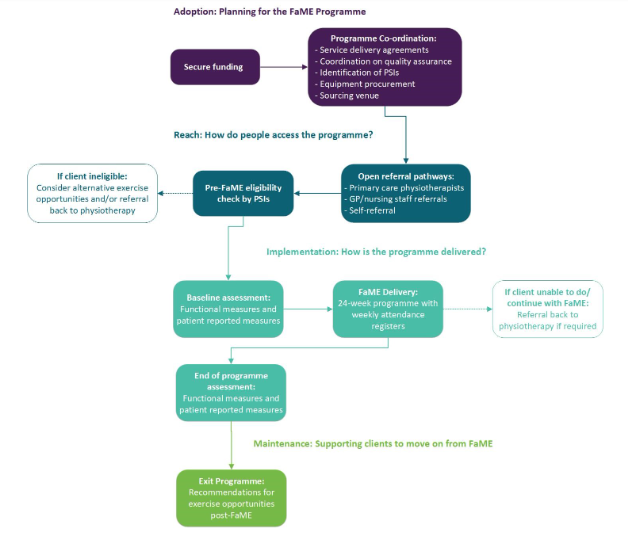
2.5 Example FaME Delivery Model
The following is an example model of how the FaME programme can be delivered. This model is based on the delivery approaches adopted by the three sites within the FaME Ireland study (Dublin, Kerry, Leitrim). Throughout the model, areas of good practice, issues arising from FaME delivery, and practical solutions to address these barriers are highlighted based on the learnings from the three sites.
Falls Management Exercise Programme: Ireland
Contact us
Discipline of Physiotherapy | UCC | Nano Nagle Place | Douglas Street | Cork T12 X7OA,