In This Section
The border in the office
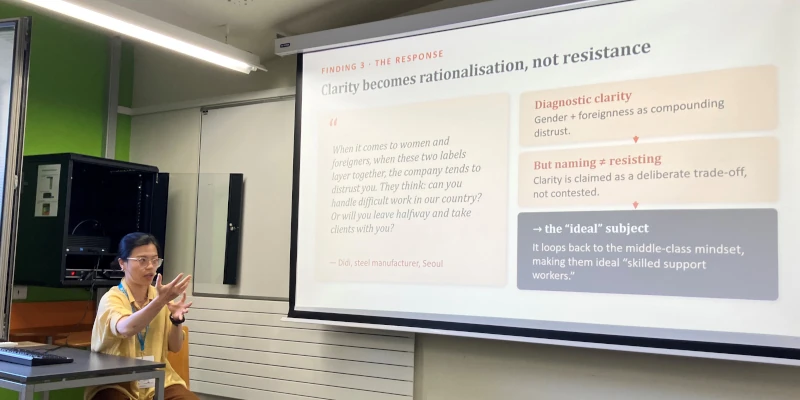
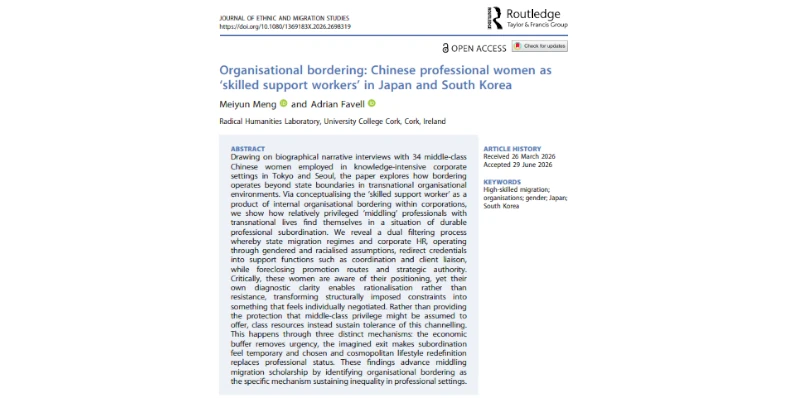
Dr Meiyun Meng, Postdoctoral Research Fellow on the MIGMOBS project at University College Cork, has published “Organisational bordering: Chinese professional women as ‘skilled support workers’ in Japan and South Korea”, co-authored with project PI Adrian Favell. It is the first major publication from the East Asian sub-project, Migration and Mobilities in East Asia: the Chinese in Japan and Korea, and a flagship output of MIGMOBS. The photo above shows Mei presenting the work at the annual IMISCOE conference in Girona, in July 2026.
 Bordering beyond the state
Migration research has long treated the border as something encountered at the airport, the consulate or the visa desk. This paper argues that for skilled migrants the more consequential border is often met much later, at work.
Drawing on fieldwork with Chinese women professionals in Japanese and South Korean firms, Meng and Favell develop the concept of the “skilled support worker”: a position produced not by any single gatekeeper but by internal organisational bordering. State migration regimes and corporate HR departments operate as a dual filter, working through gendered and racialised assumptions about who belongs where. Credentials that would elsewhere lead to strategic or managerial roles are quietly redirected into support functions (coordination, translation, client liaison), while promotion routes and decision-making authority are foreclosed.
The women in the study see this clearly. What the paper shows, strikingly, is that clarity does not produce revolt.
Why class privilege keeps the arrangement intact
The paper identifies three mechanisms through which class privilege sustains tolerance of this channelling:
The economic buffer — financial security removes the urgency that might otherwise force confrontation or exit.
The imagined exit — the belief that leaving is always available makes subordination feel temporary and voluntary.
Cosmopolitan lifestyle redefinition — the rewards of living an international life come to stand in for the professional status that has been withheld.
Together these help explain a puzzle at the heart of skilled migration: why highly qualified, highly aware people stay in roles that systematically under-use them.
From Singapore workshop to flagship output
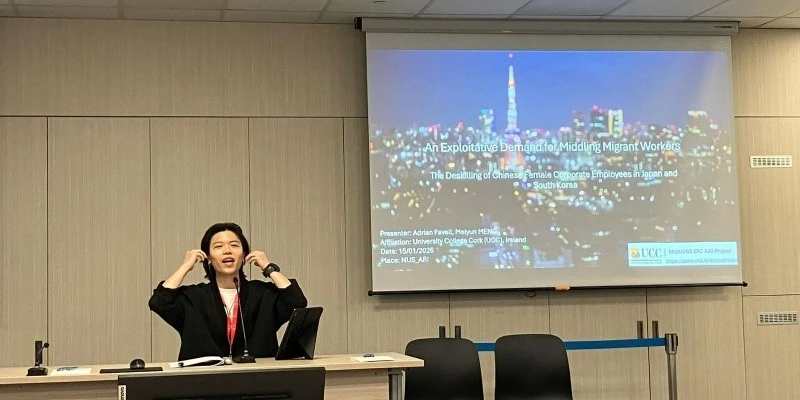
The paper grew out of a conference presentation at the workshop “New Dynamics in Asia’s Migration Regimes”, held on 15–16 January 2026 at the Asia Research Institute (ARI), National University of Singapore. It was an event that brought East Asian and European migration scholarship into direct conversation.
The research it draws on was made possible by the sustained support of MIGMOBS Co-PI Gracia Liu-Farrer (Waseda University), whose collaboration has been central to designing and implementing the East Asian sub-project on the ground in Japan and South Korea.
As the first of the sub-project’s main publications, this paper opens a line of work. Further outputs from the East Asian strand are already in preparation.
MIGMOBS ERC AdG Project 101097240
Contact us
Radical Humanities Laboratory, Wandesford Quay Research Facility, University College Cork, Republic of Ireland
- migmobs@ucc.ie
- Professor Adrian Favell, Project PI