In This Section
Bridging the East Asia-Europe Divide: Insights from the Singapore Workshop on Migration Regimes
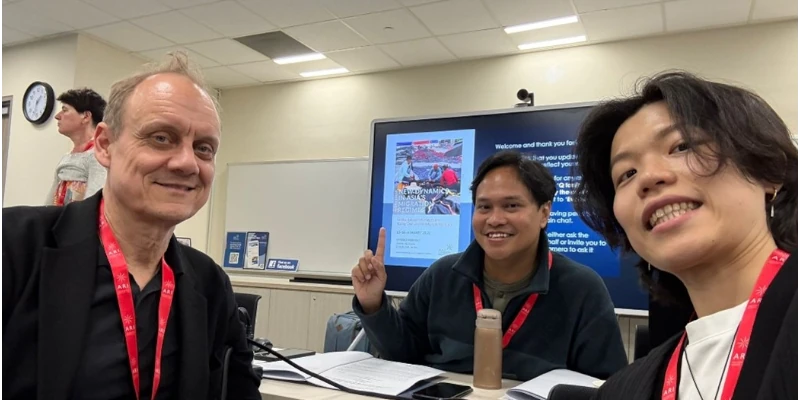
Building on our commitment to mapping the complexities of global mobility, our team recently participated in the workshop "New Dynamics in Asia's Migration Regimes" on 15-16 January 2026 at the Asia Research Institute (ARI), National University of Singapore. The event aims to understand how demographic shifts and acute labor shortages in Asia are reconfiguring the way states manage migrant labor.
By bringing together experts in sociology, geography, and political science from across East Asia, Southeast Asia, Europe, and North America, ARI fostered a rare level of cross-pollination. The workshop served as a site for high-level networking, where formal sessions transitioned into deep, informal intellectual exchanges. These interactions allowed the MIGMOBS team to place our specific case studies within a broader global context, forging connections with colleagues from multiple regions.
Here are some of the highlights from MIGMOBS team:
Rethinking "Skill" and the Pink-Collar Logic in Tokyo and Seoul
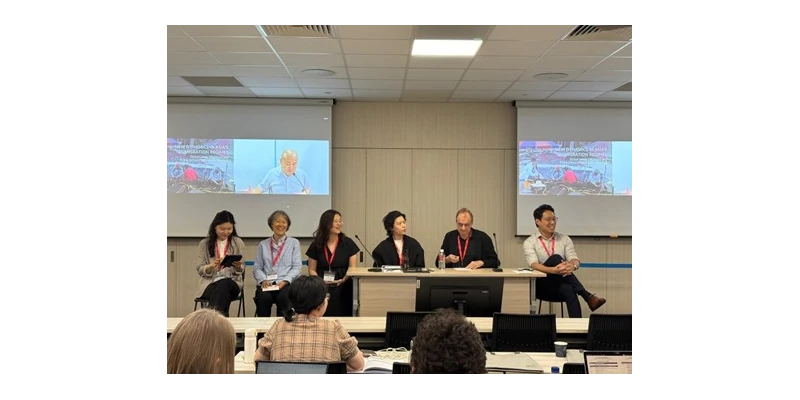
A central highlight of the workshop was the presentation by Dr. Meiyun Meng and Prof. Adrian Favell. Their paper is one of the many outputs of the East Asian sub-project of MIGMOBS: Migration and Mobilities in East Asia: The Chinese in Japan and Korea. Her talk explored how Chinese female corporate employees in Japan and South Korea experience systematic deskilling despite entering through "high skilled" migration categories. Drawing on interviews with 34 women in Tokyo and Seoul, she revealed how migration policies, employer practices, and gendered workplace norms interact to transform professionals (e.g. programmers, designers, medical graduates) into support workers with diminished authority. She demonstrated that this "pink-collar" logic extends into corporate domains, creating skilled support workers who perform technical tasks without corresponding creative or strategic roles, arguing that transnational labour markets exploit middling migrants through reclassification rather than integration. Following the presentation, Dr. Meng and Prof. Favell engaged in a lively discussion with attendees, addressing questions on the notion of 'de-skilling' and exploring how research on Chinese professionals reveals new racialized migration patterns compared to European and North American professionals in East Asia.
Japan’s SSW Scheme: Path-Dependency and Reconfiguration
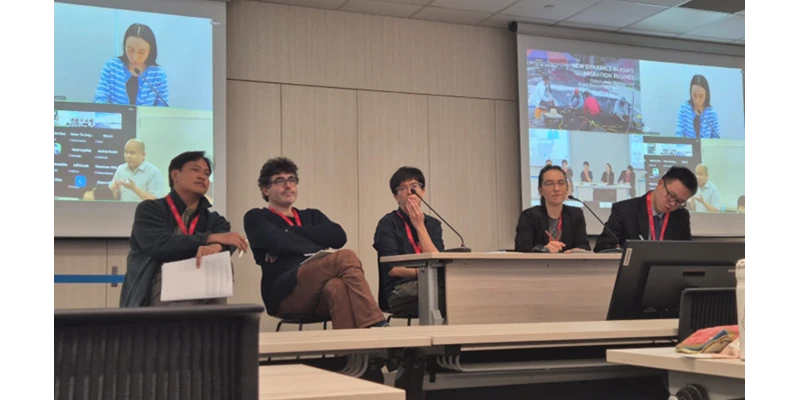
The focus then shifted to the structural mechanisms of recruitment. Pamungkas Dewanto, co-authoring with Gracia Liu-Farrer and Firman Budianto (Waseda University), examined the evolution of the Indonesia-Japan corridor following the introduction of the Specified Skilled Worker (SSW) scheme.
While the SSW was designed as a skill-based alternative to the older Technical Intern Training Program (TITP), their multi-sited qualitative fieldwork suggests that the transition is heavily path-dependent. Although the new scheme expands opportunities and leverages digital platforms, the findings indicate that access remains uneven. Resource-rich intermediaries and experienced migrants continue to benefit disproportionately, suggesting that the SSW represents a reconfiguration of Japan’s transnational labor market rather than a total rupture from previous inequalities.
The "Asian Migration Regime" in East Central Europe
Moving the lens toward a dramatic and under-researched development, Pamungkas Dewanto also presented a paper co-authored with Pal Nyiri and Andrew Lacisna regarding the massive flow of Asian labor into East Central Europe. In countries like Poland, Hungary, and Romania, hundreds of thousands of workers from South and Southeast Asia are now filling vital roles in factories, farms, and logistics.
The research suggests two provocative conclusions. First, the rise of contract labor in Eastern Europe may herald a shift toward an "Asian migration regime" in the West—one that prioritizes state-to-state mediation and agency control over individual integration. Second, despite the restrictive nature of these contracts, workers from the Philippines and Indonesia often perceive these European opportunities as an expansion of freedom compared to traditional destinations in the Gulf or East Asia.
The ARI workshop underscored that understanding modern migration requires a global, multi-sited approach. By bringing together scholars studying different "corridors"—from Indonesia-Japan to South Asia-Eastern Europe—the institute provided the infrastructure necessary to see these global patterns as interconnected. We are deeply grateful to Dr. Eva Samia Dinkelaker and Prof. Brenda S.A. Yeoh for convening such a productive and welcoming space. These connections will undoubtedly fuel our future research as we continue to track the "orders and borders" of global inequality.
MIGMOBS ERC AdG Project 101097240
Contact us
Radical Humanities Laboratory, Wandesford Quay Research Facility, University College Cork, Republic of Ireland
- migmobs@ucc.ie
- Professor Adrian Favell, Project PI