UCC researchers celebrate record-breaking Horizon Europe funding success
Researchers at University College Cork have secured €146m in Horizon Europe funding, exceeding the institutional Horizon Europe funding target two years ahead of schedule.
UCC’s Horizon Europe activity has increased steadily since the framework programme began in 2021, growing from an initial cluster of ERC frontier research awards into a broad and mature portfolio of multi-discipline, multi-partner projects. This further success demonstrates UCC’s commitment to European research excellence, securing over 200 funded projects across the Horizon Europe program, representing more than €146 million in secured grant funding across 2021–2026 (already 112% of institutional target by 2028).
In addition to the record funding, UCC is now ranked the number 1 third-level institution in Ireland for Horizon Europe Pillar II Cluster 1 – Health, and Pillar II Cluster 4 - Digital, Industry & Space.
This achievement reflects a truly collective endeavor, driven by the ambition, excellence and collaboration of UCC’s research community, and supported by dedicated research support teams across the University, and at our flagship Tyndall National Institute.
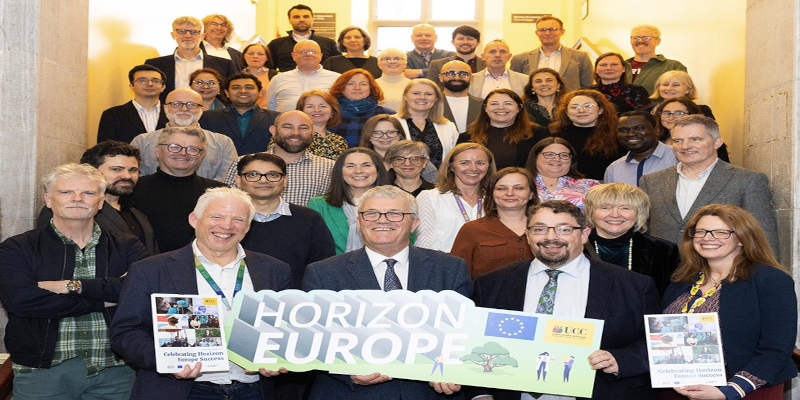
In recognition of this success, researchers and support staff gathered to celebrate this outstanding achievement at an event held in UCC on Thursday April 30th, in the presence of UCC President Professor John O’Halloran, and Vice-President for Research & Innovation, Professor John F. Cryan.
Key UCC Horizon Europe Facts and Figures:
- €146.4m - Funding secured
- 203 – Number of projects
- 77 – Projects coordinated by UCC researchers
- 1 – Ireland's top university for Research & Innovation Actions
- 20 – In the top 20 universities in Europe for Innovative Actions
Download Report: Celebrating Horizon Europe Success
Professor John F. Cryan, Vice President for Research & Innovation at UCC said: "UCC’s Engagement with Horizon Europe has been transformative, driven first and foremost by the ambition, excellence and collaborative endeavor of researchers across the university, whose work has strengthened UCC’s role within the European research and innovation landscape. Particularly notable is the contribution of our research institutes and centres, including our flagship Tyndall National Institute, who are leading the charge when it comes to securing Horizon Europe awards. This momentum is echoed across the university, with Horizon Europe success spanning all disciplines and areas of research."
-----------------------------------------------------
Here, two researchers at UCC give us their thoughts on their paths to Horizon Europe funding success.
- Dr. Fiona Devoy McAuliffe (FDMA), Senior Research Fellow, Offshore Renewable Energy, MaREI/Sustainability Institute.
- Professor Eugene Costello (EC), School of History and Radical Humanities Laboratory.
FDMA: "I joined UCC’s former Hydraulics and Maritime Research Centre in 2012 specifically to help prepare an FP7 proposal, LEANWIND, my first entry into EU funding. From the beginning, I benefitted from two exceptional mentors, Dr. Jimmy Murphy and Katie Lynch, whose networks opened the door to strong international partnerships."
EC: "My first real engagement with EU funding came through Horizon 2020, where after several attempts I secured an MSCA Individual Fellowship. The process was demanding, but it taught me to be exhaustive in preparation, an approach that proved essential when developing my ERC Consolidator Grant proposal in 2023–2025."
FDMA: "The biggest challenge is always securing the right partners, especially when competing with other consortia. Balancing expectations between new participants and experienced ones, and between academia and industry is equally important. Still, I have learned that most obstacles can be overcome by building goodwill and keeping the "human factor" in mind. For me, success has always come down to having strong partners, a clear concept, accessible writing, and sometimes just being in the right place at the right time."
EC: "Horizon Europe comes with highs and lows. Alongside the ERC success, I have also had a Cluster 2 proposal rejected and supported an MSCA Postdoctoral Fellowship application that was ultimately unsuccessful. These setbacks remind me that even experienced applicants face unpredictability. Getting the budget right takes time and careful planning."
FDMA: "Over time, I have found Horizon Europe applications increasingly structured and manageable. With a strong consortium and clear adherence to guidelines, the process becomes formulaic in a good way. What I enjoy most is collaborating internationally. EU projects create rich professional relationships that ultimately enhance the science. UCC’s budgeting support, reviews, and help with consortium agreements have also been invaluable. My advice to others is simple: explore the portal, identify what you can contribute, research the key players, and reach out. Opportunity often starts with a single email!"
EC: "My advice for anyone considering coordinating a Horizon Europe project: start early —ideally two years out, and read widely, including the work of critics and competitors. Solid preliminary research strengthens your case, ultimately you need to be 'bould' (in the Hiberno- English sense!), ambitious, unapologetic, and willing to stake out a confident position. Horizon Europe rewards big ideas, but only if you give yourself the time and space to develop them."
UCC’s EU Research Team and Research Support staff in UCC’s Colleges, Research Centres, and Tyndall National Institute are available to assist researchers in navigating the Horizon Europe funding landscape and apply for funding.
Useful Links:
Main Photo (Front Row L-R): Dr. David O'Connell, Director of Research Support and Policy; Professor John O'Halloran, UCC President; Professor John F. Cryan, UCC Vice President for Research & Innovation; Dr. Siobhán Cusack, Director of Research Strategy and Projects. Joining them are researchers from across the University who have been successful in receiving Horizon Europe funding. Image credit: Rubén Tapia (UCC Audiovisual Media Services).
Sustainability Institute
Contact us
Ellen Hutchins Building, 6 Lee Rd, Sunday's Well, Cork, T23 XE10 and Beaufort Building, Ringaskiddy, Cork, P43 C573,