In This Section
Unresolved: Negotiating complexities, contestations and inheritances after Apartheid
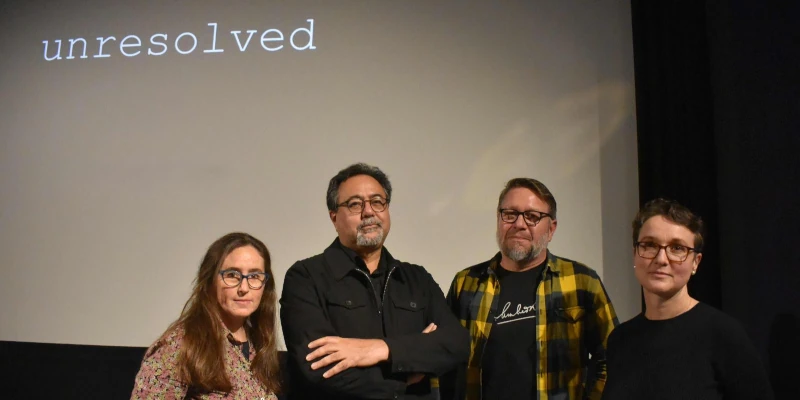
Film Screening and Discussion with Kylie Thomas, Brent Meistre, and Brandon Hamber at Queens University, Belfast
Unresolved: Negotiating complexities, contestations and inheritances after Apartheid
Brent Meistre will show a version of a safe house (2026), an autobiographical, experimental film exploring redacted traumatic witnessing of his childhood within a family closely intertwined with the local apartheid security police in Grahamstown (now Makhanda), conjured through objects, VHS films and music cassettes of 1980s.
Kylie Thomas will draw from her recently published book Afterimages of Apartheid (Routledge 2025), which considers the ways in which photographs can be used to contest impunity for state violence and includes chapters on the Sharpeville and Marikana massacres, on the re-opening of cases of human rights violations that remain unresolved in the aftermath of the South African Truth and Reconciliation Commission (TRC), and on contemporary protests against the post Apartheid state.
Framing the interaction will be Brandon Hamber, who has decades of experience of thinking South Africa from Northern Ireland, and reflecting on the conflict here through the lens of the South African transition.
The event is organised by Institute Fellow Professor Dina Zoe Belluigi, interested in the complications of injunctions to represent, felt by individuals and institutions in the arts and academia, in the aftermath of historic injustices and oppression.
The 24th of September is a national holiday intended to engender affirmative celebration of post-apartheid South Africa’s shared cultures and heritages, yet the wounds of the past remain. 2026 marks 50 years since 1976, the year of the Soweto Uprising and Massacre, when young Black South Africans who were protesting the weaponisation of formal education for oppression were killed by the police, many of them shot in the back as they tried to flee. 2026 also marks 30 years since the approval of the ‘new’ South African Constitution and since the beginning of the Truth and Reconciliation Commission hearings, which opened a space for the truth about the atrocities committed during Apartheid to be exposed. However, after the Commission drew to a close, much remained unknown and unresolved.
Set within the context of renewed attention to impunity and ongoing injustice in the light of the ‘unfinished business of the TRC’, this event contributes to raising questions about what visual representation, memory activism, and the arts can bring to what is unresolved.
Due to the limited capacity in the venue, please notify the organiser Professor Dina Belluigi by email at d.belluigi@qub.ac.uk should your intention to attend change.
This event is co-hosted by the Queen’s Institute for Peace, Security and Justice and the School of Social Work, Education and Social Sciences at Queen’s University.
For more on this story contact:
kthomas@ucc.ie
Radical Humanities Laboratory
Contact us
O'Rahilly Building (ORB) 2.20, University College Cork,,