

In This Section
Florence To gives talk for Digital Humanities and a Film Screening & Lecture Performance at Plugd
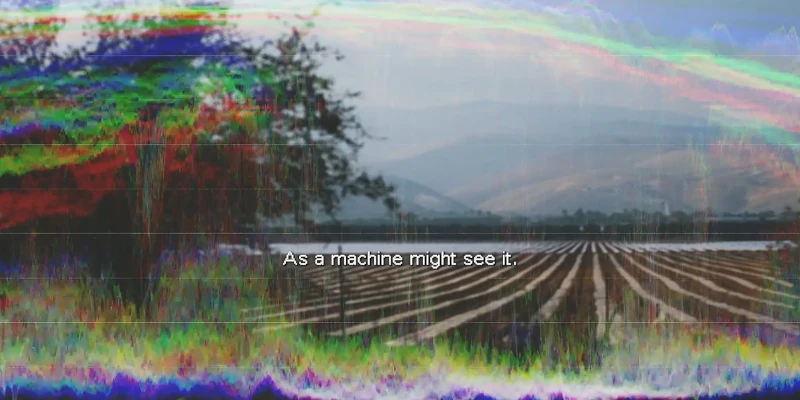
The Department of Digital Humanities presents: Invisible Signals: Semiotic Thresholds of Surveillance and Technological Infrastructure, with Florence To, Centre for Research Architecture, Goldsmiths University of London. The event takes place in the DH Learning Space, FSB 4.58 on Wednesday, October 28th at 12:30pm, in collaboration with the Radical Humanities Laboratory. On the evening of the 29th Florence will present a Film Screening & Lecture Performance: Ground Air Other Thresholds at Plugd.
What can technical instruments reveal about an environment, and what remains beyond their limits of detection?
Florence To will present their research into how environmental observations are collected, organised and interpreted through technological systems.
The discussion examines the methodological decisions involved in working with different forms of evidence, and how recordings, measurements and datasets can be brought into relation within a digital archive.
Particular attention is given to the treatment of missing information, inconsistent measurements and interrupted transmissions, and what these records reveal about the limitations of technical observation.
The research also considers how access to data, systems of classification and the design of digital interfaces influence what becomes visible, what remains uncertain and what can be made publicly accessible
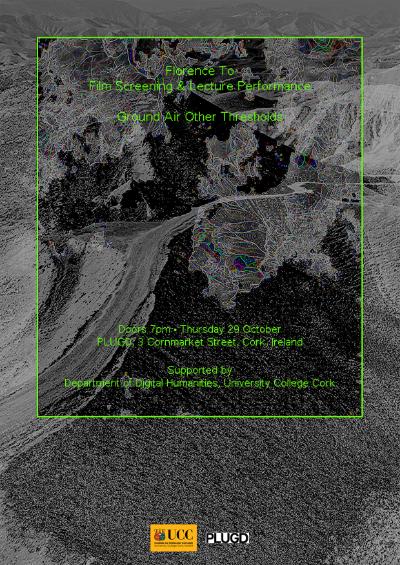
Film Screening & Lecture Performance: Ground Air Other Thresholds
Thursday 29th October| Doors 7pm | Plugd | 3 Cornmarket Street, Cork | Tickets €12 via Eventbrite
During fieldwork in Palestine, To followed birds at different altitudes, using their movements to investigate environmental conditions between ground and airspace. Exchanges with Palestinian ornithologists informed observations of flight, migration and the places birds inhabit. The film examines how machines translate wavelengths into images, measurements and data, connecting these investigations to To’s Spectrum Ecologies relations index. Field recordings, electromagnetic sensing, geophysical measurements and bird-tracking data expose differences between biological perception and the partial representations produced by technical instruments. The research also considers the politics of wildlife conservation, including classifications of native and invasive species, protected natural areas and their intersections with military infrastructures and territorial control under occupation.
The accompanying lecture performance takes place through Sonic Dispossession, To’s interactive map archive. As field recordings are played and their locations traced on screen, To will read selected passages from their book Other. Absence and Making Public, composing their spoken voice with sounds from the archive and accounts of the environments encountered during fieldwork.
Florence To is an artist, researcher and director of Hong Kong diasporic heritage, creating acoustic scenographies and audiovisual installations with an emphasis on architectural spatial design. They specialised in textiles and tailoring before combining this material knowledge with digital and computational technologies to create installations in abandoned and disused spaces. Working across different architectural environments led them to investigate how spatial arrangements and sensory conditions influence cognition, emotion and perception. Their practice draws on the physical properties of vibration, psychoacoustics and phonetics to investigate sound as a spatial and material relation. They have undertaken residencies and commissions with Berliner Festspiele, STRP Eindhoven, Mass MoCA in Massachusetts, EMPAC (Experimental Media and Performing Arts Center) in New York and the Spatialization and Auditory Display Environment (SpADE) in Limerick. Their work has also extended into neuroscience and photonics, including a Creative Fellowship with the Department of Clinical Neurosciences in Edinburgh and research with the Photonics group at the International Iberian Nanotechnology Laboratory in Portugal in 2019. The latter explored light detection, generation and manipulation, with particular attention to wavelength propagation and human visual perception.
During their time at the Centre for Research Architecture at Goldsmiths, University of London, To further developed their investigations into ecological relations and the infrastructures involved in observing, measuring and interpreting environments. Their research methodology draws on situated listening, field and geophysical recordings, electromagnetic sensing, moving image and bird-tracking data to examine relationships between human and nonhuman perception and technical forms of sensing. Following the movements of birds across different altitudes and sensory conditions, their research examines how ecological knowledge is produced within technological systems, and how interference, interrupted transmissions and absences expose the limitations of what instruments are able to detect and register.
Informed by visual and acoustic ecology and phenomenology, To approaches listening as a physical and spatial practice, attentive to how bodies, materials and technical instruments encounter the same environment differently. Their work moves between artistic disciplines and scientific methods, investigating the sensory relations that connect human experience with built and ecological environments.
For more on this story contact:
Radical Humanities Laboratory
Contact us
O'Rahilly Building (ORB) 2.20, University College Cork,,