

News and media
Call for official, voluntary Certificate of Pregnancy Loss under 23 weeks to be introduced in Ireland
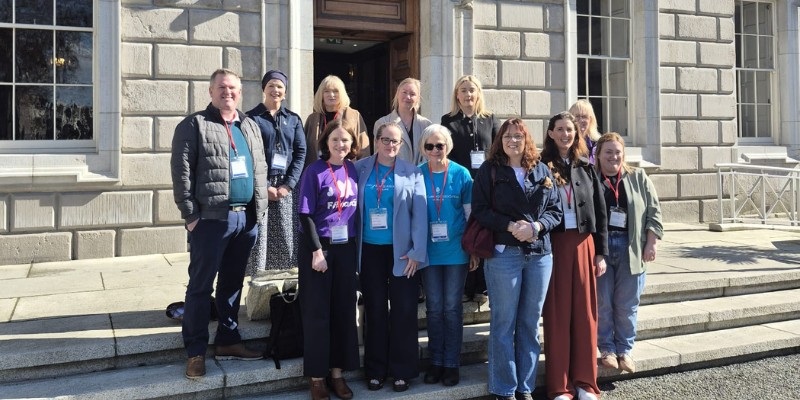
Representatives from the Pregnancy Loss Research Group, Féileacáin and the Miscarriage Association of Ireland attended and presented at an Oireachtas Briefing on introducing a Certificate of Pregnancy Loss in Ireland on Wednesday 25 March.
Hosted by the Cross-Party Oireachtas Group on Pregnancy and Infant Loss, the briefing focused on the need for, and significance of, an official certificate to acknowledge pregnancy loss under 23 weeks.
In the first presentation of the session, Professor Keelin O’Donoghue spoke about the importance of acknowledgement of pregnancy loss, the desire for formal recognition, and an official record. She cautioned that while this matters for many, there is general agreement that participation in such schemes should be voluntary, as people have different preferences and experiences. Professor O’Donoghue outlined key characteristics of schemes that have been introduced in other countries, including England, Scotland and Australia: they are voluntary, certificates/entries have no legal status and there is no charge for the original certificate. Discussions with colleagues involved in the development of The Memorial Book of Pregnancy and Baby Loss Prior to 24 Weeks in Scotland, including NHS Scotland and Held in Our Hearts, highlighted the importance of involving people with lived experience in development – in particular to ensure that wording was inclusive, and continued communications and awareness-raising activities to maximise uptake of the Scheme. In England, the Baby Loss Certificate Scheme was introduced in February 2024 and, by April 2025, over 100,000 certificates had been issued. Professor O’Donoghue also provided a brief overview of the development of the Baby Loss Certificate Scheme in Northern Ireland, which will be launched this year. In a public consultation held by the Department of Finance, 95% of respondents felt that the Scheme should be open to any form of early pregnancy loss, regardless of how long ago it occurred, and 95% felt that the first copy should be free to applicants. There was also a strong desire for the certificate to have an official appearance (similar to a birth certificate) with high-quality paper and formal layout.
She cautioned policymakers about the need to mitigate any unintended consequences in developing and implementing any scheme – such as assuming pregnancy loss has the same meaning for everyone, making certification mandatory, forcing disclosure of pregnancy, or requiring medical certification. She emphasised that recognition of pregnancy loss in the form of an official certification scheme was not the same as legal status and that the value assigned to a pregnancy is personal and different for everyone. She called on Government and officials to work with experts by experience, support organisations, maternity hospitals/units and the National Women and Infants Health Programme’s Advisory Group for the National Standards for Bereavement Care following Pregnancy Loss and Perinatal Death.
Professor O’Donoghue concluded her talk by highlighting how acknowledging and counting pregnancy loss under 23 weeks through a national registration and certification system was an important step in better supporting people who experience pregnancy loss. She noted that it is just one of a series of actions being championed by the PLRG and the Cross-Party Oireachtas Group, others being better supporting workers who experience pregnancy loss under 23 weeks (through statutory leave and implementing findings from the PLACES project) and implementing a model of miscarriage and recurrent miscarriage care based on findings from the Health Research Board (HRB)-funded RE:CURRENT project.
Nina Doyle, Regional Coordinator of Féileacáin and Mam to Liam and Grace highlighted that unlike stillbirth, there is no official birth or death certificate for losses that occur before the viability threshold (that is 23 weeks or a weight of 400g or more), which can be deeply distressing for parents and feel like a secondary trauma. She stated that second trimester loss is not rare: While the specific number of second trimester losses that occur each year is unknown, as they are not officially recorded, Féileacáin gifts approximately 500 second trimester memory boxes to parents annually. Nina also provided powerful testimony from bereaved parents, including Caroline (Mam to Stephen) and Sarah and Davy (James and Max’s Parents), of the impact of the lack of official recognition of babies that did not meet the threshold for a stillbirth certificate. She concluded by stating that while a voluntary certificate would cost the State very little, it would serve as an official record and acknowledgement of loss for grieving parents and families and for future generations.
Speaking on behalf of the Miscarriage Association of Ireland, Niall Moriarty also emphasised the importance of acknowledgement and validation of people’s experiences. He highlighted that while the Association’s own Book of Remembrance — now on volume 7 — holds much meaning to those who make entries into it, it is an unofficial commemorative register: An official Pregnancy Loss Certificate, recognised by the State, is needed to give the acknowledgement and validation that the loss is real, and it matters.
Finally, Deputy Shónagh Ní Raghallaigh, spoke about the development of The Baby Loss Certificate Scheme in Northern Ireland on behalf of Jemma Dolan MLA.
Many thanks to Senator Nicole Ryan and Senator Linda Nelson Murray for organising the briefing, to Senator Evanne Ní Chuilinn for chairing the session, and to all those in attendance, including members of the Oireachtas, Government Department officials.
Photo Gallery
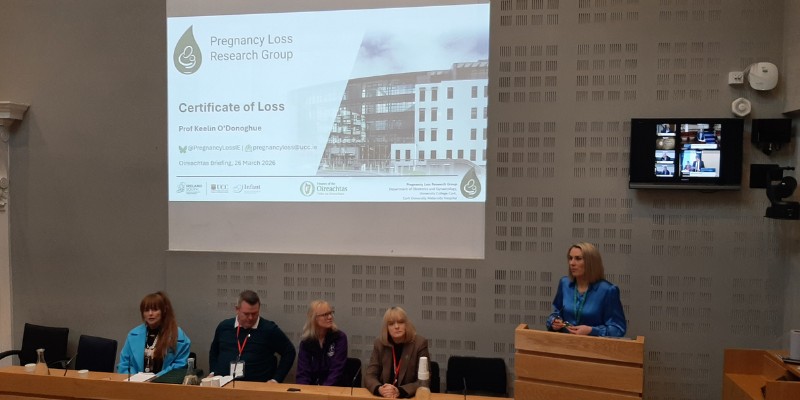
Senator Evanne Ní Chuilinn opening the session, with panel members (L-R): Shónagh Ní Raghallaigh TD, Niall Moriarty, Nina Doyle, Professor Keelin O’Donoghue
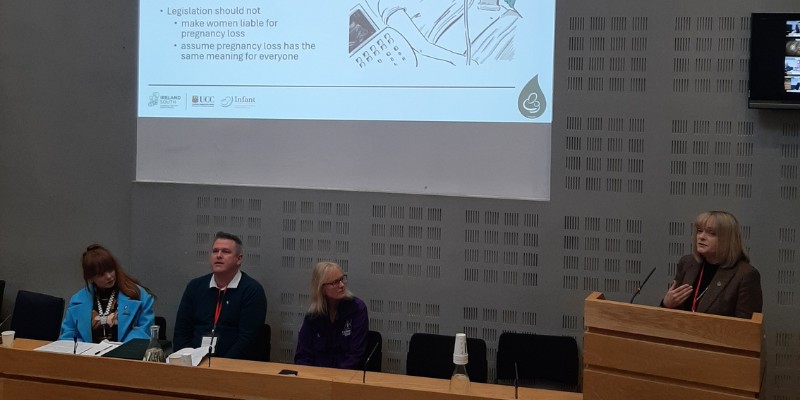
Professor Keelin O’Donoghue, Pregnancy Loss Research Group
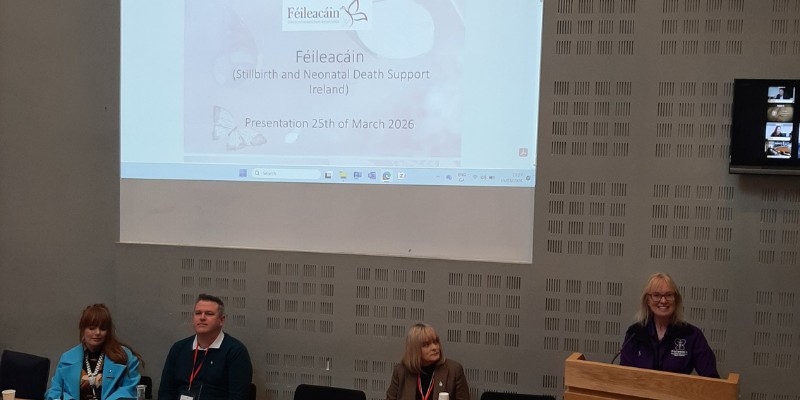
Nina Doyle, Féileacáin
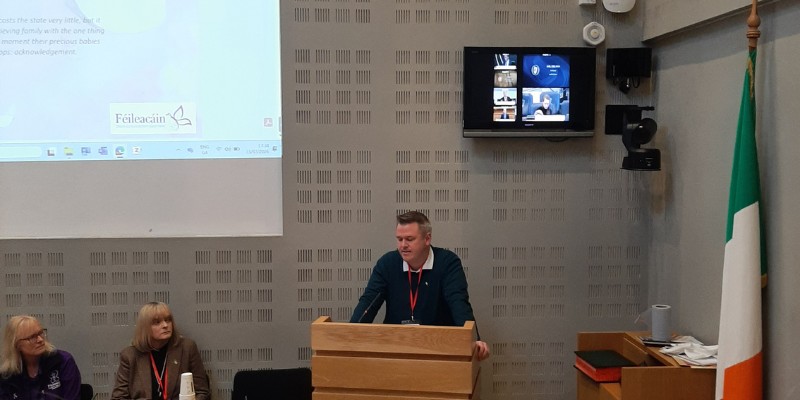
Niall Moriarty, Miscarriage Association of Ireland
More information
The Oireachtas Cross-Party Group on Pregnancy and Infant Loss is an informal interest group which aims to ensure that pregnancy and infant loss is central to Government policy in Ireland, by raising awareness, and informing action. It was established in June 2025 by Senator Nicole Ryan (Chair). The Pregnancy Loss Research Group and Féileacáin are Expert Advisors to the Group.
The Pregnancy Loss Research Group leads national research to better understand pregnancy loss experiences and impacts, and the development of resources and evidence-based advice and interventions, to improve health care and health and social outcomes for women, babies, families and communities. This includes all types of pregnancy and infant loss, including first trimester miscarriage, second trimester miscarriage, ectopic pregnancy, molar pregnancy, multiple pregnancy complications, stillbirth, termination of pregnancy, neonatal death and pregnancy after loss. Website: www.ucc.ie/pregnancyloss
Féileacáin was formed by a group of bereaved parents to offer support to anyone affected by the death of a baby around the time of birth, and the organisation is now the national charity supporting families affected by perinatal loss. Website: www.feileacain.ie
The Miscarriage Association of Ireland is a registered charity set up by and run with the support of women and men who themselves have experienced the loss of a baby through miscarriage. Website: www.miscarriage.ie
For more information about all forms of pregnancy and infant loss, including details of support organisations, see the Pregnancy and Infant Loss Ireland Website: www.pregnancyandinfantloss.ie