In This Section
UCC Professor Séamus Davis awarded prestigious Faraday Prize
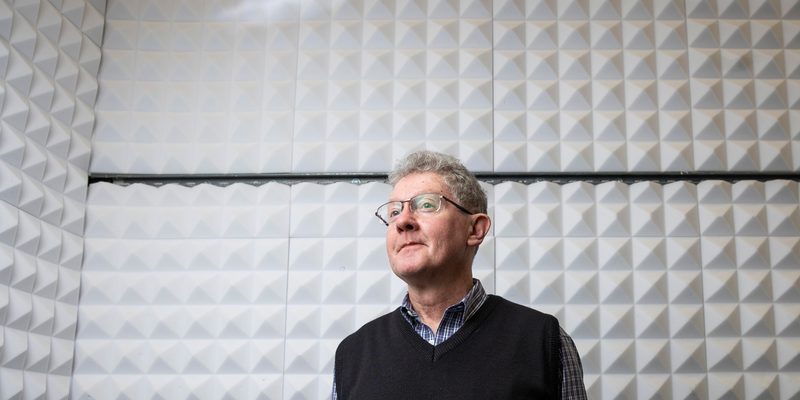
Professor J.C. Séamus Davis, of the School of Physics at University College (UCC) has today been awarded the 2026 Michael Faraday Medal and Prize by the Institute of Physics (IOP), one of the most prestigious honours in science.
Professor Davis, who is also Professor of Physics at the University of Oxford, has been recognised for his outstanding and sustained contributions to the study of macroscopic quantum physics in emergent quantum matter.
The Michael Faraday Medal and Prize is awarded for exceptional achievements in experimental physics, and commemorates the legacy of Michael Faraday, whose pioneering work laid the foundations for modern electromagnetism and information technology.
The prize will be awarded on Tuesday 3 November 2026 at the IOP Awards Dinner in Glasgow.
Throughout his career, Professor Davis has combined scientific insight with technological innovation, developing groundbreaking physics instruments and techniques that make it possible to visualise and interrogate quantum phenomena with unprecedented precision.
“We invented new instruments to visualise materials at a quantum level. Before we pictured in our minds what we believed quantum matter looked like, but we never knew for sure as we could never see it,” Professor Davis explained.
“Our instruments are like a superpower that have revolutionised how we see quantum matter and with them we have discovered that a large number of our assumptions were not correct, that the quantum world is more complex than our models suggested,” he said.
Professor Davis sits on the Membership of the National Advisory Forum for Quantum Technologies, a key group central to the government's “Quantum 2030” National Quantum Technologies Strategy for Ireland.
“This work is a key piece in the larger jigsaw that is Ireland’s bid to be an international player in quantum physics,” Professor Davis said.
Looking to the future of quantum physics discovery, Professor Davis said the advancements in artificial intelligence will build upon the foundations set by his advanced microscopy techniques.
His instruments are producing huge amounts of data, which A.I. is now beginning to assist in parsing for new discoveries.
“We can use A.I. to explore our quantum imaging information. The amount of data we produce with our instruments is huge, going over all of it alone would be almost impossible. Imagine taking ten million photographs of the night sky, and trying to identify all the stars you see in each image, that is the scale of the challenge we face,” Professor Davis said.
“However by uploading all this data for A.I. analysis we can confirm theories and make new discoveries. In the past three months alone we have made two major discoveries, with A.I. speeding up the process and analysing in days the kind of large data sets that would take humans years to assess on their own.
“This is the new frontier in quantum physics.”
Congratulating Professor Davis on his award, UCC President Professor John O’Halloran said:
“On behalf of all at UCC I wish to give our heartiest congratulations to Séamus on yet another well-deserved accolade. His pioneering work has enabled us to see the fabric of all matter at its most fundamental level, enhancing our understanding of quantum physics and laying a foundation that will pave the way for the technology of tomorrow,” he said.
Congratulating this year’s Award winners, Paul Howarth, IOP President, said:
"Our award winners represent the very best of physics. Through their curiosity, expertise and dedication, they are expanding knowledge, driving innovation and inspiring the next generation of scientists.
"Physics underpins so much of the modern world, from healthcare and clean energy to advanced technologies and our understanding of the universe. The achievements we celebrate today demonstrate the extraordinary impact that physicists have in research, education, industry and beyond.
"On behalf of the Institute of Physics, I offer my warmest congratulations to every one of our award winners. Their contributions strengthen our discipline, benefit society and show what can be achieved through a career in physics. I hope they take great pride in this well-deserved recognition and that their success encourages others to follow in their footsteps."