In This Section
UCC celebrates membership of Global Coalition for Ukrainian Studies
- UCC marked its membership of the Global Coalition for Ukrainian Studies, bringing together diplomats, researchers and members of the Ukrainian community to celebrate the milestone and outline future plans for Ukrainian Studies at UCC.
- The event highlighted UCC’s ongoing commitment to supporting Ukrainian scholars, advancing research and teaching on Ukraine, and new initiatives including the East Central Europe and Ukraine research cluster.
University College Cork (UCC) hosted an official ceremony celebrating the university’s membership of the Global Coalition for Ukrainian Studies, marking a significant milestone in the development of Ukrainian Studies in Ireland.
UCC joined the Global Coalition for Ukrainian Studies in December 2025, becoming one of the first Irish higher education institutions to formally commit to embedding Ukrainian history, politics, society, language and culture across its teaching and research activities.
Membership of this international network reflects UCC’s long-standing commitment to supporting Ukrainian scholars and scholarship, advancing deeper understanding of Ukraine’s past and present, and ensuring that Ukrainian language, history and cultural studies have a strong, visible and enduring place within Irish higher education.
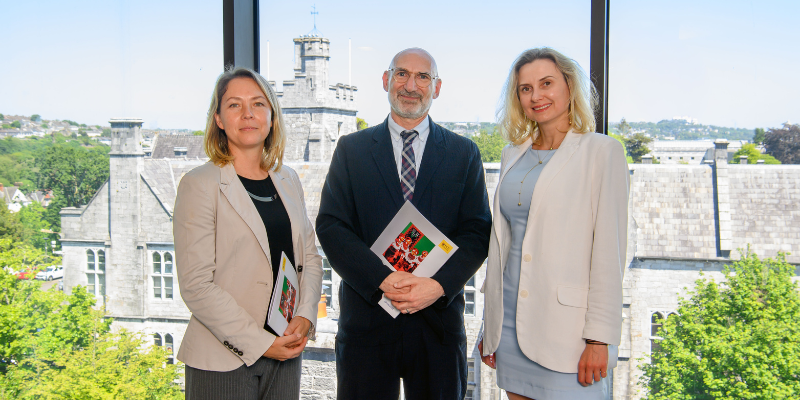
The event brought together diplomats, researchers and members of the Ukrainian community to celebrate this milestone and to outline plans for the future development of Ukrainian Studies at UCC.
Professor John O’Halloran MRIA, President of University College Cork, said: “At a time when war has brought not only devastating human suffering but also widespread disinformation, the promotion of knowledge and understanding about Ukraine, its people, culture, history and language has never been more important. Supporting Ukrainian Studies is not only important for Ukraine itself, but for the future of Europe, for democracy, stability and peace.”
“UCC’s membership of the Global Coalition for Ukrainian Studies reflects years of sustained engagement by our university in supporting Ukrainian academics, developing research partnerships, and advancing teaching and scholarship on Ukraine across a wide range of disciplines. We are proud to stand alongside colleagues and institutions internationally in ensuring that Ukrainian scholarship and cultural understanding continue to grow and flourish,” Professor O’Halloran said.
Dr Olha Oseredchuk, Head of the Project Office of the Global Coalition of Ukrainian Studies, said: “The Global Coalition brings together 81 universities from 26 countries with UCC representing a very important new partner. UCC has strong expertise in Ukrainian history, religion, memory and heritage which means that our cooperation starts on an already firm footing. We look forward to building sustainable initiatives and programmes that will elevate global awareness of Ukraine and integrate Ukrainian Studies in Irish higher education and research.”
Addresses were delivered by Antonina Shliakotina, Deputy Head of Mission, Embassy of Ukraine; Artur Michalski, Chargé d’affaires a.i. of the Embassy of the Republic of Poland; Professor Ursula Kilkelly, UCC Vice President of Global Engagement; Professor Yuriy Petrushenko, Director of the Fund of the President of Ukraine for Education, Science and Sports; Dr Alim Aliev, Deputy Director of the Ukrainian Institute; Dr Olha Oseredchuk, Head of the Project Office of the Global Coalition of Ukrainian Studies
UCC’s commitment to supporting Ukrainian scholars and scholarship has included the introduction of the Sanctuary Fellowship Scheme, led by Dr Tatiana Vagramenko, Professor James Kapaló and Dr Dug Cubie, which provided six-month visiting researcher positions to nine displaced Ukrainian researchers and university staff across a range of disciplines including Engineering, Study of Religions, Law and Philosophy. This commitment continued through the Research Ireland Ukrainian Researcher Scheme, through which UCC has hosted and supported displaced Ukrainian scholars.
Several research projects and civic initiatives at UCC focus on Ukraine and are being developed in close collaboration with Ukrainian partners and communities. These include History Declassified, a project led by Dr Tatiana Vagramenko, to rescue and preserve vulnerable historical collections, cultural memory, and documentary heritage threatened by war and destruction.
Future plans include the introduction of Ukrainian language teaching at UCC and the expansion of modules on Ukrainian history, politics and culture across degree programmes in UCC College of Arts, Celtic Studies and Social Sciences.
This work will be advanced through the newly established East Central Europe and Ukraine Cluster, which seeks to challenge longstanding Western-centred frameworks in the study of the cultures, societies, history, politics and economics of East Central Europe. The cluster will contribute to a more balanced, decentred and globally aware approach to knowledge production on East Central Europe and to inspire the next generation of Ireland-based scholars specialising in the languages, literatures, histories, politics, minority peoples, arts and religions of the region.
Professor James A. Kapaló, UCC School of Society, Politics and Ethics and member of the East Central Europe and Ukraine research cluster, said: “This partnership allows us not only to deepen academic collaboration but also to contribute to meaningfully to the wider decolonisation of Ukrainian Studies. By embedding Ukraine’s experiences, heritage and contemporary realities into our teaching and research, we help preserve knowledge at risk, support colleagues affected by war, and foster connections that will benefit both societies for generations.”
The formal ceremony concluded with a concert and cultural exhibition celebrating Ukrainian music, culture and artistic expression, featuring UKRAINE Voice Music Group, VOICES OF PEACE Intercultural Children and Young People’s Choir; Svitlana Deikum; and Olga Zaitseva-Herz.