In This Section
Early career researchers receive €4.3m in prestigious Research Ireland funding
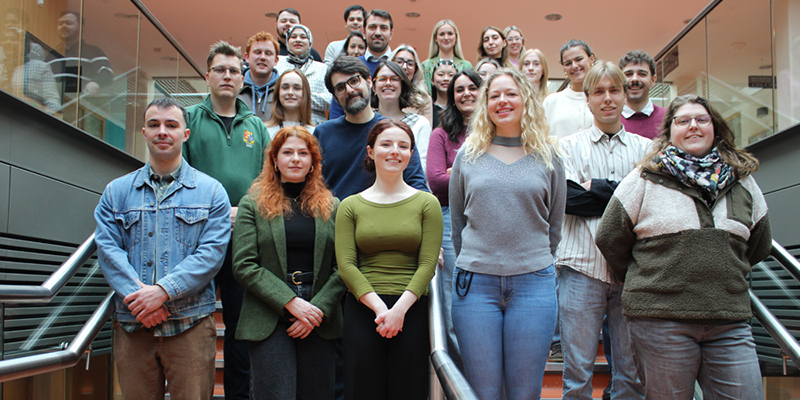
Early-career researchers at University College Cork (UCC) have received a combined €4.3m in research funding in the 2025 Government of Ireland (GOI) Postdoctoral Fellowship and Government of Ireland Postgraduate Scholarship awards.
The programmes support exceptional early-career researchers to pursue cutting-edge research with world-class potential in any discipline across the sciences, engineering, arts and humanities. The highly competitive programme enables the development of high-level skills and knowledge for current and future challenges across a variety of settings, including industry, the public sector, civil society and academia.
39 UCC research projects have received awards announced today by the Minister for Further and Higher Education, Research, Innovation and Science, James Lawless TD.
Among the 26 UCC projects funded under the GOI Postgraduate Scholarship programme are:
- Exploring the development of post-diagnostic support pathways for late-identified autistic adults in Ireland.
- Investigating abiotic and biotic drivers of intertidal communities on eco-engineered seawalls.
- Exploring the relationship between massive black hole spin and galaxy evolution.
- Female succession and leadership dynamics in small and medium-sized enterprises.
- Design of drug-microneedle formulations for the treatment of skin cancer.
The full list of UCC postgraduate awardees are:
| Lead Researcher | School | Project Title |
|---|---|---|
| Alexander Brennan | Biochemistry & Cell Biology | Prime-editing for the treatment of inherited metabolic disease |
| Alison Warren-Perry | Applied Psychology | Exploring the development of post-diagnostic support pathways for late-identified autistic adults in Ireland |
| Amy Walsh | Medicine | Development of a novel Vδ1 γδ T cell expansion protocol for adoptive cell therapy to treat colorectal cancer |
| Aoibhinn Fanning | Chemistry | Tandem processes designed to turn flatland into 3D space embedding transition metal catalysis |
| Borys Shvalov | Chemistry | Enantioselective aromatic additions with alpha-diazo-beta-ketonitriles |
| Charlotte Troy | English & Digital Humanities | Ecogothic gardens and the collapse of social binaries |
| Corryn Knapp | Biological, Earth & Environmental Sciences | Investigating abiotic and biotic drivers of intertidal communities on eco-engineered seawalls |
| Darragh Counihan | English & Digital Humanities | Monstrous Transformations: The evolution of the new american gothic (1914-1945) |
| Elisa Rosati | Languages, Literatures & Cultures | Vertical Dante: The «Descensus Christi ad Inferos» and the ascent of the ladder in the «Commedia» |
| Emily Butler | Biochemistry & Cell Biology | Bacterial derived mediators in the diet-microbe-host dialogue |
| Emily Whitaker | Physics | Spinning Cosmic Webs: Exploring the relationship between massive black hole spin and galaxy evolution |
| Grace Phillips | Public Health | Postpartum post-traumatic stress disorder: a mixed methods study |
| Karan Roy | Tyndall National Institute | Development of wideband electromagnetic transduced non-linear vibrational energy harvesters |
| Kathleen Coker | Film, Music & Theatre | Exploring syncretic approaches to improvisatory practices in Irish bluegrass |
| Kim Keohane | Chemistry | Endolysin-directed photoactive metal complexes as tools to explore an antimicrobial photodynamic therapy of acne |
| Luca Caminiti | Human Environment | Assessment of cold-water coral morphology from the belgica mound province using novel 3D photogrammetry |
| Massiel Pardo | Cork University Business School | Empowering Change: Female succession and leadership dynamics in small and medium-sized enterprises |
| Meadhbh Coomey | Chemistry | An organocatalytic approach to triphenylphosphine oxide valorisation |
| Mohamed Elkhashab | Pharmacy | Design of drug-microneedle formulations for the treatment of skin cancer |
| Rachel Roberts | Medicine | Investigating the impact of LRRK2 and GBA mutations on environmental pesticide-induced neurotoxicity in Irish patient-specific iPSC-derived midbrain dopaminergic neurons |
| Sean McColgan | Physics | Anomalous transport and critical behaviour near a ferromagnetic quantum critical point |
| Tara McInerney | Chemistry | Enter the Dragon: Next generation anti-cancer therapy by photo-oxidative damage targeted at membrane-less organelles of human SMAUG1 protein |
| Tobias Heyduk | Society, Politics & Ethics | Administrative autonomy in cross-border cooperation |
| Urszula Dudek | Chemistry | Telescoping multi-step processes of interest to the pharmaceutical industry and investigation of machine learning to accelerate optimisation |
| Yushuai Guo | Irish Learning | Feel Feelings: A study of emotions in medieval Irish literature |
| Zahra Khan | Medicine | Investigating the impact of gestational diabetes mellitus and maternal obesity on the developing brain in order to develop new therapeutic approaches to improve brain health and function |
Among the 13 UCC projects funded under the GOI Postdoctoral Fellowship programme are:
- Fluorinated polymer nanoparticles for mRNA-based cancer therapy.
- Exploring the role of exercise-induced changes in maternal microbiota in brain development.
- A framework for the use of scientific evidence in EU environmental decision-making.
The full list of UCC postdoctoral awardees are:
| Lead Researcher | School | Project Title |
|---|---|---|
| Dr Alessio Aletta | Languages, Literatures & Cultures | Pirandellian Atlas - Space and geography in the works of Luigi Pirandello |
| Dr Cara-Lena Nies | Tyndall National Institute | Selective capture, elimination and conversion of NOx pollutants using dynamic ferro- and piezoelectric catalysts |
| Dr Carola Romani | Pharmacy | FluorNano: Fluorinated polymer nanoparticles for mRNA-based cancer therapy |
| Dr Claudiu Roman | Chemistry | Fate of light aromatics from residential emissions |
| Dr Elisa Cintado Reyes | Medicine | Exploring the role of exercise-induced changes in maternal microbiota in brain development |
| Dr Elisabeth O'Flaherty | Microbiology | Using bifidobacterium to improve iron absorption – a novel approach for the prevention of anaemia |
| Dr Emma Dore-Horgan | Society, Politics & Ethics | Protecting Sociality: A right to human encounters in the age of smart technology |
| Dr Federico Granziera | Medicine | Gut microbiota and undernourishment-related Cognitive development dysfunction: cause-effect roles, underlying mechanisms and microbiota-based intervention for long-term cognitive protection |
| Dr Mórna O'Connor | Society, Politics & Ethics | Incongruous afterlives? A theoretical and empirical examination of the pursuit of fidelity to the dead in the modern digital afterlife industry. |
| Dr Nasrin Khandoker | Society, Politics & Ethics | Betrayal, Belonging and Bordering: Affective engagement of digital activism among Bangladeshi exiles |
| Dr Nicolai Egjar Engesland | Irish Learning | A critical edition of the lower Connacht Recension of Auraicept na nÉces |
| Dr Rhoda Jennings | Law | A framework for the use of scientific evidence in EU environmental decision-making |
| Dr Shefali Baweja | Physics | Leveraging unexplored nitrate radical atmospheric reactions during nighttime |
Nationally, the Research Ireland funding is a combined €36.3m and will be allocated to 341 projects across the two programmes.
Announcing the awards, Minister Lawless said: "This significant investment of €36.3 million in our early career researchers reinforces the Government’s commitment to the future of Ireland’s research and innovation system. The Government of Ireland programme is a central measure in supporting the system’s continued development and in strengthening Ireland’s international competitiveness. Early career researchers are the lifeblood of that system. These awards, which span a wide range of subject areas, represent an investment in the country’s future capacity to innovate, driving both social and economic benefits."
Welcoming the announcement, Dr Diarmuid O’Brien, CEO of Research Ireland, commented: "At the heart of these programmes are the researchers themselves – individuals whose creativity and determination are shaping new ideas and advancing knowledge across all disciplines. This year’s awardees have demonstrated exceptional potential, bringing forward ambitious ideas and fresh perspectives that will enrich Ireland’s research community. Research Ireland is proud to support their development and to provide an environment in which their talent can thrive."
Congratulating all UCC awardees, Professor John F. Cryan, UCC Vice President for Research and Innovation said: "I would like to congratulate all postgraduate students, postdoctoral researchers, and their principal investigators on securing these prestigious awards. These awards will support the development of the next generation of innovative researchers in UCC, as they pursue excellence across a range of research disciplines, spanning all thematic areas of our UCC Futures programme."