

A Day of Collective Gathering around Creative Methodologies in UCC on 8th October, 2026
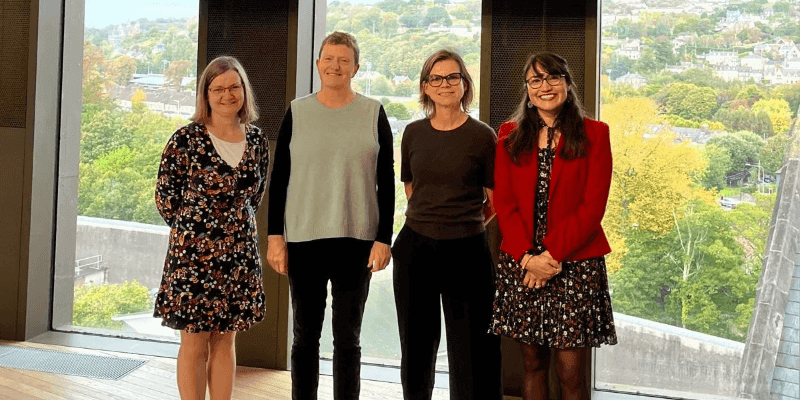
An enthusiastic group of researchers came together on Thursday 8th October 2026 to explore the myriad ways creative research methods could enhance both the execution and presentation of their research.
The one-day symposium was hosted by two ISS21 research clusters - Genders, Sexualities and Families, and SHAPE (Society, Health Equity and Political Economy). Dr Monica O’Mullane of the School of Public Health and Dr Gema Kloppe-Santamaría from the Department of Sociology & Criminology co-organised and co-led the day.
The event started with a warm welcome and brief talk from Dr Shirley Martin, Head of School of Applied Social Sciences. Shirley described how she uses creative methods like storytelling, body-mapping and drawing in her work with children. She explained how these methods can disrupt the power balance between researcher and research participants, giving kids more agency in the process. A child can furthermore display their work at an exhibition and be seen as a human being who participates in society rather than simply a ‘human becoming’. Creative methods are also particularly useful with younger children and those with different language abilities she claimed, based on her own research studies. After 22 years at UCC, Shirley is delighted to see that creative methods are much more embedded in academic practice these days.
Next up, Dr Kate Carruthers-Thomas of Birmingham City University delivered what she calls a deconstructed keynote talk. Dotted around the room were various installations, displaying ‘experimental’ ways of doing and disseminating research created by Kate. ‘Exhibits’ include the Five ‘Survive’ Lockdown, a popular graphic novella about life during lockdown as well as the HE Career Game, a highly-engaging board game resembling snakes and ladders. Kate also delivered several ‘lightning talks’ on topics such as the ‘tyranny of tidy’ in academia. Here, she homed in on the desire to make 'messy' data orderly as well as the pressure to publish in prescribed formats. While Kate does publish articles and her research is based on, in her words, 'fairly conventional' qualitative methods, the examples around the room present refreshing ways of revisualising data (some of Kate’s wide-ranging work can be found here). They allow participants to interact differently with the data and artefacts, ‘sparking connection’, or even, ‘division’. The mood in the room was buoyant as people browsed the exhibits and I certainly found it enjoyable and enlightening to move around freely and chat to people about the installations. Kate gave advice on how researchers could incorporate creative methods into data presentation. She suggested people think about what they want participants to remember and how best to facilitate this; comic strips, postcards or posters being some ideas. Even asking a participant to read out a quote on your slide can present a new voice and disrupt power dynamics. Some researchers in the room had kept and regularly looked at a postcard distributed by Kate at a previous UCC talk. A testament to the power of doing things differently! It was noted in the discussion that nowadays there can be pressure on academics to do both conventional as well as creative methods on top, however. Plenty of food for thought for researchers here!
Following Kate, it was time for the Make your Pitch group discussion session. Here we heard about the expansive range of creative research methods being used by researchers in the room. Some participants used theatre techniques without calling them such so as not to potentially make some people less receptive. Others displayed beautifully-designed visual cue cards for initiating conversation. Textile weaving, yoga, cooking, and hairdressing are other avenues to making people feel comfortable and stimulate conversation. Certain challenges involved in using creative research methods also featured here. An example being that conferences claim to be open to the idea of creative practices, but in reality the space is not equipped to facilitate them.
After the lunch break, we learned all about the creative research methods Prof. Jelke Boesten and her team at King's College London employ. Jelke describes how she and her fellow VEMinists use Visual and Embodied Methodologies (VEM) in a highly-collaborative research project investigating gendered violence. Given discussions centring violence are challenging, alternative research methods can help people feel more comfortable and connected. VEM encompasses visual, embodied, sensory, narrative and craft-based methods and the VEM Network at King's College London have recently published an instructive and visually-engaging guide for researchers (available for free here). Jelke talks us through the principles underlying VEMinism. Reflexivity is intentional, iterative, accountant and relational, for example. Care, connection, and collaboration are deeply embedded in veminist praxis with the aim of fostering creatively compassionate spaces. Participants have said that during sessions they feel able to express themselves and behave in ways that they cannot do elsewhere. Flexibility is essential when it comes to creative research methods and researchers should learn to let go of assumptions as well as lean into unpredictability. You may plan a crafting session, for example, but it turns out people would rather dance. Facilitators need to learn to simply go with that and bring in outside help if needed. Project outputs include art, arts performances, video, music, policy briefs, and much more. Jelke engaged in a generative dialogue with participants around the tensions that might emerge while producing creative outputs in settings that still value more conventional peer-reviewed texts. As well as issues around using the language of ‘data’ and ‘data collection’ for research that is co-produced and art-based. She offered numerous tips on how to do VEM as well as how to avoid the mistakes they have made along the way. A heartwarming portrayal of the beauty that can emerge when compassion, community and creativity come together!
The day then finished up with speed-dating and a feedback session. Researchers were clearly keen to get to know each other and their creative projects better in brief pair discussions. The upbeat mood and positive energy in the room remained strong until the end of the day. Participants were very eager for more in the form of a follow-up hands-on session trying out some of the creative methods discussed. Watch this space! #CreativeUCC
This event news item was written by Clare Gallagher, student on the Masters in Sociology, with input from Dr Gema Kloppe-Santamaría & Dr Monica O’Mullane
For more on this story contact:
Dr Gema Kloppe-Santamaría & Dr Monica O’Mullane.
Collective Social Futures Institute
Contact us
- collectivesocialfutures@ucc.ie
- Professor Maggie O'Neill, Director of Collective Social Futures Institute