The Criminology BA is a window into the world, giving insight into human diversity in complex societies and a textured view of our propensity to err, conflict, blame, and punish.
This contemporary course combines key topics in the social sciences and law – such as crime, deviance, morality, conflict, censure and justice – with philosophy, history, cultural studies and a language. The result is an exceptional breadth and depth of perspective and context.
This is a research-driven, interdisciplinary programme that delivers an international body of knowledge, as well as research skills and critical thinking. Criminology provides a strong intellectual background for anyone thinking of working in culturally sensitive areas such as policing, prisons, social work, journalism, politics, research, care, health and justice agencies, support groups, charities, film or television.
Modules
All modules are worth 5 credits unless otherwise stated.
The criminology electives are the following: Women, Confinement and Social Control in Ireland; Crime, Urbanization and Cities; Policing Modern Society; Victims and Victimology; Young People, Trauma and the Criminal Justice System; Prisons in Practice; Online Hackers and Cyber-deviants; The Global Trade in Illicit Drugs and Its Regulation; Inside-Out Criminal Justice and Social Justice;
Students can also take electives in French; Gaeilge/Irish; German; Hispanic Studies; Italian; Philosophy; Government; Geography; History; Sociology; Law; and more. A full list of electives can be found here.
*Please note that modules are subject to availability and not all of these modules run every year.
CR3010Widening the criminological imagination: critical and creative perspectives (10 credits)
Electives You can take some modules on offer from Year 2 as well as modules on:
Corporate Crime; Dissertation in Criminology; Abolitionism: Critical carceral studies.
Students can also take electives in French; Gaeilge/Irish; German; Hispanic Studies; Italian; Philosophy; Government; History; Sociology; and more. A full list of electives can be found here
Note Students may opt to spend their third year studying at a partner institution abroad if they are registered on the BA Criminology (International Pathway).
Academic Programme Catalogue
See the Academic Programme Catalogue for the complete and up-to-date content for this course. Note that the modules for all courses are subject to change from year-to-year. For complete descriptions of individual modules, see the Book of Modules.
Course Practicalities
Written exams will take place before Christmas and in May. Not all modules will have formal examinations. Most modules use other types of assessment, such as essays.
In the final year, students may write a dissertation, which will normally be a literature review, on a topic of their choosing, and thus have the opportunity to undertake substantial research.
Who teaches this course?
Core modules of this degree will be taught by UCC academic staff members. Several electives will be taught by outside experts, including practitioners from the criminal justice system, and there will be seminars led by doctoral students and local scholars.
Why Choose This Course
My time at UCC has provided me with an exceptional foundation and strengthened my commitment to understanding crime, justice and the ways research can contribute to meaningful social change.
From an early age, I found myself captivated by the question of what drives an individual to commit a crime. I was fascinated by the intersection of psychology, sociology, criminal profiling and the broader social factors that influence human behaviour. While true crime stories and criminal dramas are incredibly interesting, they tend to focus on the most extreme offences, so I was always drawn to think about the everyday realities of crime.
I found myself asking different questions. What leads a single mother to steal nappies for a child she cannot afford? Why might a young person from a disadvantaged neighbourhood face harsher treatment than someone from a more privileged background? To what extent does society itself shape the circumstances that lead individuals towards offending? These were the questions that ultimately led me to study Criminology at UCC.
What is it like to study Criminology at UCC
Beginning the course, I quickly realised how much there was still to learn. Throughout my time at UCC, I had the privilege of learning from some of the country's leading academics, each of whom challenged my thinking and helped develop the analytical, research, and critical-thinking skills that have shaped me both academically and personally.
Beyond the classroom, I was eager to contribute to the university community. I served as my class's Academic Representative throughout my three years and helped revive the Criminology Society after almost three years of inactivity, eventually becoming its Chairperson. Through these experiences, I was honoured to become a finalist in the national Undergraduate of the Year Awards in the Female Leadership category.
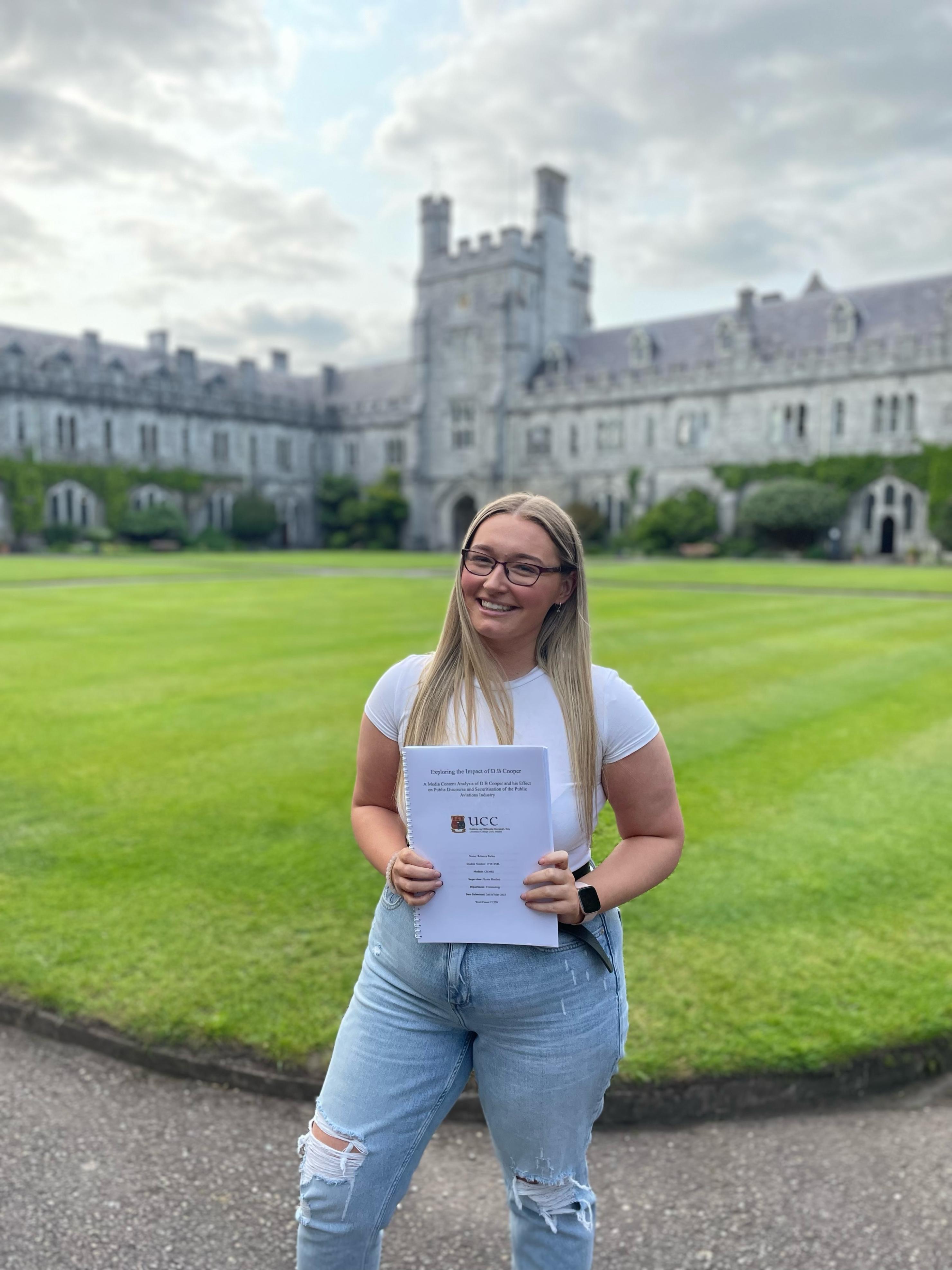
Among the many excellent modules I studied, three had a particularly lasting impact: Policing Modern Society with Dr Kevin Sweeney, Victimology with Dr Joan Cronin, and The Global Trade and Regulation of Illicit Drugs with Dr James Windle. My interest in policing developed into my undergraduate dissertation, From Grievance to Governance: Insights from Section 98 Trends in the Garda Síochána Complaints System, for which I received a First Class Honours grade.
Student life and community at UCC
One of the things I valued most about studying at UCC was the sense of community. Whether it was getting involved in clubs and societies, meeting people from different backgrounds, or simply spending time on campus and around Cork city, there was always something happening. Cork has such a welcoming atmosphere that it was easy to feel at home and build friendships that I know will last well beyond university.
Career in criminology
I hope to continue my academic journey by completing both a Master's degree and, ultimately, a doctorate. My long-term ambition is to pursue a career in criminological research, with the aspiration of contributing to organisations such as INTERPOL.
My time at UCC has provided me with an exceptional foundation and strengthened my commitment to understanding crime, justice and the ways research can contribute to meaningful social change. It has given me the knowledge, confidence and skills to take the next step towards achieving my career goals.
Understanding the social forces that shape human behaviour
I chose to study the BA in Criminology at UCC because I have always been passionate about understanding the social forces that shape human behaviour and the justice system. The course offered a perfect balance between theory and real-world application, allowing me to explore topics like gender, trauma, and social control from both academic and practical perspectives.
One of the most rewarding aspects was the supportive learning environment and the opportunities to collaborate across disciplines and even with community groups through modules like Inside-Out. This Inside- Out programme was definitely one of the highlights of my degree. It was a transformative experience that challenged my thinking and deepened my empathy. I would strongly encourage anyone who gets the opportunity, to put themselves forward for it, you will learn as much about yourself as you do about the justice system.
For my thesis, I explored the societal stigmatisation, marginalisation, and control of voluntarily childfree women in modern Ireland. Drawing on the theory of secularisation and labelling theory, I examined how cultural expectations around motherhood can lead to harmful stereotypes and social exclusion. My research aimed to give voice to a group of women often overlooked in criminological and sociological discourse.
Studying Criminology at UCC strengthened my drive to work in a field where I can support people facing difficult life circumstances and contribute to more inclusive and understanding communities. I am now preparing to pursue a master’s in occupational therapy, where I hope to carry forward this commitment.
Criminology gives the student the opportunity to take modules on sociology, psychology, anthropology, law as well as social policy. Connecting the dots in later years [...] was amazing...
“UCC has a beautiful, green, and friendly campus, so the decision to study a discipline closely related to Sociology was an easy one to make.
Criminology gives the student the opportunity to take modules on sociology, psychology, anthropology, law as well as social policy. Connecting the dots in later years on how modules and content relate to each other was amazing.
The Inside-Out module was the highlight of studying Criminology. It offered a chance to study and create together with persons living in prison and provided an opportunity to critically reflect on the knowledge we had gathered over the years while questioning many of our underpinning assumptions of a 'prisoner'.
I would encourage anyone thinking about studying the BA in Criminology to stay open-minded towards the content and engage with the programme; try out as many diverse modules as possible and sometimes take a step back and critically reflect on the introduced ideas and on yourself. But most of all, have fun, join study groups, clubs, and societies and enjoy campus life!”
If you have any interest in the areas of crime, what it is, what it means, or why some people commit crimes and others don’t, I would definitely suggest looking into studying BA Criminology...
"Criminology was a relatively new course to me when I chose it back in 2019 but I was always keenly interested in studying what exactly crime is and what defines being criminal.
Criminology in UCC allowed me to study a range of different modules from law, sociology, philosophy and everything in between. It allowed me to study all different areas of crime and I covered a range of modules from education in prisons, how policing works and exists in our society, feminist criminology, victims and victimology and lots more.
The course is so broad but at the same time so detailed as whatever area you have an interest in, there is a corresponding module to facilitate and allow you to delve in deeper.
The most enjoyable part of BA Criminology was the Inside-Out module and my Erasmus year abroad. My Erasmus year gave me the chance to study crime and criminality in a whole different country and draw similarities and differences between what I had learned in UCC and then on the other hand what I learned while abroad. It was a fantastic idea that allowed me to build upon and add to my pre-existing knowledge on these areas while getting a whole new perspective at the same time.
The Inside-Out module was easily my favourite part of studying criminology in UCC. The experience in itself that I received as a result of the hard work of the Criminology department to put together such a module was second to none. This module dissolved any pre-existing perceptions or stereotypes I would have had surrounding prisoners and prison life and allowed us all to learn and grow together as what we all were inside that classroom- students.
We were the first group in the whole of Ireland to complete this course and the experience and knowledge that I gained from this was massive. It was an experience I will always be grateful that I got to part take in and also has opened my mind up to the possibility of going into a line of work within prisons whatever that may be.
If you have any interest in the areas of crime, what it is, what it means or why some people commit crimes and others don’t, I would definitely suggest looking into studying BA Criminology."
Immersing myself in the multidisciplinary approach of Criminology at UCC was a source of immense satisfaction...
Michael Harney, Graduate and member of An Garda Síochána
"From an early age, I found myself captivated by the complexities of human behaviour. The questions surrounding why individuals commit crimes, what factors influence their decisions, and how society responds to such behaviour ignited an insatiable curiosity within me. Criminology presented an opportunity to explore these mysteries, delving into the depths of psychology, sociology, and criminological theories to gain a profound understanding of the intricacies behind criminal acts. I also wished to gain more in-depth insight into the workings of the criminal justice system.
From the initial investigation to the courtroom proceedings and the subsequent rehabilitation processes, the system serves as a vital pillar of society. Studying Criminology at UCC allowed me to gain a comprehensive understanding of its inner workings, shedding light on the flaws, challenges, and potential for improvement.
Immersing myself in the multidisciplinary approach of Criminology at UCC was a source of immense satisfaction. It bestowed upon me the invaluable ability to perceive societal issues through diverse lenses, thereby enabling me to engage in profound critical analysis of a myriad of topics that permeate our society. This interdisciplinary perspective fostered a deep understanding of the intricate connections between psychology, sociology, and law, equipping me with the tools to navigate the complexities of criminological phenomena with astute discernment. Most of all, the way in which UCC guide their students is first class.
I suggest two main points to any student that is considering studying Criminology at UCC. Firstly, take the time to thoroughly research the Criminology program. Familiarise yourself with the curriculum, course offerings, faculty expertise, and any specialised areas of focus within the field. This will ensure that the program aligns with your academic and career goals. Secondly, reflect on your own interests within the field of Criminology. Identify specific areas, such as criminal profiling, restorative justice, or policy analysis, which intrigue you. For me, this was in the area of policing, which I now work in. This will allow you to tailor your studies and seek out relevant elective courses or research opportunities that align with your passions. By completing a degree in criminology, helped set the foundation for my MSc which I have just completed."
Choose this course if you later want to work in your society to confront its social problems on the basis of a sophisticated analysis of crime, moral regulation and social deviance and if you want to develop a professional approach to bad behaviour, discipline and justice.
Placement or Study Abroad Information
You will have the option of adding a year to this three-year degree by studying abroad in Year 3. After studying abroad in Year 3, you will return to UCC to complete your final year.
We currently have links with universities in the following countries: Canada, Poland, Sweden, Malta and the UK.
Skills and Careers Information
Students in this course will develop skills in critical thinking, comparative and cultural analysis, research methods and statistics. They will also strengthen their grasp of the role of history and examine the basis of moral justifications.
This skill set is invaluable for sensitive occupations such as:
policing
prisons
probation
social work
social administration
security work
charities
journalism
television and film
politics
community development
Requirements
Leaving Certificate Entry Requirements
At Least six subjects must be presented. Minimum grade H5 in two subjects and minimum grade O6/H7 in four other subjects. English and Irish are requirements for all programmes unless the applicant is exempt from Irish.
Applicants will need to meet the following minimum entry requirements:
English
Irish
Other Language
O6/H7
O6/H7
O6/H7
EU/EFTA/UK Qualifications
EU/EFTA/UK applicants presenting an equivalent school-leaving qualification should review the EU/EFTA/UK Applicants page for information on equivalent grades and how to prove their level of English.
Mature Students
To compete through the mature entry route, applicants must be 23 years of age on or before 1 January of the application year and apply online via the CAO by 1 February. The application should include a statement of interest.
Applicants who meet the required level of distinctions in required subjects can apply for entry to this course using specific QQI FET qualifications. Please review the Programme Requirements on our Information for QQI FET Applicants page for information on related QQI courses, and visit Access UCC’s QQI/FET Entry section for further support.
Non-EU Applicants
Non-EU applicants are expected to have educational qualifications of a standard equivalent to the Irish Leaving Certificate. In addition, where such applicants are non-native speakers of the English language they must satisfy the university of their competency in the English language.
Non-EU applicants are expected to have educational qualifications of a standard equivalent to the Irish Leaving Certificate. In addition, where such applicants are non-native speakers of the English language they must satisfy the university of their competency in the English language.
The State will pay the tuition fees for EU students who are eligible under the Free Fees Scheme. The annual student contribution and capitation fees are payable by the student.
Check out scholarships that may be available to you.
Explore our Nurturing Bright Futures free online course (Module 5) to learn about managing your money as a student and budgeting for university life.
How To Apply
Irish and European (EU/EFTA/UK) Applicants
Apply via the CAO. See the CAO Handbook for useful information on applying through the CAO.
Mature Applicants
Apply via the CAO by 1 February. To apply for a place as a mature student, you must be 23 years of age on or before 1 January of the year of entry.
QQI/FET Applicants
Apply via the CAO. See our QQI/FET Applicants page for information on the Quality and Qualifications Ireland (QQI) Further Education and Training (FET) application process and whether there are routes available to this course.
Non-EU Applicants
If you are from outside the EU/EFTA/UK, apply online via the UCC Apply portal. See our International Office page for more information.
You should be seeing some content in this space that is currently blocked due to cookie settings. Open the Cookie Management Tool to change your settings.