-200x106.jpg)
News & updates
UNIC Project Manager participates in staff week in Jena and Dresden, Germany
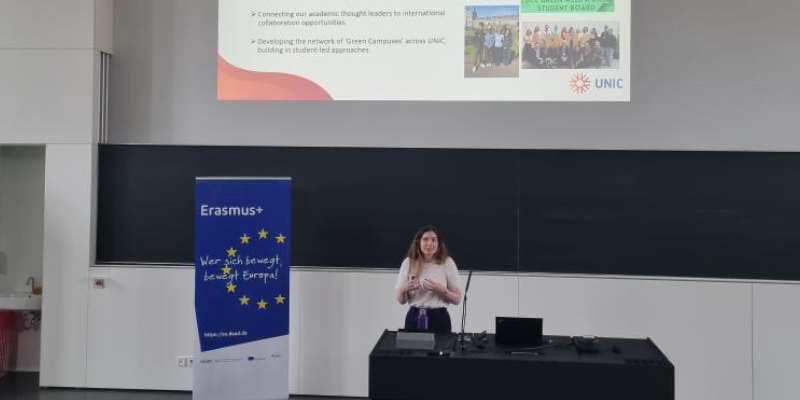
Aoife Dowling, UNIC Project Manager at UCC, participated in a staff training week in Jena and Dresden, Germany, on September 15-20, 2025. Aoife presented a session entitled 'Quality Assurance and Sustainability: ensuring that projects deliver measurable impact and long-term value'. Aoife outlines her experience of the staff week and key learnings below.
I was lucky to take part in an extremely enjoyable and inspiring staff week in Jena and Dresden. Sincere thanks to the organisers for their hard work to deliver the week, as well as to colleagues in UCC for supporting my visit. My travel was funded by an Erasmus+ staff mobility grant.
The international staff training week focused on the theme of "Advanced Project Management for Erasmus+ KA2 Projects" and was hosted by Friedrich Schiller University Jena and the Technological University Dresden, with a rich programme delivered across both campuses. The staff week brought together 20 professional staff from universities across Europe, including other participants also directly involved in European Universities alliances: Arqus, Charm-EU, and EUTOPIA. The staff week was a valuable opportunity to share knowledge on collaborations, capacity-building and best practice in project management and European Universities alliances.
Some memorable key learnings:
I gained new appreciation of the effective use of Key Performance Indicators (KPIs) in the successful implementation of European universities alliances. This was a theme that emerged strongly in a fascinating interactive session: "Impact assessment and development of Key Performance Indicators”. It was valuable to learn how the process of developing indicators had supported project delivery and impact in another alliance. My new appreciation for KPIs is something I've brought back to UNIC and integrated into my project management work, especially in terms of monitoring and reviews.
A session and conversation on artificial intelligence (AI) demonstrated to me the rising centrality of AI in project management. Colleagues shared tips and ideas on how to integrate AI into higher education management work in a responsible and efficient way. This dialogue was interesting as a type of temperature-check on the role played by AI - and the reception of it - in university professional services at this time.
Various institutional cultures and perspectives were shared by participants, opening my eyes to new ways of working and solving problems. A particular focus was on researcher networking and how this can be facilitated and supported. In the medium term, I hope to use this knowledge to enhance the unlocking of researcher collaboration across UNIC.
Connecting with colleagues from other European Universities alliances was a particular pleasure and enabled very specific knowledge sharing and networking. Informal discussions proved just as useful as the formal sessions, as I used meals and coffee breaks to swap stories and advice with alliance colleagues. These relationships endure beyond the staff week and I have no doubt will continue to be a source of information and mutual support.
My own presentation focused on ensuring impact and long-term value in my project management in UNIC, bringing in some key examples and advice. The positive reactions of the audience gave me a renewed sense of UNIC's achievements as an alliance, and how far we've come. It was rewarding to present to an audience that was not familiar with UNIC already, and to hear their unfiltered response.