Free workshop on species distribution models using Google Earth Engine led by School of BEES researcher reaches over 1600 people from across 162 countries
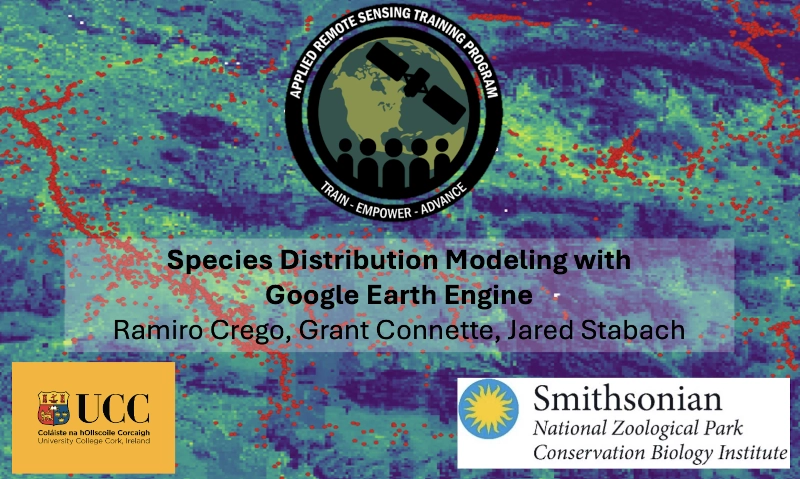
1615 participants from over 800 organisations and from across 125 countries participated in July on a free course in Species Distribution Models using Google Earth Engine led by Dr Crego from the School of BEES/Sustainability Institute and colleagues from the Smithsonian Conservation Biology Institute (Dr Stabach and Dr Connette). The course was part of NASA’s Applied Remote Sensing Training Program (ARSET) series.
Dr Ramiro Crego and colleagues from the Smithsonian Conservation Biology Institute have been working on making complex modelling frameworks used in ecology and conservation more accessible for practitioners around the world. Species distribution models are one of the most widely used analytical techniques to assess patterns of species occurrence and habitat suitability to inform conservation and management. However, the high computational demand of accessing remotely sensed data and running machine learning algorithms can be a barrier for many working in regions where access to fast computers is a challenge. The implementation of SDMs in Google Earth Engine, a cloud-based spatial analysis platform, can simplify the process of accessing and analysing huge quantities of data.
"It is extremely encouraging to see such a level of engagement across the world on this course and a testament to the work being done at the School of BEES in collaboration with leading international institutions to make science more accessible, helping generate the information needed to tackle the biodiversity crisis", said Dr Crego.
For those interested in the course, the recordings of the sessions are freely available at https://www.earthdata.nasa.gov/learn/trainings/species-distribution-modeling-google-earth-engine
Sustainability Institute
Contact us
Ellen Hutchins Building, 6 Lee Rd, Sunday's Well, Cork, T23 XE10 and Beaufort Building, Ringaskiddy, Cork, P43 C573,