
Decarbonising Global Shipping is possible but costly, new research finds
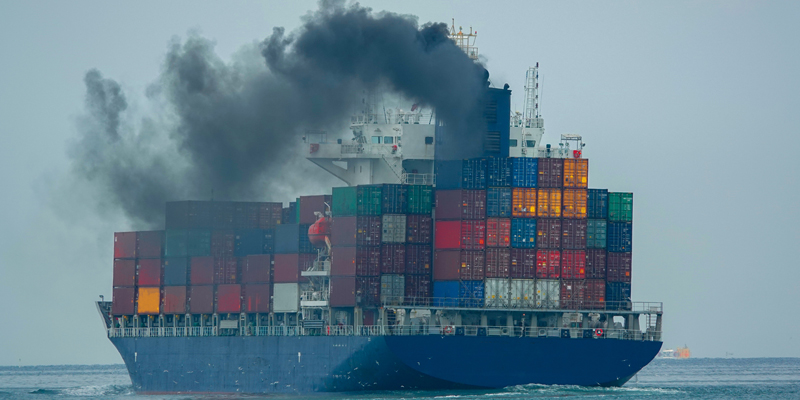
The decarbonsiation of the worldwide shipping sector - responsible for 3% of global greenhouse gas emissions - is possible researchers have found, but none of the fuel production pathways are perfect, and none are cheap.
A landmark study led by researchers at University College Cork (UCC) has identified e-methanol as one of the most promising near-term fuel options for reducing greenhouse gas emissions in the shipping sector. The findings are based on a newly developed framework to evaluate renewable fuel pathways for international maritime transport.
Published today in the journal Cell Reports Sustainability, the study, led by Professor Jerry Murphy, UCC Sustainability Institute, involved collaboration over two years with colleagues in Cornell University (USA), Southeast University Nanjing (China), and the University of Galway.
The International Maritime Organization has targeted a 70-80% reduction in emissions from large ships by 2040, and the European Union's FuelEU Maritime regulation requires progressive reductions in greenhouse gas intensity of fuels through to 2050.
These are significant challenges with no definitive agreed pathway to decarbonise shipping. To address this gap, the research team created a transferable sustainability framework to analyse ten renewable fuels sourced from electricity (e-fuels) and woody biomass.
They chose eleven criteria to compare fuels including: land use required to produce the fuel; the potential geographic specific resource of the fuel system; cost of production of fuel at a facility; the total cost of ownership of fuel including storage and use on board the ship; the energy efficiency of the fuel production system; and the hazard associated with each fuel.
The results demonstrate that liquid fuels, particularly e-methanol, offer the most favorable near-term pathway to deep maritime decarbonisation, yet the total cost of ownership is 4.3 times that of heavy fuel oil. This indicates that while decarbonisation of the shipping sector is technically possible, it is likely to come with significant costs.
Key findings from the research:
- Hydrogen offers strong energy efficiency but has a cost of ownership 10 times that of marine fuel.
- Ammonia has many advantages, but human toxicity and operational safety are of concern.
- E-methanol emerged as a favourable option, despite its cost of ownership of 4.3 times that of marine oil.
- Viability requires low-cost electricity and reduced capital costs for electrolysers.
Professor Jerry Murphy, lead author of the study commented: "This work integrated technical, economic, environmental analysis with a life cycle analysis and a multi-critera decision analysis, to assess 10 differing fuel production pathways. It was a large undertaking by the team and required honing our scientific communication skills to synthesis two years of work. We created a transferable sustainability framework to analyse renewable fuels sourced from electricity (e-fuels) and woody biomass. Our overarching conclusion is that though we can generate a range of technical solutions for decarbonization of shipping, none are perfect and none are cheap. Realistically our challenge is to find the least bad solution."
Great thanks to our funders: Sustainable Energy Authority of Ireland; the Department of Transport; Research Ireland through the MaREI centre for energy, climate and marine; the Cornell Atkinson Centre for Sustainability; and the Environmental Defense Fund (EDF).
Sustainability Institute
Contact us
Ellen Hutchins Building, 6 Lee Rd, Sunday's Well, Cork, T23 XE10 and Beaufort Building, Ringaskiddy, Cork, P43 C573,