In This Section
UCC researchers secure €6.2m for pioneering research infrastructure projects
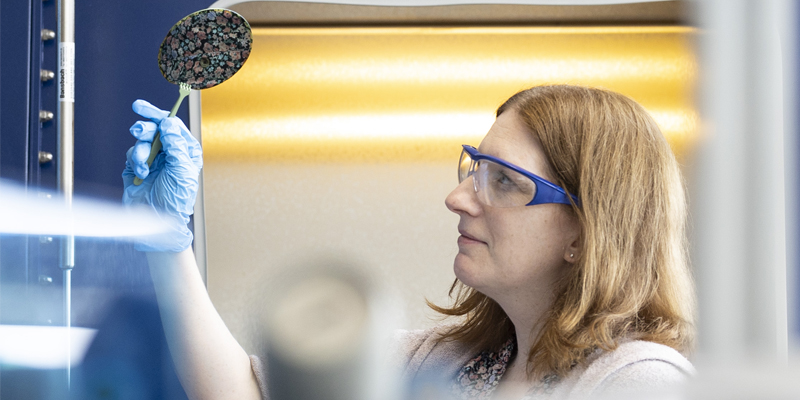
Leading research projects at University College Cork (UCC) have been awarded combined funding of €6.2m under the Research Ireland Infrastructure Programme.
The multimillion-euro funding will support research by providing national capability for growing and analysing ultra-thin semiconductor materials and establishing Ireland’s first dedicated quantum sensing laboratory.
Minister for Further and Higher Education, Research, Innovation and Science, James Lawless TD, has announced an investment of €17 million to support nine key infrastructure projects through the Research Ireland Infrastructure Programme, with UCC and UCC’s research flagship, the Tyndall National Institute, accounting for two of the nine projects awarded. The programme is designed to ensure that Irish researchers can access the specialised equipment needed to compete on the global stage.
Accelerating progress in advanced electronics and emerging technologies
Transforming advanced materials into real-world semiconductor technologies requires reliable ways to grow and characterise ultra-thin layers in device structures. These thin films must be made with incredible precision, down to the atomic level, to tune their performance for next-generation devices. Modern materials growth techniques allow consistent production of these films at scale, moving innovative discoveries from the lab towards applications.
Led by Dr. Lynette Keeney, the €4.67m ASPIRE project aims to provide national capability for growing and analysing ultra-thin semiconductor materials with atomic precision, accelerating progress in advanced electronics and emerging technologies. When combined with state-of-the-art material processing, electromechanical, electrical and magnetoelectric characterisation, this facility will enable comprehensive correlation between physical and functional properties of novel materials and devices. This facility will provide unparalleled insights into materials performance, from synthesis to device integration, will provide a uniquely integrated approach to prototyping novel materials and semiconductor devices, accelerating innovation in computing, biomedical, and low-power electronic technologies.
"ASPIRE will significantly enhance our capacity to develop and prototype the next generation of advanced materials and devices at wafer scale. It will strengthen Ireland’s position in strategically important areas including semiconductors, photonics, quantum technologies, and advanced multifunctional oxides, while supporting collaboration across academia, industry, and the wider innovation ecosystem. This investment will help build national capability, attract and retain high-calibre researchers, and reinforce Ireland’s competitiveness in European and international research and innovation landscapes," said Dr. Keeney.
Ireland’s first experimental facility for quantum gravimetry
The Quantum Sensing Laboratory (QSL) will establish Ireland’s first dedicated platform for developing portable, cost-effective sensing technologies for geo-engineering, supported by a helium recycling system that will also enable cutting-edge quantum physics and chemistry research across UCC. Led by Dr. Zili Li (School of Engineering & Architecture) in collaboration with internationally renowned researchers Professor Alix McCollam (School of Physics) and Professor Anita Maguire (School of Chemistry), the €1.56m interdisciplinary project unites researchers creating a unique confluence of expertise from geotechnical engineering and quantum interference theory to synthetic organic chemistry.
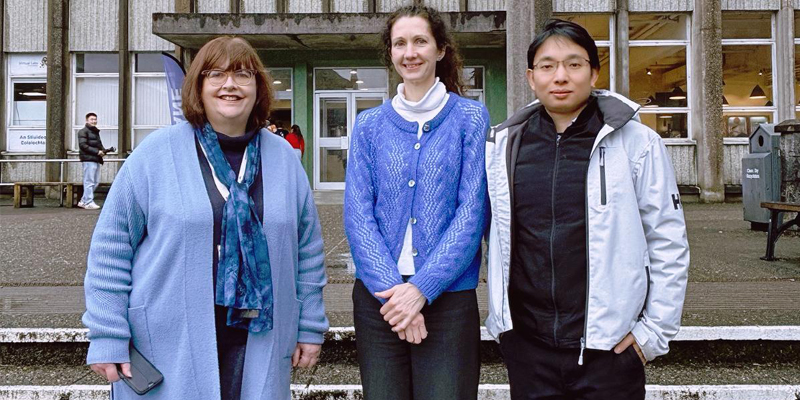 Photo (L-R): Professor Anita Maguire, Professor Alix McCollam and Dr. Zili Li.
The project team will provide world-leading expertise in Superconducting Quantum Interference Device (SQUID)-based sensing and cryogenic environments, translate these high-precision quantum tools into the field for geo-engineering applications, and integrate this infrastructure to advance magnetic resonance spectroscopy.
Dr. Zili Li said: "The QSL laboratory aims to build sensors that can "see" through the ground using quantum technology. The quantum sensors can reshape the detection of sinkholes and caves on Earth, with the future potential to map hidden lunar lava tubes for human habitats. From the Earth’s subsurface to the lunar underground, UCC scientists, researchers and civil engineers are pioneering the vital technologies required for the next generation."
The Research Ireland Infrastructure Programme will enable the installation of state-of-the-art equipment and facilities across the country, strengthening Ireland’s research capacity in strategically important areas such as advanced materials, MedTech, AI, semiconductors and quantum technologies.
Minister Lawless said: "Today’s Research Ireland infrastructure announcement further underscores our strong commitment to ensuring Ireland’s research community have access to world-class facilities. These nine projects will strengthen national capability in areas vital to Ireland’s future, including advanced materials, AI, and MedTech. This investment will equip researchers across the country with the tools they need to remain at the forefront of global innovation and strengthen Ireland’s long-term competitiveness."
Professor William Scanlon, CEO, Tyndall, said: "I would like to congratulate Dr Lynette Keeney and the Tyndall team on securing this highly competitive award. This investment underscores Tyndall’s role in delivering critical national research infrastructure for Ireland. The ASPIRE facility will provide world‑class capability in advanced materials growth and characterisation, accessible to researchers and industry partners nationwide, and will play a key role in strengthening Ireland’s semiconductor and advanced materials ecosystem."
Professor John Cryan, Vice President for Research and Innovation at UCC, said: "Congratulations to the researchers behind these very important prestigious awards. These infrastructure projects will be important national resources and enhance UCC capabilities in the strategic research areas of quantum technologies and semiconductor science. These will be key enabling technologies for our UCC Futures efforts over the coming years."