
In This Section
UCC launches Collective Social Futures Institute
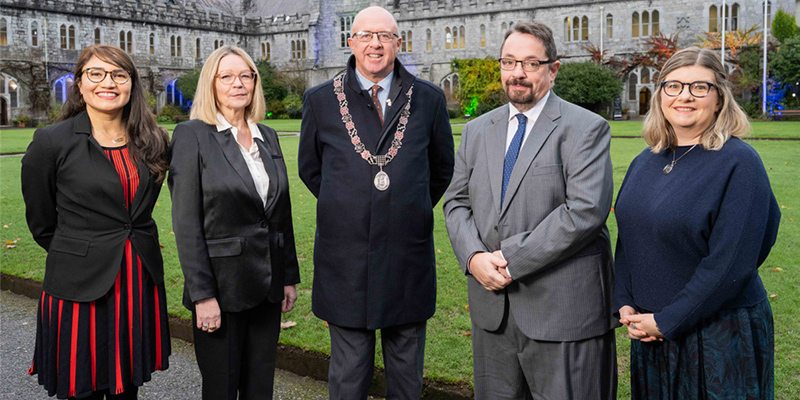
University College Cork (UCC) has launched the Collective Social Futures Institute, placing social science research at the centre of its commitment to creating a more just, inclusive, and sustainable future for all.
The Collective Social Futures Institute (CSFI), a flagship UCC Futures Institute, represents an important development for the social sciences in Ireland and reinforces UCC's position as a leading institution for interdisciplinary research that addresses some of the most pressing societal challenges facing the world.
Advancing excellence across the social sciences
From climate change and migration to democratic renewal, social inequality, and the future of care, so many of today's most complex challenges are fundamentally social. The CSFI aims to deepen understanding of these challenges through world-leading collaborative, policy-oriented and socially engaged research.
The CSFI supports thirteen research clusters and three working groups focused on themes including ageing, migration and integration, poverty and inequality, gender and sexuality, disability and mental health, housing and homelessness, democracy, social justice, and environmental action.
By connecting academic expertise with communities, policymakers and civil society organisations, the Institute contributes to national and international efforts to create an alternative social future grounded in the values of interdependence, social justice, equality and collectivity.
Today’s launch, bringing together researchers, policymakers and leaders from across the higher education sector, formed the centrepiece of UCC's annual two-day Festival of Social Science, and showcased the contribution of social science research to public understanding, policy development and community engagement. Festival events included a community roundtable discussion, two book launches, an evening of socially engaged music and spoken word and a full-day research symposium titled Understanding Crisis, Enacting Change.
Speaking at the launch, Professor Maggie O'Neill, Director of the Collective Social Futures Institute, said: "The question at the heart of our work is both simple and urgent: how can the social sciences help us understand, reimagine and enact more collective, just and sustainable futures? CSFI’s defining feature is our commitment to collaborative and participatory research. Rather than viewing communities as subjects of research, we work with communities as partners."
UCC President Professor John O’Halloran MRIA said: "The launch of the UCC Collective Social Futures Institute is a landmark milestone in this university’s ambition to connect social science research with the complex societal challenges of our time. As a pillar of UCC Futures, the Institute’s interdisciplinary model breaks down disciplinary boundaries to generate knowledge and solutions that advance social equity, resilience and sustainability. It directly advances our strategic commitment to engaged research, global citizenship, and the pursuit of a just, sustainable and inclusive future for both people and planet."
A key component of the UCC Futures Framework
A UCC Futures Institute represents the next stage in the development of a UCC Futures thematic area, moving from a thematic network to an ambitious, research-performing institute with the scale, leadership and organisational capacity to deliver major interdisciplinary research programmes, attract international talent and investment and strengthen UCC's global position in an area of exceptional existing research strength.
Professor John Cryan, Vice President for Research and Innovation at UCC, said: "The launch of the Collective Social Futures Institute represents a major milestone in the development of UCC Futures and demonstrates UCC's commitment to advancing excellence across the social sciences. The societal challenges that shape our world today cannot be understood through any single discipline. By connecting expertise across the university and beyond, the Institute strengthens Ireland's capacity to re-imagine alternative social futures."