

News
New APC research reveals how gut microbes convert peanuts into compounds involved in immune regulation
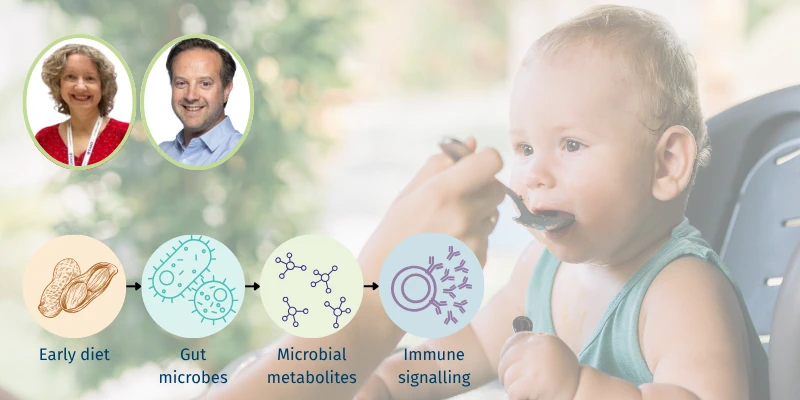
Research from APC Microbiome Ireland at University College Cork has identified how gut bacteria break down peanuts to produce compounds that can influence immune signalling, providing new insight into the relationship between early-life diet, the gut microbiome and immune function.
The study, published in Gut Microbes, examined how peanut consumption affects the gut microbiome during infancy and how gut bacteria metabolise peanut components.
Peanut introduction during infancy is already known to play an important role in reducing the risk of developing peanut allergy. The researchers wanted to understand whether interactions between peanuts and gut microbes could contribute to the biological processes involved.
Exploring the relationship between peanuts and gut bacteria
The research team analysed faecal samples from 343 children at 12 months of age, using DNA sequencing to examine the composition and functional potential of their gut microbiomes.
They found that peanut consumption was associated with changes in the abundance of several gut bacterial species, including Prevotella buccae, Megasphaera micronuciformis and Blautia wexlerae.
To investigate how microbes process peanuts, the researchers also used laboratory fermentation systems containing human gut bacteria. These experiments allowed them to measure changes in microbial communities and the compounds produced when bacteria broke down peanut components.
The results showed increased production of short-chain fatty acids, compounds generated through microbial fermentation that have recognised roles in gut and immune function.
The researchers also identified 188 metabolites that changed significantly following peanut fermentation, highlighting the range of chemical compounds generated through this process.
Identifying compounds involved in immune regulation
The team investigated how specific gut bacteria metabolise peanuts, focusing on Bifidobacterium, a group of bacteria commonly found in the infant gut.
They found that Bifidobacterium longum subsp. longum strain 160 efficiently metabolised peanut components and produced indole-3-lactic acid, a microbial metabolite associated with immune regulation.
Further laboratory experiments examined how compounds produced by these bacteria affected immune cells.
The researchers observed increased production of interleukin-10 (IL-10), an immune signalling molecule involved in regulating inflammation, alongside reduced production of the inflammatory signalling molecules TNF-alpha and IL-5.
These findings suggest that microbial breakdown of peanuts generates compounds capable of influencing immune responses.
Understanding the role of the microbiome in early life
The findings provide new insight into how foods introduced during infancy interact with developing gut microbial communities.
By combining microbiome analysis from children with laboratory experiments, the researchers identified specific bacteria and metabolic pathways that may help explain the relationship between peanut consumption and improved immune regulation.
The work adds to growing understanding of how the gut microbiome contributes to the biological effects of early-life diet during weaning.
Importantly, the findings identify a potential microbial mechanism associated with peanut consumption. They do not establish that the metabolites themselves prevent peanut allergy.
APC-led research and international collaboration
The study was led by researchers at APC Microbiome Ireland, University College Cork, including Emer Shannon, Hannah Devotta, Cebile Ndwandwe, Songhui Kim, Lu Yao, Lamiah Kareem, Avril Walters, Nonhlanhla Lunjani, Lisa Friess, Douwe van Sinderen, Catherine Stanton, Jens Walter and Liam O'Mahony.
The research also involved Sadhbh Hurley, Katri Korpela, Fatma Koc, Harsh Mathur, Anoop T. Ambikan, Ujjwal Neogi, Carina Venter and Jonathan Hourihane, from collaborating institutions including Teagasc, the University of Helsinki, Karolinska Institutet, the University of Colorado and RCSI.
The findings demonstrate the value of combining microbiome research, microbial metabolism and immunology to better understand the mechanisms underpinning dietary effects on immune development and prevention of immune-mediated disorders.
Publication: Shannon E. et al. (2026). Gut microbial metabolism of peanuts generates immunoregulatory metabolites. Gut Microbes.
Read the full paper: https://doi.org/10.1080/19490976.2026.2743944
