

Students and early career researchers

Explore this page
Why clinical audit matters in maternity services?
Maternity services involve care for both mother and baby, often during rapidly changing and high-risk situations where decisions need to be made quickly. Because of this, even small improvements in practice can have a big impact on safety and outcomes.
Clinical audit is one of the key tools used to make sure care stays high quality. It works by checking what is actually happening in practice against agreed standards and guidelines, then using that information to improve care.
Clinical audit helps ensure that maternity care is:
- Safe: risks are identified earlier.
- Effective: aligned with evidence and national guidelines.
- Consistent: reducing unwarranted variations across units.
- Person-centred: improving women's experiences and outcomes.
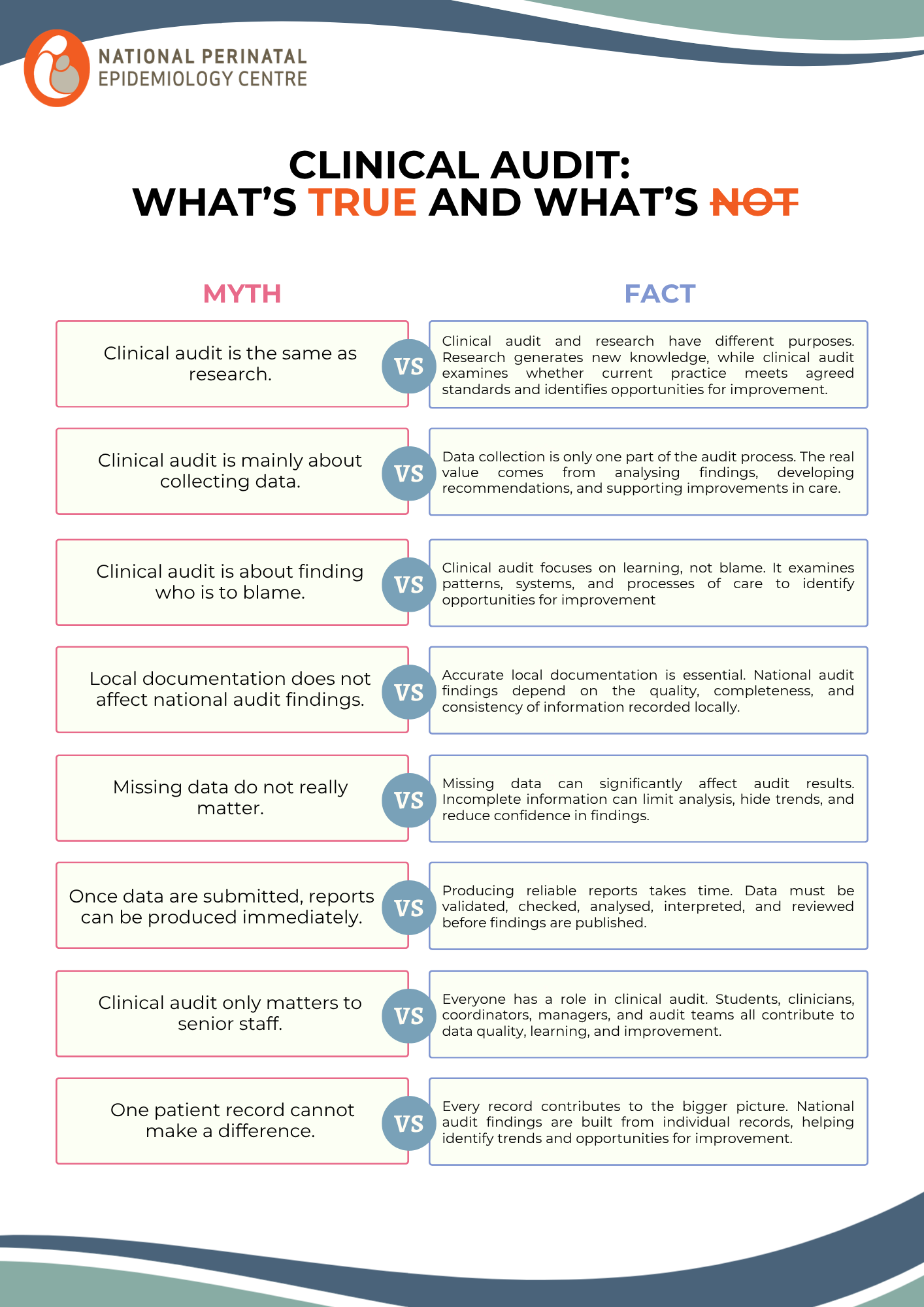
Key Takeaways
Clinical Audit: Key Takeaways
| 1. Audit improves care | It is about learning, not blaming. |
|---|---|
| 2. Standards matter | We measure practice against agreed guidelines. |
| 3. Good data = good decisions | Inaccurate data leads to unsafe conclusions. |
| 4. Audit is continuous | Change, re-audit, improve, repeat. |
| 5. Maternity care is high-risk | Audits help prevent avoidable harm. |
| 6. Governance ensures accountability | Someone is responsible for acting on results. |
| 7. GDPR protects patients | Only collect what you need and keep it secure. |
| 8. National audits (NPEC, VON) | Help us benchmark and improve care across Ireland. |
| 9. Your documentation matters | Students contribute to national datasets. |
| 10. Audit strengthens teamwork | Shared learning leads to safer care for women and babies. |