


Clinical audit resources

Explore this page
Behind the Audit: From Local Data to National Impact
The journey behind every national NPEC report
Clinical audit reports are often seen at the final stage, when findings, recommendations and national trends are published. Behind every report, however, is a careful process that begins much earlier — with local documentation, audit data submission, validation, analysis, interpretation and shared learning.
At the National Perinatal Epidemiology Centre, clinical audit helps turn local data into national evidence. This process supports reflection, learning and improvement across maternity services.
The diagram below shows the journey behind every national NPEC report: how information collected locally is transformed into national findings, recommendations and actions that can support safer, better care.
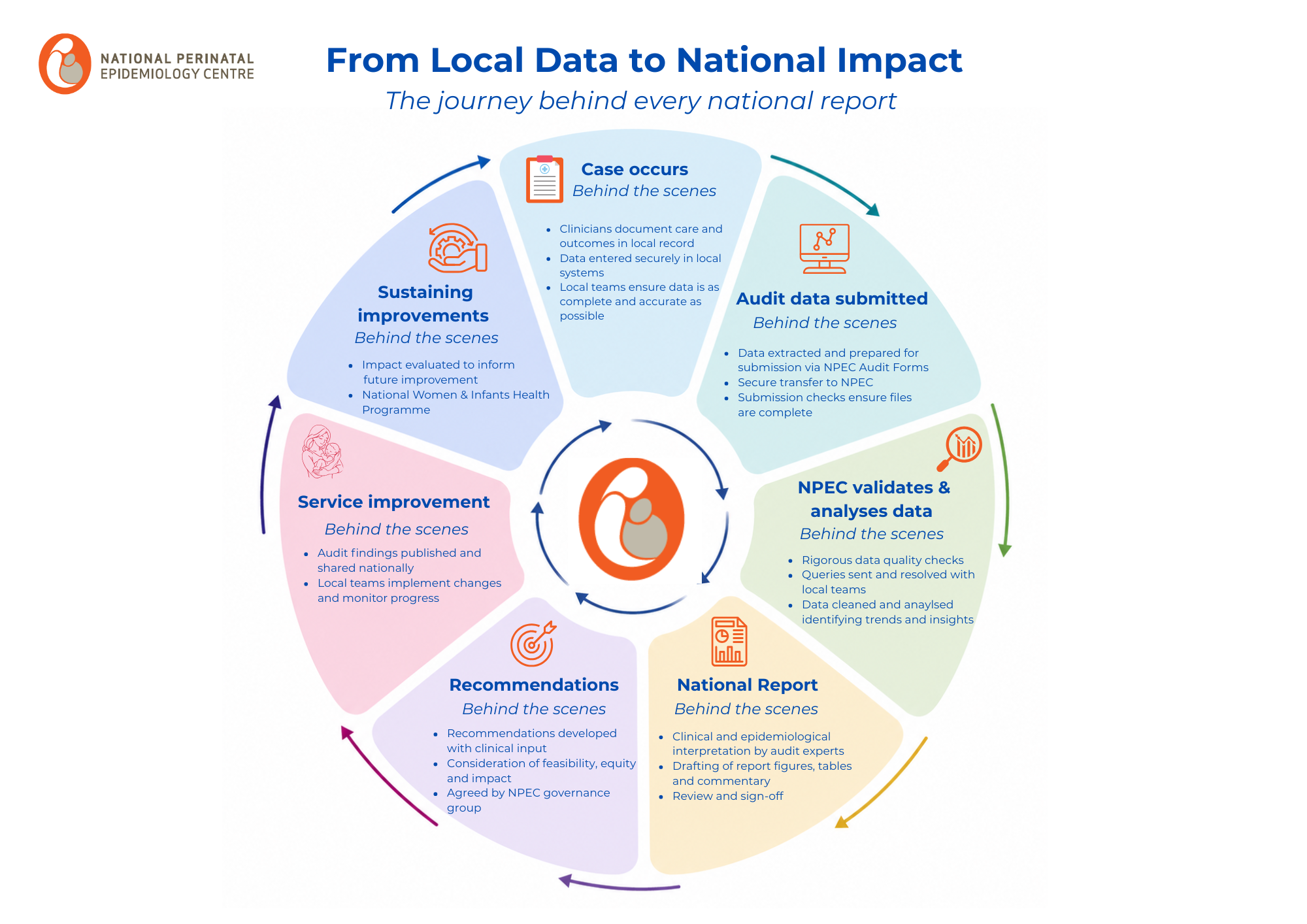
Figure: From Local Data to National Impact — the journey behind every national report.
The process begins when a case occurs and care is documented locally. Audit data are then submitted to NPEC, validated, analysed and interpreted before findings are presented in national reports. These findings inform recommendations, service improvement and sustained learning across maternity services.
What happens behind the scenes?
Behind each national audit report are several important stages.
- A case occurs. The audit begins locally. Clinicians document care and outcomes in local records, and relevant information is entered securely into local systems. Local teams play an essential role in ensuring that data are as complete and accurate as possible.
- Audit data are submitted. Data are extracted and prepared for submission to NPEC using agreed audit processes and data collection forms. Submission checks help ensure that files are complete and ready for review.
- NPEC validates and analyses the data. Before audit findings are reported, data undergo rigorous quality checks. Queries are sent to and resolved with local teams where needed. Once validation is complete, NPEC analyses the data to identify patterns, trends and insights.
- A national report is developed. Clinical and epidemiological interpretation is central to the reporting process. Audit findings are reviewed and discussed, and national reports are developed with figures, tables, commentary and sign-off from relevant governance structures.
- Recommendations are developed. Recommendations are developed with clinical input and consideration of feasibility, equity and impact. Governance groups play an important role in reviewing and agreeing recommendations before publication.
- Findings support service improvement. Audit findings are published and shared nationally. Local teams can use the findings to reflect on practice, identify opportunities for improvement, implement changes and monitor progress over time.
- Improvements are sustained. Clinical audit is part of an ongoing cycle of learning. The impact of recommendations and service improvements can be evaluated, helping to inform future audit cycles and national maternity care priorities.
Why this process matters
High-quality audit depends on high-quality data. Reliable findings require clear definitions, consistent documentation, careful validation and meaningful interpretation.
Clinical audit also depends on collaboration. Behind every NPEC report is a shared effort involving local clinicians, audit coordinators, data managers, epidemiologists, clinical experts, governance groups and maternity services.
This collective work helps ensure that national audit findings are accurate, relevant and useful. Most importantly, it helps ensure that audit does not stop at measurement, but contributes to learning and improvement.
Clinical audit resources
This section brings together introductory resources to support understanding of clinical audit and its role in improving maternity and perinatal care. Use the links below to explore frequently asked questions, key audit terms, training resources, and student-focused materials.