Blog
EuroBorderWalks at the European Sociological Association Biennial Conference in Warsaw 25-28th August 2026
.webp)
The EuroBorderWalks team delivered five papers and one fringe event workshop/exhibition last month at the European Sociological Conference in Warsaw, Poland.
By Professor Maggie O'Neill
The 17th European Sociological Conference took place recently in Warsaw on the theme of Strengthening Democracies: Social Action, Solidarity, and Sustainable Futures and the EuroBorderWalks team were there in strength, with Kresimir leading the pre-conference summer school for postgraduate researchers.
Maggie was a tutor at the summer school and delivered a lecture on Walking Methods/Research on the Move. Creative applications of Participatory Arts/biographical research with young people in Direct Provision.
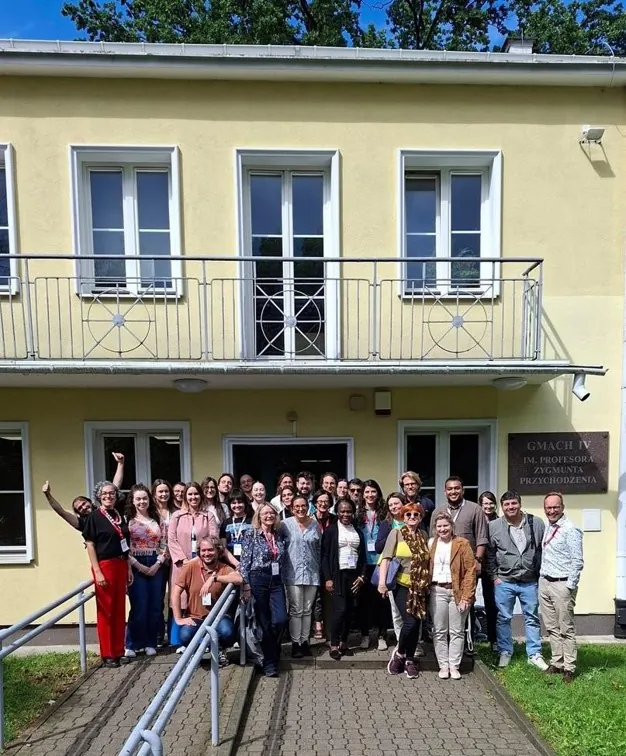
Pre Conference Postgraduate Summer School organised by Kresimir Zazar
The EuroBorderWalks team delivered five papers (in two panels) and one fringe event workshop/exhibition in a conference of 3,285 conference presentations, across 729 scientific sessions!
The first EuroBorderWalks event was a fringe event, immediately before the opening session of the conference in the Cos Torwar, Warsaw. Organised by artist Michael Mcloughlin, John Perivolaris, Tomas Ferenc and Marek Domnanski the session shared a film about the three artist commissions, documenting the exhibition and the visual photo-cartography created in response to both the socio-biographical work taking place on each border and artists’ encounters with the three borders - Poland/Ukraine; Croatia/Bosnia and Herzegovina; and Northern Ireland/UK.
Supported by the research team, Michael invited the audience to map their journeys to the conference and think about the borders they crossed and what borders mean to them.
Responses by the participating academics were rich, including a moving account of the closing of the Finnish border with Russia in 2023 with border towns suffering huge losses; reflections on the increased use of bio-metrics at European borders; the way borders can move from the periphery into the centre of a country; and one participant shared his story of a 16 hour bus journey to the conference from Germany that included an unsettling experience at a border that was a reminder of the power and militarisation of borders. He was woken from a deep sleep by a border guard whose handgun was touching his face – he had to show his passport, and the guard moved on through the bus. The narratives shared and maps produced in the workshop supported the team’s understanding of European borders as well as the US / Canada border as complex assemblages. The workshop facilitated an understanding of borders from the ground up, through narrative, mobile, and visual arts-based research, and revealed how everyday experiences of mobility, immobility, uncertainty, and belonging are shaped by shifting border regimes and broader processes of social transformation.
.png "Sketches on white and yellow pieces of paper, pinned to a board.")
Some of the journey’s sociologists sketched. Image: Maggie O’Neill
A central aim of EuroBorderWalks research programme is interdisciplinary collaboration between biographical sociology and arts practice through ethno-mimetic approaches and three artist commissions.
This collaboration integrates visual, sensory, and performative dimensions into sociological analysis, opening new horizons for knowledge production and critical pedagogy. This was the theme of our second contribution, the EuroBorderWalks panel, delivered in Research Network 03 stream on Biographical Perspectives on European Societies (Thursday 27th 4.30-6.00pm).
The panel was made up of four papers that together demonstrated the distinctive contribution of biographical sociology in turbulent times, highlighting the value of the autobiographical narrative method and the walking interview as biographical method as well as the importance of developing comparative, participatory, and arts-based approaches for understanding borders, strengthening democratic engagement, fostering solidarity and addressing social transformation in Europe.
Responding to contemporary social and geopolitical turbulence, the panel examined how innovative biographical methods can illuminate social problems, risks, and forms of belonging that emerge at Europe’s internal and external borders.
The four papers address a significant gap in sociological scholarship across critical border studies and mobilities research: the relative absence of ethnographic, biographical, visual, and relational approaches to European borders and ‘borderities’. Foregrounding methodological and conceptual innovation, the papers employ walking interviews as a biographical method (WIBM), autobiographical narrative interviews, participatory arts-based workshops, and commissioned artistic collaborations. These approaches extend biographical sociology beyond conventional interview settings, conceptualising borders as lived, embodied, mobile, and historically situated social processes.
Historical Collective Traumas as a threat to cross national solidarity – the perspective of biographical research Agnieszka and Ola :This presentation addresses the issue of past collective trauma as a significant threat to democratic processes and reconciliation work in the Polish–Ukrainian border region. Ukrainian–Polish relations have been complicated since the 14th century, when Casimir the Great incorporated the territories of present-day Ukraine into the Polish Crown. This marked the beginning of a long history of mutual harm, conflict, and trauma, as well as attempts to establish supra-ethnic neighbourly relations.
Border Regimes as a mirror of tectonic structural shifts -individual life narratives from the south-eastern periphery. Kresimir, Vladimir and Maggie: This paper refers to time framework from 1990s onwards as last decades mark severe societal transformation such as post-socialist transition, shift towards market economy, Croatian accession into European union in 2013, or more recent entering Schengen and Euro currency zone. On a wider scale, there are also ongoing processes of securitization and reinforcing borders as the response to an intensified migration influx from the Global South.
Walking The Irish Border Using Creative, Mobile And Spatial Practices: Everyday Borderings, Moral Injury And Mobility Justice Maggie, Michael and Conach: The participant’s place based narratives in this paper demonstrate how the borderlanders experience the Irish Border as both material and immaterial, a hard border, an invisible line on a map, a watery border, a membrane, that is spatial and visual, temporal, symbolic, affective, lived and embodied- in part through the current conjuncture (since Brexit) using what Stuart Hall called (after Gramsci) conjunctural analysis, for understanding borders, strengthening democratic engagement and addressing social transformation in Europe.
An Invisible Line: Untangling Art Process and Sociological Research Through EuroBorderWalks: This paper presents the processes, methods, and conceptual framing of the artistic interventions and reflections at each of the three EU border sites. Michael, John, Tomasz and Marek.
The fifth contribution was delivered in a panel on ‘Beekeeping and Environmental Knowledge’. It doesn’t matter which foot you kick with was presented by Conach Gibson Feinblum and drew on early findings from her PhD research as part of the EuroBorderWalks project. Her paper focused on beekeeping across borders and was rooted in ethnographic, walking, and autobiographical interviews conducted on the Irish border. The presentation explored the divisive and connective potential of the border itself, drawing attention to how beekeeping serves as a shared practice that can foster the possibility of connectivity across borders and between communities.
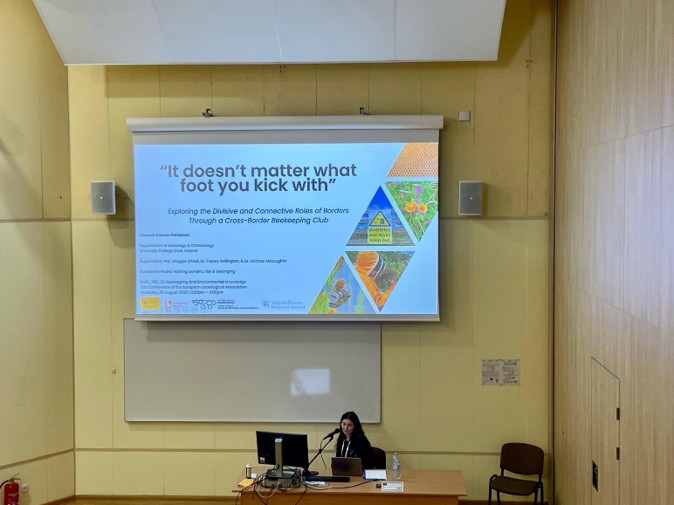
Conach Gibson-Feinblum presenting her paper at the ESA Conference. Image: Maggie O’Neill